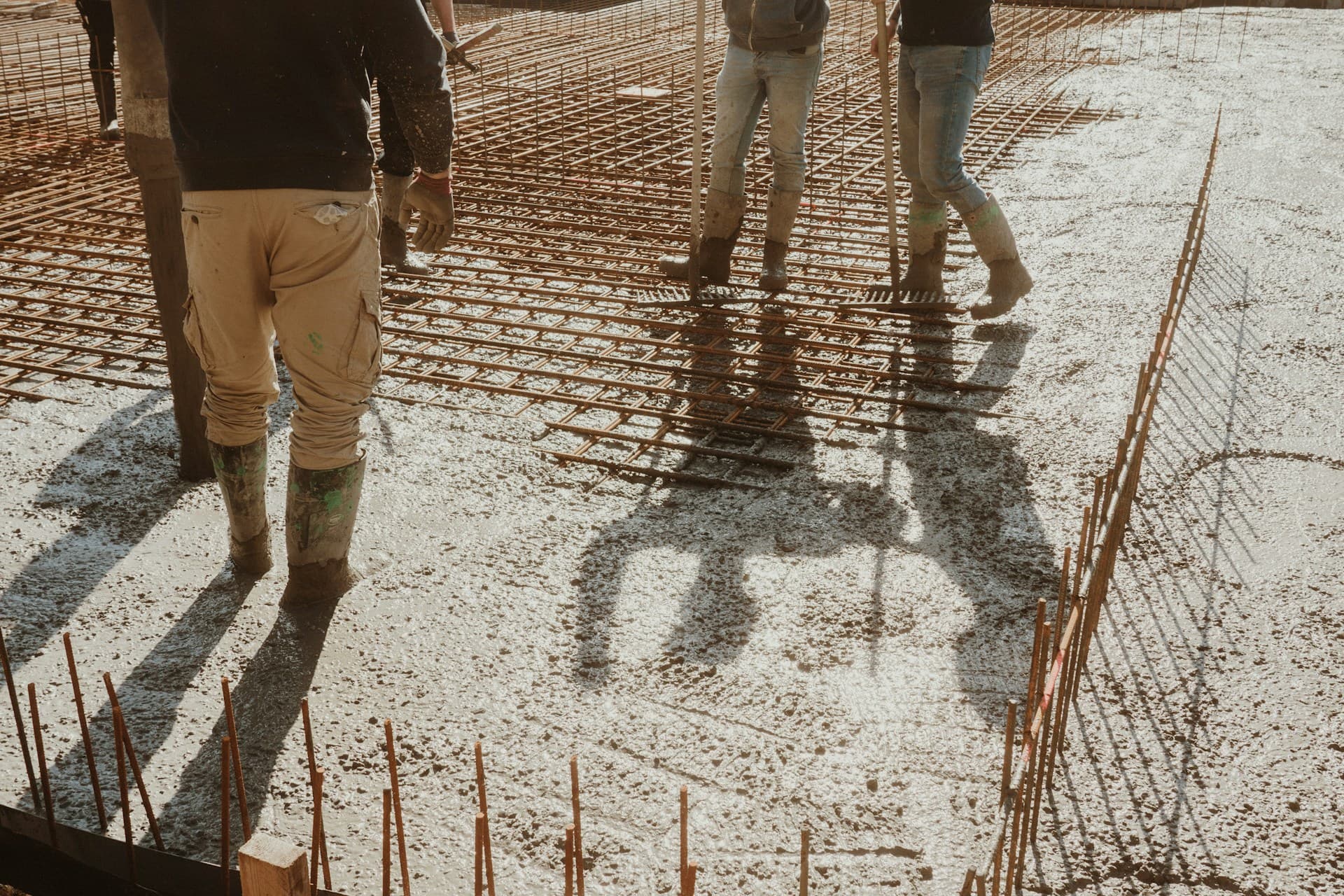
Concrete Slab Pouring
Pouring, placing, and finishing concrete slabs including pump operations, screeding, floating, trowelling, and curing. Covers residential and commercial slab work in accordance with AS 3600:2025 and AS 1379-2007. Companion template to Formwork Construction. Pre-filled hazards, controls, and risk ratings.
The hose on a line pump that has just cleared a partial blockage holds a pressure surge that can whip the discharge end through a six-foot arc in less than a second. The injury that follows ranges from a broken nose to a fatality, depending on where the discharge end lands; line-pump operators who learned the trade by watching boom-pump operators often miss the progressive pressure-drop sequence that prevents the surge in the first place. Two-way radios between the operator and the placement crew, agreed signals before each pour, and a rule that no worker stands directly in line with the discharge end during a re-prime are the practical controls — none of them intuitive on the day. The pump operator licence requirement tracks back as the gap on residential slab work; many small concreters run hire-equipment with operator familiarity that doesn't extend to a national high-risk work licence.
What sits around that hazard is the broader pour profile: alkali wet concrete at pH 12–13 burning through cotton during finishing on knees (knee boards or alkali-resistant pads, alkali-resistant gloves, full-body coveralls), respirable crystalline silica during dry handling and any post-cure cutting, slips on wet concrete around hoses and leads, heat stress because slab pours get scheduled in summer to control cure timing, and formwork collapse during pour where the head pressure of the placement rate exceeds the formwork's design capacity. AS 3610.1:2018 is the link to the formwork SWMS — slab pouring is companion work to a formwork document, not a substitute for one. AS 3600:2025 (sixth edition; supersedes AS 3600:2018) covers the structural concrete and AS 1379-2007 the supply, with the Guide to managing risk in construction: Concrete pumping and Guide for managing the risks of working in heat rounding out the SafeWork Australia material. The crew that briefs the pump operator before the truck arrives, agrees the radio words and pours during the cooler half of the shift gets the slab finished without the call to a workers' comp claim line.
What's In Your SWMS
8 Hazards & Controls
Chemical burns, skin ulceration, permanent scarring, infection
Keep concrete splashes contained within formwork where possible
- Ensure adequate water supply for immediate skin washing
- Eye wash station on site
- Pump hose positioned to minimise splashing
- Wash any skin contact immediately with clean water for minimum 20 minutes
- Do not kneel in concrete or allow it to enter boots
- Remove contaminated clothing immediately
- Check skin regularly for redness or irritation
- No bare skin contact with wet concrete at any time
- Toolbox talk on concrete burn risks before pour
Alkali-resistant gloves (nitrile/butyl), waterproof boots, long sleeves and pants, safety glasses
18-Step Work Procedure
Equipment & PPE
Equipment (14)
- Concrete pump (boom or line pump)
Operated by licensed pump operator. Establish exclusion zones.
- Concrete vibrator (poker/immersion type)
For compacting concrete and removing air voids
- Screed board or straightedge (aluminium)
For levelling concrete to formwork height. Various lengths.
- Bull float with extension handles
For initial surface finishing after screeding
- Power float/trowel machine
Walk-behind or ride-on. For final surface finish.
- Hand trowels and floats
For edges, corners, and detail finishing
- Edging and grooving tools
For creating control joints and edge profiles
- Concrete rakes and shovels
For spreading and distributing concrete
- Laser level or dumpy level
For checking slab levels during pour
- Water hose and supply
For tool cleaning, dust suppression, and curing
- Curing compound or membrane
Applied after finishing to retain moisture
- Knee boards
For kneeling on fresh concrete during hand finishing
- Two-way radio or communication system
For communication with pump operator
- First aid kit
Include burn treatment, eye wash station, and wound dressings
PPE (9)
- Alkali-resistant gloves (nitrile or butyl rubber)AS/NZS 2161.10.1:2024 (chemical/microorganism protection - terminology and performance); AS/NZS 2161.1:2016 (general requirements)
Essential - wet concrete pH 12-13 causes chemical burns. Replace if torn. Note: previous "AS/NZS 2161.2" reference was incorrect - Part 2 covers sampling and testing methodology; Part 10.1 is the chemical-protection cite (aligned to ISO 374-1:2024).
- Waterproof rubber boots (gumboots)AS 2210.3:2019
Essential - prevent concrete entering footwear. High ankle coverage.
- Safety glasses or gogglesAS/NZS 1337.1:2010
Essential - concrete splashes cause severe eye irritation and burns
- Long pants and long-sleeved shirt
Minimise skin exposure. Tuck sleeves into gloves.
- High-visibility vest/shirtAS 4602.1:2024
Required in pump exclusion zones and on construction sites
- Safety helmet (hard hat)AS/NZS 1801:2024
Required when working near concrete pump boom or on construction sites
- Hearing protectionAS/NZS 1270:2002
Required when operating vibrators, power floats, or near pump
- P2 respirator or dust maskAS/NZS 1716:2012 (device); AS/NZS 1715:2009 (selection/use/fit testing)
Required during power floating/trowelling if dust generated. Silica exposure risk. Note: AS/NZS 1716 uses P1/P2/P3 classifications - "FFP3" is the European equivalent (EN 149).
- Sun protection (hat, sunscreen)
SPF 30+ sunscreen for outdoor work. Wide brim hat when not wearing hard hat.
Training & Emergency
Competency Requirements
- Construction Induction Card (White Card)training
Required for all workers on construction sites
- Concreting Competencycertificate
Experience in concrete placing and finishing. May hold Certificate III in Concreting.
- Concrete Pump Operator Licencelicence
Pump operator must hold appropriate licence for boom pump operation
- Formwork Inspection Competencycertificate
Person signing off formwork must be competent to do so
- Silica Awareness Trainingtraining
All workers must be aware of silica hazards and controls
- First Aid Certificate
Recommended for at least one team member on site
- Traffic Control Training
Required if concrete trucks accessing public roads or traffic management needed
Emergency Procedures
CONCRETE BURN: Wash affected area with clean water for minimum 20 minutes. Remove contaminated clothing (cut off if stuck). Cover with clean sterile dressing. Seek medical attention - burns may be deeper than they appear.
CONCRETE IN EYES: Immediately irrigate with clean water for minimum 20 minutes. Hold eyelids open. Do not rub. Cover eye with clean dressing. Seek immediate medical attention.
PUMP BOOM INCIDENT: Call 000 immediately. Do not move injured person unless immediate danger. Secure pump controls. Clear area of non-essential personnel.
FORMWORK COLLAPSE: Call 000 immediately. Do not enter collapse zone. Account for all workers. Do not move debris until emergency services arrive.
HEAT STROKE: Call 000 immediately. Move person to cool shaded area. Remove excess clothing. Cool with water (spray, wet towels). Do not give fluids if unconscious.
Everything above, included in your SWMS document.
Get This TemplateWriting a SWMS from scratch?
That's 2-4 hours of research, formatting, and cross-referencing regulations.
We've done the starting work — pick your template, add your details, review.
Or just do this:
- Unlimited documents
- All 70+ templates
- Instant PDF & DOCX
- Cancel anytime
High-Risk Construction Work Categories
Under Australian WHS Regulations (291 - High Risk Construction Work), this work is classified as high-risk due to:
- Concrete pumping operations (Concrete pump boom operations require exclusion zones and dedicated communication with operator)
- Loading of formwork during concrete pour (Risk of formwork collapse if design loading exceeded. Competent person inspection required before pour.)
- Exposure to respirable crystalline silica (Generated during power floating, trowelling, and cutting operations. WES 0.05 mg/m³.)
Australian Standards Referenced
Who Needs This SWMS?
This template is designed for the following trades and roles performing concrete slab pouring work.
Frequently Asked Questions
Why is wet concrete dangerous?
Wet concrete has a pH of 12-13 (highly alkaline) due to calcium hydroxide. This can cause severe chemical burns that may not be immediately painful. Burns can progress to third-degree within 2 hours of skin contact. Always wear alkali-resistant gloves, waterproof boots, and long clothing.
What is the exclusion zone for a concrete pump boom?
The exclusion zone covers the entire area under and around the moving boom, extending to the maximum boom reach at all heights. Only essential personnel wearing hard hats and high-vis clothing should be within this zone, and only when necessary for the pour.
What should I do if concrete gets in my eyes?
Immediately irrigate with clean water for a minimum of 20 minutes. Hold eyelids open during irrigation. Do not rub your eyes. Cover with a clean sterile dressing and seek immediate medical attention. Concrete in eyes is a medical emergency.
Why is silica dust a hazard during concrete work?
Concrete contains crystalline silica. When dry finishing operations (power floating, cutting, grinding) generate dust, workers can inhale respirable silica particles. Long-term exposure causes silicosis, an irreversible lung disease. Use wet methods and respiratory protection.
What is the maximum concrete temperature for placement?
AS 1379 specifies a maximum concrete temperature of 35°C for field placement. Higher temperatures accelerate setting, reduce workability, and can cause cracking. In hot weather, schedule pours for early morning or request retarder admixture.
How long should concrete cure before foot traffic?
Concrete should cure for minimum 7 days under Australian conditions. Foot traffic should be excluded for at least 3-5 days or until minimum strength is reached. Apply curing compound or membrane immediately after finishing.
What PPE is required for concrete pouring?
Essential PPE includes alkali-resistant gloves (nitrile or butyl rubber), waterproof boots with high ankle coverage, safety glasses, long pants and long-sleeved shirt, high-vis vest, and hard hat in pump zones. Add P2 respirator for power floating/cutting.
What formwork checks are required before a pour?
A competent person must inspect and sign off formwork before concrete is ordered. Checks include: formwork to design specifications, bracing secure, bearing surface stable, all connections tight, no damage or warping, reinforcement correctly positioned.
Get Your Concrete Slab Pouring SWMS
Pre-filled. Risk-rated. Ready in 5 minutes.
Get Your SWMS PDFNo credit card required. First SWMS is free.
