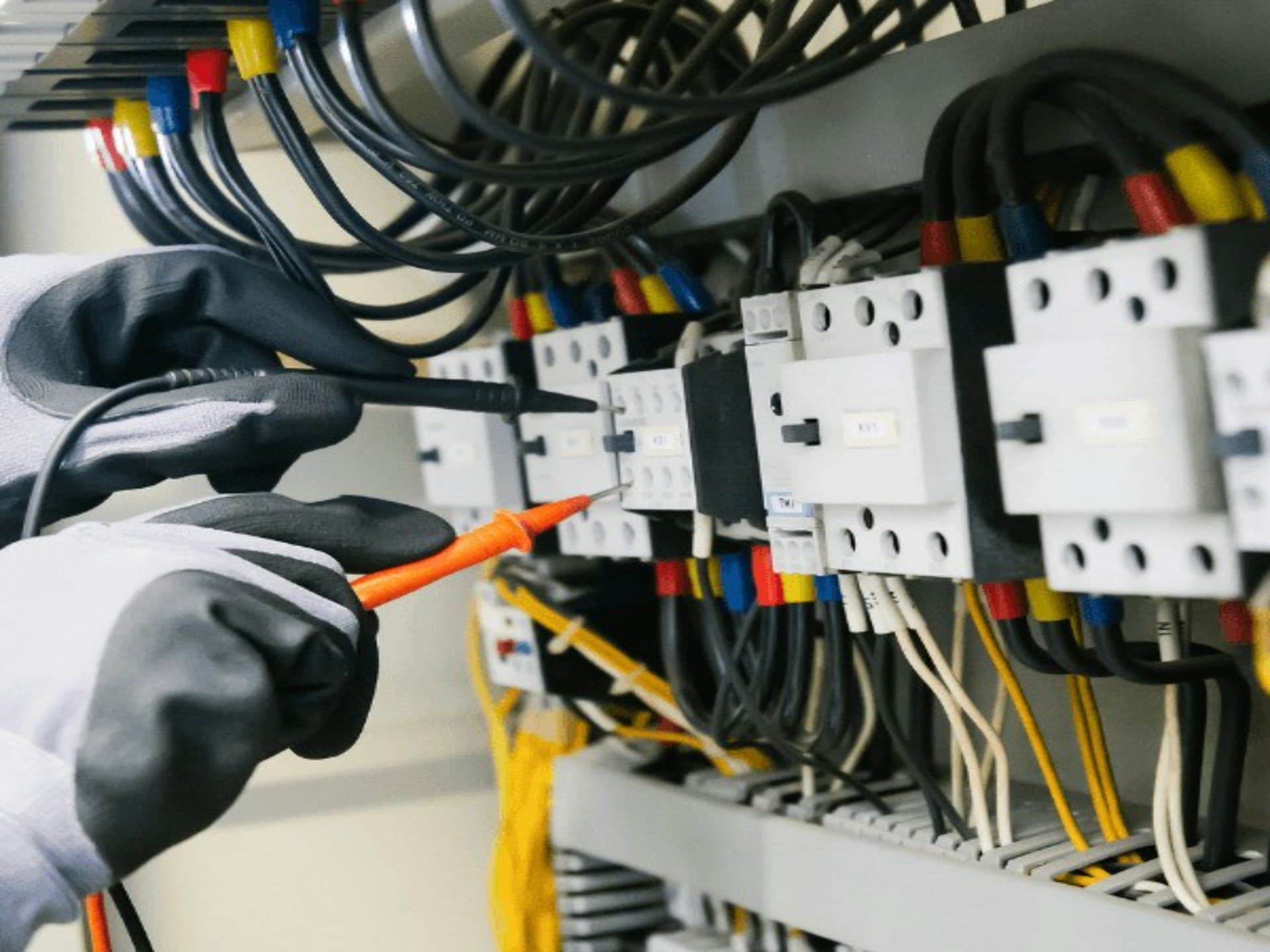
Electrical Work (General)
General electrical installation, maintenance, repair, and fault-finding work on low voltage electrical systems including switchboards, wiring, power points, lighting, and associated electrical equipment. Pre-filled hazards, controls, and risk ratings.
A general electrical SWMS is the document a principal contractor reaches for after something has already gone wrong — an arc-fault burn, a sparky working alone with no LV rescue ticket, a fault-finding job that turned into a hospital visit. The bar this kind of SWMS has to clear is high, because it covers everything from stripping a power point in an occupied home to fault-finding under load on a commercial board, and every one of those tasks sits inside AS/NZS 3000:2018 and AS/NZS 4836:2023 differently.
The single control that separates competent operators from the rest is "test before touch" with a proven instrument — voltage indicator confirmed live on a known source, isolation locked off, then re-tested on the conductor about to be worked on. A documented fatality cause is sparkies trusting a voltage tester they never proved; the SWMS needs to capture that sequence, the proving source and the LOTO step so it isn't optional on the day. The other gap that catches experienced electricians out is arc-rated clothing — most blokes treat 8 cal/cm² as switchboard-only, but a fault during fault-finding under load can flash anywhere on a circuit.
Beyond shock and arc, this work carries hazards electricians regularly wear without naming: ceiling-cavity heat stress under metal roofs in summer, asbestos backing boards in pre-2003 buildings, falls through ceiling sheets when a boot lands off a joist, and the LV rescue plus CPR currency that lapses quietly between refreshers. AS/NZS 3012:2019 governs construction sites, AS/NZS 3760:2022 covers test and tag, and IEC 60900:2018 sets insulated tools to 1000V — they get cited tied to the actual step they govern, not as an ornament list. State context shifts the picture too: Queensland's Electrical Safety Act sits alongside the WHS Act, Victoria works under the OHS Act 2004 and the Certificate of Electrical Safety regime, and South Australia carries its own elevated fall threshold; the document earns its keep when it reflects the state where the job sits.
What's In Your SWMS
11 Hazards & Controls
Cardiac arrest, ventricular fibrillation, respiratory arrest, burns at entry/exit points, muscle contractions, falls from reflex action, death
Work de-energised wherever practicable. Isolate supply at main switchboard before commencing work.
Use extra-low voltage (ELV) equipment where possible. Specify battery-powered tools instead of mains-powered.
Apply lock-out/tag-out (LOTO) at all isolation points. Each worker applies personal lock and danger tag.
- Use 30mA RCD protection on all circuits being worked on
- Install physical barriers around live parts that cannot be isolated
- Use insulated tools rated to 1000V (AS/NZS 60900)
- Verify isolation with CAT III/IV rated voltage tester - test before and after on known live source
- Follow 8-step isolation procedure per AS/NZS 4836
- Test for dead at work point before touching any conductor
- Treat all conductors as live until proven dead
- Permit to work system for complex isolations
- Safety observer required for any energised work
- Only licensed electricians to perform electrical work
Class 00 or Class 0 insulated gloves with leather protectors when testing or working near potentially live parts
14-Step Work Procedure
Equipment & PPE
Equipment (10)
- Digital multimeter (CAT III or CAT IV rated)
Minimum CAT III 600V for distribution-level work; CAT IV for supply-side work. Must have fused leads.
- Non-contact voltage tester (volt stick)
For initial detection only - must confirm with contact tester before work
- Insulated hand tools (1000V rated)
Screwdrivers, pliers, side cutters, cable strippers rated to IEC 60900:2018 (the international live-working hand-tools standard adopted in Australian practice; cited by AS/NZS 4836:2023)
- Lock-out/tag-out (LOTO) kit
Personal padlocks, danger tags, circuit breaker lockouts, fuse lockouts, hasp
- Cable locator/tracer
For identifying cables in walls/ceilings before penetration work
- LED torch/headlamp
For illuminating work areas in switchboards and ceiling spaces
- Heavy-duty extension lead with RCD
Must have current test tag; 30mA RCD built-in or portable RCD used
- Cordless power tools (drill, driver)
Battery-powered preferred to eliminate cord hazards; inspect before use
- First aid kit
Including burns dressings and eye wash
- CO2 or dry chemical powder fire extinguisher
CO2 (black band) or ABE powder (white band) - suitable for electrical fires
PPE (3)
- Safety boots (electrical hazard rated)AS 2210.3:2019
EH-rated with non-conductive soles; steel cap acceptable for general electrical work
- Safety glasses (clear lens)AS/NZS 1337.1:2010
Impact-rated; worn when working in switchboards or using power tools
- Insulated gloves (Class 00 or Class 0)AS/NZS IEC 60903:2020
Class 00 (500V AC) or Class 0 (1000V AC) with leather protectors. Test every 6 months.
Training & Emergency
Competency Requirements
- Electrical Licence (State-Issued)licence
State-issued electrical licence required. NSW: Qualified Supervisor Certificate or Endorsed Contractor Licence (verify.licence.nsw.gov.au). VIC: A Grade Electrician's Licence via ESV (portal-public.energysafe.vic.gov.au). QLD: Electrical Mechanic licence via ESO (fswqap.worksafe.qld.gov.au/elis). WA: Electrician's Licence via Building and Energy (ols.demirs.wa.gov.au). SA: via CBS (cbs.sa.gov.au). TAS: via CBOS. NT: Unrestricted Electrical Work Licence under new ES Act 2022. ACT: via Access Canberra.
- Construction Induction (White Card)training
Required for all workers on construction sites. Nationally recognised but state-issued.
- CPR Training (HLTAID009)certificate
CPR training is recommended to be renewed every 12 months (per ARC/ANZCOR guidance). QLD mandates current CPR as a condition of electrical work licence renewal — see WorkSafe QLD guidance under stateGuidance.qld.
- Low Voltage Rescue (LVR) Training
Required for safety observer role during energised work per AS/NZS 4836. Recommended for all electricians. Includes rescue techniques and equipment use.
- First Aid Certificate (HLTAID011)
Renewed every 3 years, but CPR component annually. At least one person on site should hold current certificate.
- Working at Heights (RIIWHS204E)
Required when using fall arrest systems or working above 2 metres without edge protection.
- EWP Operator Licence (WP)
Required for operating boom-type elevated work platforms over 11 metres. Check HRWL classes for specific requirements.
- Confined Space Entry (RIIWHS202E)
Required when entering spaces classified as confined spaces per AS 2865.
- Asbestos Awareness Training
Recommended when working in pre-1990 buildings where asbestos-containing materials may be present. There is no national CPCC unit for awareness alone — jurisdictions point to courses such as the ACT-owned 11084NAT Course in Asbestos Awareness or equivalent state-recognised e-learning. CPCCDE3014 (Remove non-friable asbestos) and CPCCDE3015 (Remove friable asbestos) are removal-licence units, not awareness training.
- Test and Tag Competency
Training in AS/NZS 3760:2022 for in-service safety inspection and testing of electrical equipment and RCDs.
Emergency Procedures
ELECTRIC SHOCK RESCUE - DRSABCD Protocol:
1. DANGER - Do not touch victim until power confirmed isolated. Use non-conductive material (dry timber, plastic pipe) to separate from source if cannot isolate.
2. RESPONSE - Check if person is conscious, ask "Can you hear me?"
3. SEND - Call 000 immediately. Send someone to get AED.
4. AIRWAY - Open airway with head tilt, chin lift
5. BREATHING - Look, listen, feel for breathing for 10 seconds
6. CPR - If not breathing normally, start CPR: 30 compressions at 5-6cm depth, rate 100-120/min, then 2 rescue breaths. Continue 30:2 ratio.
7. DEFIBRILLATION - Apply AED as soon as available, follow voice prompts
LOW VOLTAGE RESCUE (LVR) Procedure:
- If victim is in contact with live equipment: isolate power at switchboard if safe and quick to do so
- If cannot isolate: use insulated rescue crook or non-conductive material to separate victim from source
- Pull victim clear using one-person drag (hook arms under armpits, pull backwards)
- Do not touch victim's skin if unsure of isolation status
- Commence DRSABCD once victim is clear of electrical source
SUSPENDED WORKER IN HARNESS:
- Rescue must commence within 15 minutes (suspension trauma risk)
- Call 000 immediately
- Lower worker to ground using rescue system if trained
- If worker is conscious, have them pump legs to maintain blood flow
- Place the rescued worker in a flat / supine position (or recovery position if unconscious and breathing) once they are clear of suspension, per ANZCOR Guideline 9.1.5. Earlier advice to keep the worker upright after rescue has been retracted.
Everything above, included in your SWMS document.
Get This TemplateWriting a SWMS from scratch?
That's 2-4 hours of research, formatting, and cross-referencing regulations.
We've done the starting work — pick your template, add your details, review.
Or just do this:
- Unlimited documents
- All 70+ templates
- Instant PDF & DOCX
- Cancel anytime
High-Risk Construction Work Categories
Under Australian WHS Regulations (Part 4.7 - Electrical Safety; Section 291 - High Risk Construction Work. NOTE: Victoria uses OHS Act 2004 (non-harmonised). QLD Electrical Safety Act 2002 takes priority over WHS Act for electrical matters. NT has new Electrical Safety Act 2022 & Regulations 2024. SA fall height threshold is 3m until 1 July 2026.), this work is classified as high-risk due to:
- Work on or near energised electrical installations or services (Primary trigger - all electrical work involves potential exposure to energised conductors during testing, fault-finding, or if isolation fails)
- Work at height (>2m) with risk of fall (Applicable when accessing switchboards, ceiling spaces, or external installations above 2 metres)
- Work in confined spaces (Applicable when working in ceiling spaces, under floors, or electrical pits with restricted access/egress)
- Work in area with contaminated or flammable atmosphere (Applicable when electrical work is performed in areas with potentially explosive atmospheres or hazardous gases)
Australian Standards Referenced
National Guidance Documents
Who Needs This SWMS?
This template is designed for the following trades and roles performing electrical work (general) work.
Frequently Asked Questions
When is a SWMS required for electrical work?
A SWMS is legally required for electrical work that constitutes high-risk construction work (HRCW) under WHS Regulation 291. This includes work on or near energised electrical installations or services. Even if the work will be performed de-energised, the SWMS is required because the installation contains electrical services that could become energised. Victoria uses OHS Regulations 2017 (non-harmonised) but has equivalent requirements.
Can electrical work be performed while circuits are energised?
Energised electrical work is prohibited under WHS Regulations except in specific circumstances: when de-energising would create a greater risk, when equipment must be energised for the work to be done properly (testing/commissioning), or when necessary for life support systems. An energised electrical work permit, risk assessment, and safety observer are required. Victoria requires compliance with Electricity Safety (General) Regulations 2019, Reg 509-511.
What PPE is required for electrical work?
Minimum PPE includes safety boots (AS/NZS 2210.3), safety glasses (AS/NZS 1337.1), and access to insulated gloves (Class 00 or 0 per AS/NZS 2225). For switchboard work with arc flash risk, arc-rated clothing (minimum 8 cal/cm²) and arc-rated face shield are required. Hard hats and hi-vis are required on construction sites. Victoria has joint ESV/WorkSafe Arc Flash Hazard Management Guidelines.
What is the lock-out/tag-out (LOTO) procedure?
LOTO involves 8 steps per AS/NZS 4836: consult with affected parties, shutdown equipment, identify all energy sources, isolate at each source, apply personal padlock to isolation points, attach danger tag with your details, control stored energy, and verify isolation by testing for dead at the work point. Each worker must apply their own lock and tag.
How do electrical licensing requirements vary between states?
Each state has its own licensing system: NSW uses Qualified Supervisor Certificates via Fair Trading; VIC requires A Grade Electrician's Licence via Energy Safe Victoria plus mandatory COES; QLD issues licences via the Electrical Safety Office with mandatory annual CPR renewal; WA requires compliance with WAER in addition to national standards; SA licences via Consumer and Business Services; TAS via CBOS with TechSafe inspections; NT has a completely new licensing framework under the Electrical Safety Act 2022; ACT licences via Access Canberra with DER endorsements for solar/battery work.
What testing is required before re-energising a circuit?
Before re-energising, perform visual inspection for correct terminations, insulation resistance testing, earth continuity testing, and polarity testing. All test results must be documented. Compliance certificates vary by state: NSW requires CCEW, VIC requires COES (Certificate of Electrical Safety), QLD requires ESO notification, ACT requires CES within 14 days.
What are the key state regulatory differences for electrical SWMS?
Key differences: Victoria operates under OHS Act 2004 (not harmonised WHS) and requires COES for all electrical work. Queensland's Electrical Safety Act 2002 takes priority over WHS Act, with mandatory CPR for licence renewal. SA has a 3-metre fall height threshold (vs 2m nationally) until 1 July 2026. NT introduced completely new Electrical Safety Act 2022 and Regulations 2024 from 1 July 2024. WA requires compliance with WAER (WA Electrical Requirements) in addition to AS/NZS 3000.
Get Your Electrical Work (General) SWMS
Pre-filled. Risk-rated. Ready in 5 minutes.
Get Your SWMS PDFNo credit card required. First SWMS is free.
