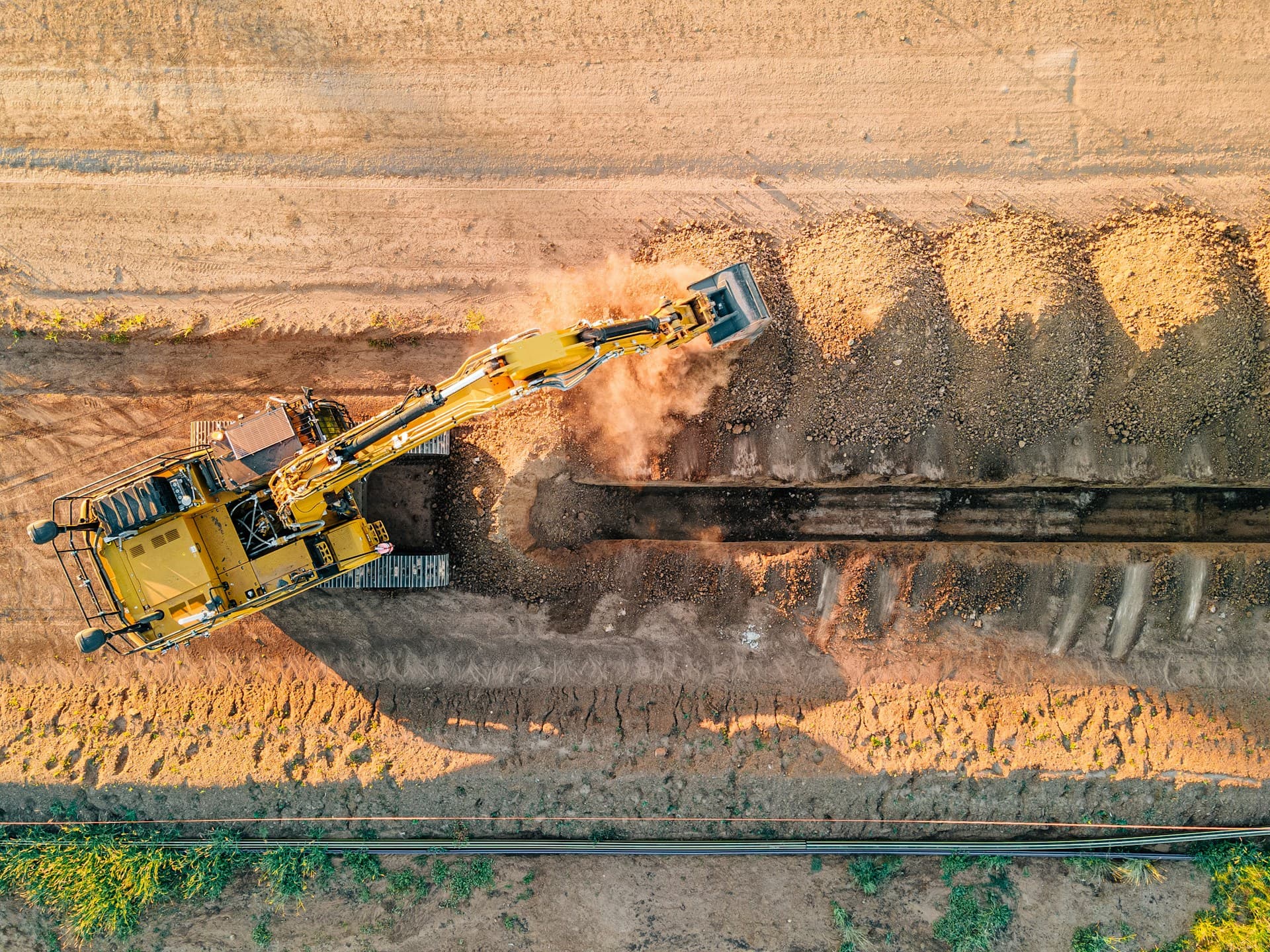
Excavation and Trenching
Excavation and trenching operations for service installation (water, sewer, electrical, gas, communications) and foundation work using powered excavators, with controls scaling from shallow excavation to deep trenching (≥1.5m). Pre-filled hazards, controls, and risk ratings.
A site planner pricing an excavation job in road reserve relies on Before You Dig Australia plans by default, but a BYDA referral on its own is typically AS 5488 Quality Level D — service location based on records, not field-verified. Quality Level A is the standard for confirmed location: physical exposure of the service in a daylighting hole or test pit before any mechanical excavation crosses the corridor. The cost gap between assuming Level D is good enough and verifying to Level A is the difference between a clean dig and a struck high-pressure gas main. Underground service strikes are concentrated in operators who treat BYDA tickets as final rather than starting points.
The trench itself is the dominant fatality mechanism. Cave-in deaths at one metre depth happen because soil at 1.5 tonnes per cubic metre buries to the diaphragm and asphyxiates a worker before help can reach them. AS 4744.1-2000 covers shoring and trench support — boxes, shields, hydraulic props, battering and benching matched to soil class — and the 1.5-metre threshold under the Model Code of Practice on Excavation Work is the line where shoring stops being optional. The "I'm only going down 1.2 metres" reasoning shows up repeatedly in fatality reports; trench-wall stability cuts off well below the threshold trigger.
Atmospheric monitoring with a four-gas detector in deep service trenches catches H₂S off-gassing from old fill, methane build-up and oxygen depletion before workers descend; AS 2865-2009 brings the trench into confined-space scope when the atmosphere is hazardous. AS 3798-2007 governs commercial and residential earthworks; AS 1742.3:2019 covers traffic management for kerbside or road-reserve work. RIIMPO320F for the excavator operator, RIIWHS202E for confined space entry, asbestos awareness on pre-2003 fill, and a current state operator licence sit alongside the trade ticket. The four sign-offs that matter on this work — location verified, shoring designed, atmosphere measured, traffic planned — are what convert a deep dig from a fatality column into a billed job.
What's In Your SWMS
7 Hazards & Controls
Crushing injuries, suffocation, death. Trench collapse is the dominant cause of excavation-work fatalities in Australia (per Safe Work Australia and state regulator incident data — most state coroners highlight cave-in as the primary mechanism).
Consider trenchless technology (horizontal boring, pipe bursting) where practicable to avoid open excavation
Install trench shields/boxes that protect workers even if collapse occurs; keep all personnel outside excavation when not essential
- Install hydraulic shoring, sheet piling, or closed sheeting before workers enter trenches ≥1.5m
- Batter/bench trench walls to safe angles per the Safe Work Australia Excavation Work Code of Practice — typically a maximum of 45° from horizontal without geotechnical engineer certification, regardless of soil class. Steeper angles require written certification by a competent person. Note: the OSHA "Type A 53° / Type B 45° / Type C 34°" classification is the US OSHA scheme; Australian practice does not adopt those specific thresholds.
- Place spoil piles minimum 900mm from trench edge
- Install dewatering systems to prevent water accumulation weakening walls
- Obtain geotechnical engineer assessment if shoring not used for trenches ≥1.5m
- Conduct daily inspections by competent person before work commences
- Re-inspect after rain, vibration from traffic/plant, or changes in ground conditions
- No vehicles or plant within zone of influence unless shoring designed for loads
- Workers to remain within protected zone of trench shields at all times
Safety helmet (AS/NZS 1801), safety boots (AS/NZS 2210.3), high-visibility clothing
16-Step Work Procedure
Equipment & PPE
Equipment (8)
- Excavator (mini or standard)
Mini excavator (1.5-5t) for residential/tight access; standard excavator (6t+) for larger works
- Trench buckets
Narrow profile buckets sized to trench width requirements
- Trench shoring system
Hydraulic shores, trench shields/boxes, or timber shoring - required for trenches ≥1.5m
- Electromagnetic cable/pipe locator
For locating metallic underground services
- Compaction equipment
Plate compactor for granular material; jumping jack/rammer for cohesive soils
- Industrial ladder (AS 1892.1:2018)
For trench access - must extend 900mm above surface level
- Barricading and signage
Mesh fencing, star pickets, warning signs (AS 1319), flashing lights
- Hand digging tools
Non-powered shovels, spades, picks for potholing near services
PPE (7)
- Safety helmetAS/NZS 1801:2024
Type 1 minimum; replace every 3 years or after impact
- Safety bootsAS 2210.3:2019
Steel or composite toe (200J impact); penetration-resistant sole recommended
- High-visibility clothingAS 4602.1:2024
Class D/N for day and night work; minimum 0.2m² fluorescent background
- Hearing protectionAS/NZS 1270:2002
Class 3-5 for excavation equipment (90-105 dB typical)
- Safety glassesAS/NZS 1337.1:2010
Medium impact minimum; clear or tinted as conditions require
- Safety glovesAS/NZS 2161.3:2020
Cut and abrasion resistant; impact protection for plant operation
- Sun protectionAS/NZS 4399:2020
UPF 50+ clothing; SPF 30+ sunscreen; wide-brim hard hat attachment
Training & Emergency
Competency Requirements
- Construction Induction (White Card)training
CPCCWHS1001 - Required for ALL workers on construction sites
- Excavator Operator Competencytraining
RIIMPO320F Conduct Civil Construction Excavator Operations - no HRWL required but PCBU must verify competency
- First Aid Certificatecertificate
HLTAID011 Provide First Aid - at least one person on site; CPR refresher annually
- Traffic Control
RIIWHS205E Control traffic with stop-slow bat - required if work affects traffic flow
- Working at Heights
RIIWHS204E Work safely at heights - if work at excavation edges presents fall risk >2m
- Asbestos Awareness
11084NAT Course in Asbestos Awareness - recommended for excavation on developed sites
- Confined Space Entry
RIIWHS202E Enter and work in confined spaces - if excavation classified as confined space (restricted entry, hazardous atmosphere)
Emergency Procedures
TRENCH COLLAPSE: Do NOT enter collapsed trench - risk of further collapse. Call 000 requesting Fire/Rescue with technical rescue capability. Notify SafeWork NSW (13 10 50). Keep all personnel clear. Shut down machinery. Maintain communication with trapped person if conscious. Do NOT attempt to pull out partially buried person (crush injury syndrome risk).
ELECTRICAL SERVICE STRIKE: If in machine - do NOT exit unless fire. Warn others to stay 8-10m away. Call 000. Contact electricity distributor (Essential Energy 13 23 91; Ausgrid 13 13 88). If must exit: jump clear, land feet together, shuffle away with small steps.
GAS MAIN STRIKE: Evacuate upwind immediately (minimum 50m for small leak, 100m+ for larger). Call 000. Contact gas network (APA/ATCO 13 13 52; Jemena 13 19 09; AGN 1800 427 532). Do NOT operate valves, phones, vehicles or any electrical equipment. Eliminate all ignition sources.
WATER MAIN STRIKE: Evacuate trench immediately. Shut down electrical equipment near water. Contact water authority (Sydney Water 13 20 90; Hunter Water 1300 657 657). Monitor for undermining of adjacent structures and trench walls.
WORKER TRAPPED IN TRENCH: Call 000 immediately. Do NOT enter unless specifically trained and equipped. Maintain communication with person if accessible. Keep airway clear if possible from outside. Prevent additional material entering. Crush injury syndrome warning: do not release pressure suddenly if person compressed for significant time.
Everything above, included in your SWMS document.
Get This TemplateWriting a SWMS from scratch?
That's 2-4 hours of research, formatting, and cross-referencing regulations.
We've done the starting work — pick your template, add your details, review.
Or just do this:
- Unlimited documents
- All 70+ templates
- Instant PDF & DOCX
- Cancel anytime
High-Risk Construction Work Categories
Under Australian WHS Regulations (Part 6.3 - Excavation Work (Clauses 291, 299, 304-306)), this work is classified as high-risk due to:
- Work in/on trench deeper than 1.5m (Trenches exceeding 1.5m depth require SWMS, shoring/battering, and geotechnical consideration)
- Use of powered mobile plant (Excavators and other earthmoving equipment)
- Work on/near energised electrical installations (Underground electrical cables - BYDA enquiry mandatory)
- Work on/near pressurised gas mains or piping (Underground gas mains - BYDA enquiry mandatory)
- Work on/near traffic or adjacent to road (Applicable when excavating in road reserves or near traffic)
- Work in area with contaminated/flammable atmosphere (Deep trenches may accumulate hazardous gases - atmospheric monitoring required)
Australian Standards Referenced
National Guidance Documents
Who Needs This SWMS?
This template is designed for the following trades and roles performing excavation and trenching work.
Frequently Asked Questions
When is a SWMS required for excavation work?
A SWMS is mandatory when excavation involves high-risk construction work under WHS Regulation 2017. For excavation, this includes trenches deeper than 1.5 metres, work near energised electrical installations or pressurised gas mains, and use of powered mobile plant (excavators). The SWMS must be prepared before work commences, not during.
Is Before You Dig Australia legally required in NSW?
Yes. NSW is the only Australian state where Before You Dig Australia (BYDA) notification is a legal requirement under the Electricity Supply Act 1995 and Gas Supply Act 1996. Plans must be obtained before any excavation near gas or electricity networks, kept on site, and renewed if they expire (validity is set by each asset owner — typically up to 28 days). Significant penalties apply for non-compliance under the Electricity Supply (Safety and Network Management) Regulation 2014 and Gas Supply (Safety and Network Management) Regulation 2013.
What shoring is required for trenches over 1.5 metres deep?
Trenches exceeding 1.5m depth must be protected from collapse using shoring (hydraulic shores, trench shields, sheet piling), battering to safe angles (Australian practice typically caps battering at 45° from horizontal without geotechnical certification, regardless of soil class), or benching. Steeper battering requires written certification from a geotechnical engineer or other competent person, per the Safe Work Australia Excavation Work Code of Practice. Note: the OSHA Type A/B/C 53°/45°/34° classification is a US scheme and is not the Australian standard.
Do excavator operators need a high-risk work licence?
No. Excavators are not classified as high-risk work under WHS Regulations, so no HRWL is required. However, the PCBU must ensure operators are competent. Evidence includes Statement of Attainment in RIIMPO320F Conduct Civil Construction Excavator Operations, verified logbooks and references, or manufacturer-specific training certificates.
How close can I mechanically excavate to underground services?
No mechanical excavation is permitted within 500mm of located underground services. Within this zone, hand digging or vacuum excavation (hydrovac) must be used. For hand digging, maintain 300mm clearance. High-pressure gas transmission pipelines require a 3-metre exclusion zone and specific asset owner requirements.
What emergency procedures are required for trench collapse?
Never enter a collapsed trench - further collapse is the primary hazard. Call 000 immediately requesting Fire/Rescue with technical rescue capability. Notify SafeWork NSW on 13 10 50 (notifiable incident). Keep personnel clear, shut down machinery, and maintain communication with any trapped person. Do not attempt to pull out a partially buried person due to crush injury syndrome risk.
Get Your Excavation and Trenching SWMS
Pre-filled. Risk-rated. Ready in 5 minutes.
Get Your SWMS PDFNo credit card required. First SWMS is free.
