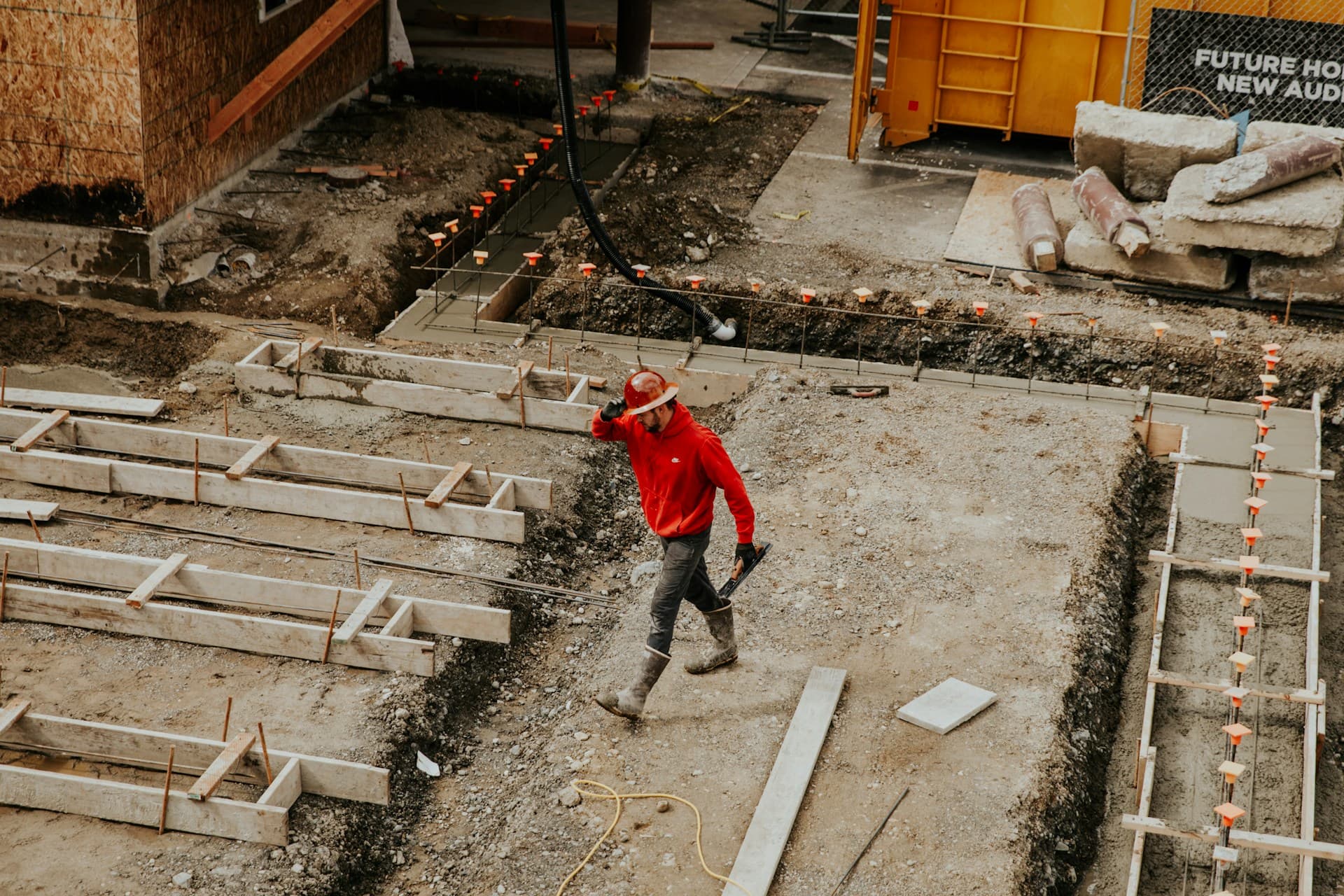
Formwork Construction (Slab Boxing)
Construction of timber or steel formwork (boxing) for concrete slabs, footings, and edge beams. Includes site set-out, edge board installation, bracing, levelling, and reinforcement mesh placement in preparation for concrete pour. Complies with AS 3610 Formwork for Concrete. Pre-filled hazards, controls, and risk ratings.
A pre-pour formwork inspection signed by a competent person is a non-negotiable item under AS 3610.1:2018, and it's the document that catches a slab edge blow-out before it happens rather than after. Builders running formwork crews informally — "the carpenter knows what he's doing" — fail that audit consistently, and the failure mode is a footing or slab edge that lets go during the pour, sending wet concrete across the site and exposing every worker downstream to the crush risk of an unsupported load. The competent person isn't the carpenter who built the box; it's the inspector who certifies the design against the head pressure of the pour rate and the bracing against the soil, the wind and the loads above.
Inside the work itself, two power-tool injuries dominate the trade's claims data. Pneumatic framing nailers in bump-fire mode account for the majority of nail-gun injuries on formwork crews — penetration through hand, foot or thigh, ricochet to the eye when a nail double-fires off a knot, and the thirty-day weeping wound that follows a bone strike. Sequential-fire mode is the safer setting for everything except production framing; many crews leave the trigger on bump because it's faster, and fall on the wrong side of the Safe Work Australia Guide to Formwork's expectations. Circular-saw kickback runs second — a wandering blade through ply or hardwood drives back toward the operator's femoral artery, and a blade guard never tampered with plus a stable cut platform is the working combination.
Manual handling carries the third column. Sheet ply at 30–40kg, long timbers carried single-handed across uneven ground, mesh rolls that take two and arrive as a one-person lift — back and shoulder claims on formwork crews track the lifting decisions made before morning tea. AS 3600:2018 covers the concrete the formwork fills, and AS 3610.1:2018 is the formwork standard the inspection runs against. Nail gun competency, power saw competency, working at heights for elevated formwork, and the competent person sign-off pre-pour are what turns a clean strip after the cure into the routine outcome.
What's In Your SWMS
7 Hazards & Controls
Penetrating wounds, severed tendons, punctured organs, eye injuries, infection, death
Use hand nailing for small jobs or where ricochet risk is high
Use sequential trigger mode instead of bump/contact trigger to prevent accidental discharge
Establish exclusion zone - no workers on opposite side of timber being nailed
- Maintain nail gun safety mechanisms - never disable or bypass
- Use correct nail length for material thickness
- Ensure work-piece is firmly secured before nailing
- Never nail into knots, splits, or near edges where ricochet likely
- Only trained and competent operators to use nail guns
- Never point nail gun at anyone, even when not firing
- Disconnect from air/gas supply when not in use, clearing jams, or carrying
- Never carry nail gun with finger on trigger
- Check behind and around target area before firing
- Pre-start inspection of nail gun before each use
Safety glasses mandatory, face shield recommended, hard hat, safety boots
19-Step Work Procedure
Equipment & PPE
Equipment (13)
- Circular saw (skill saw)
For cutting edge boards and bracing to length. Must have functioning guard.
- Nail gun (framing nailer)
For securing boards to stakes and bracing. Sequential trigger mode recommended.
- Claw hammer
For hand nailing and adjustments
- Sledgehammer / post driver
For driving stakes into ground
- Spirit level (1200mm+)
For checking level of edge boards
- Laser level or dumpy level
For setting heights across large areas
- String line, chalk line, and marking paint
For setting out slab perimeter and alignment
- Tape measure (30m)
For measuring dimensions and checking diagonals
- Crowbar / pry bar
For adjusting and removing formwork
- Bolt cutters / wire cutters
For cutting mesh and tie wire
- Bar chairs / mesh supports
For supporting reinforcement at correct cover height
- First aid kit
Include wound dressings, eye wash, splinter removal tools
- Fire extinguisher
ABE type, required on construction sites
PPE (6)
- Safety helmet (hard hat)AS/NZS 1801:2024
Mandatory on all construction sites - falling timber, nail gun ricochet
- Safety glassesAS/NZS 1337.1:2010
Essential - sawdust, nail fragments, splinters
- Hearing protectionAS/NZS 1270:2002
Required when using power saws, nail guns, or hammering
- Work gloves (leather or similar)AS/NZS 2161.1:2016
For handling timber, mesh, and general work. Remove when operating power saws.
- Safety boots (steel cap)AS 2210.3:2019
Steel cap and puncture-resistant sole for nails and dropped materials
- High-visibility vest/shirtAS 4602.1:2024
Required on construction sites
Training & Emergency
Competency Requirements
- Construction Induction Card (White Card)training
Required for all workers on construction sites
- Formwork Construction Competencycertificate
Demonstrated ability to erect formwork to design specifications. The relevant unit of competency is "Erect and dismantle formwork for footings and slabs on ground" (a CPC training package unit; check training.gov.au for the current unit code in use). Note: CPCCCM2006 is "Apply basic levelling procedures" — a separate, complementary unit, NOT formwork erection.
- Nail Gun Competencytraining
Training in safe nail gun operation, maintenance, and jam clearing
- Power Saw Competencycertificate
Training in safe circular saw and drop saw operation
- Competent Person - Formwork Inspectioncertificate
Qualified to inspect and sign off formwork for concrete pour
- Working at Heights Training
Required if formwork exceeds 2m height (suspended slabs, retaining walls)
- First Aid Certificate
Recommended for at least one team member on site
Emergency Procedures
NAIL GUN PENETRATING INJURY: Do not remove nail. Immobilise limb/body part. Call 000. Keep person calm and still. Do not apply pressure to embedded object.
SEVERE CIRCULAR SAW LACERATION: Apply direct pressure to wound. Elevate if limb injury. Call 000 immediately. Do not attempt to reattach severed tissue - wrap in clean damp cloth and keep with patient.
FORMWORK COLLAPSE: Call 000 immediately. Do not enter collapse zone until confirmed safe. Account for all workers. Do not move injured persons unless immediate danger.
SPLINTER WITH INFECTION SIGNS: If redness, swelling, or pus develops around splinter wound, seek medical attention. May require antibiotics or tetanus booster.
NOISE-INDUCED HEARING ISSUE: If ringing in ears (tinnitus) or muffled hearing persists after work, seek medical assessment. Record exposure details.
Everything above, included in your SWMS document.
Get This TemplateWriting a SWMS from scratch?
That's 2-4 hours of research, formatting, and cross-referencing regulations.
We've done the starting work — pick your template, add your details, review.
Or just do this:
- Unlimited documents
- All 70+ templates
- Instant PDF & DOCX
- Cancel anytime
High-Risk Construction Work Categories
Under Australian WHS Regulations (291 - High Risk Construction Work (formwork or falsework)), this work is classified as high-risk due to:
- Formwork or falsework (Construction and dismantling of formwork is classified as high-risk construction work under WHS Regulations)
Australian Standards Referenced
Who Needs This SWMS?
This template is designed for the following trades and roles performing formwork construction (slab boxing) work.
Frequently Asked Questions
Is formwork construction classified as high-risk work?
Yes. Under WHS Regulation 2017, formwork or falsework is explicitly listed as high-risk construction work. A Safe Work Method Statement (SWMS) must be prepared before work commences.
Who can inspect and sign off formwork before a concrete pour?
A competent person must inspect formwork before concrete placement. This is typically someone with formwork construction qualifications (such as CPCCCM2006A) or a structural engineer for complex formwork. They must verify the formwork complies with design specifications.
What is AS 3610 and why is it important?
AS 3610 is the Australian Standard for Formwork for Concrete. It specifies requirements for formwork documentation, surface finish, tolerances, and structural adequacy. Compliance with AS 3610 ensures formwork can safely support concrete loads during placement and curing.
What trigger mode should nail guns be set to for formwork?
Sequential trigger mode is recommended for formwork construction. This requires the nose to be pressed against the workpiece before the trigger will fire, preventing accidental discharge. Bump/contact trigger mode allows faster nailing but significantly increases the risk of unintended discharge.
What PPE is required for formwork construction?
Essential PPE includes hard hat (mandatory on construction sites), safety glasses, hearing protection when using power tools, work gloves for handling timber, and steel-capped safety boots. Remove gloves when operating circular saws to maintain grip control.
How deep should formwork stakes be driven?
Stakes should be driven minimum 300mm into the ground for standard conditions. In soft or sandy soils, deeper stakes or closer spacing may be required. In hard ground, pre-drilling may be necessary. The stake must provide adequate resistance to prevent formwork movement during concrete placement.
What is "drop stripping" and why is it prohibited?
Drop stripping is the practice of releasing formwork so it falls freely to the ground. It is prohibited under all state Codes of Practice because falling formwork panels can strike and seriously injure workers. Formwork must be stripped in a controlled manner with exclusion zones in place.
What should happen if formwork shows signs of movement during concrete pour?
The concrete pour must be stopped immediately. All workers should evacuate the formwork area. The formwork must be inspected by a competent person and any defects rectified before the pour can resume. Do not attempt repairs while concrete is being placed.
Get Your Formwork Construction (Slab Boxing) SWMS
Pre-filled. Risk-rated. Ready in 5 minutes.
Get Your SWMS PDFNo credit card required. First SWMS is free.
