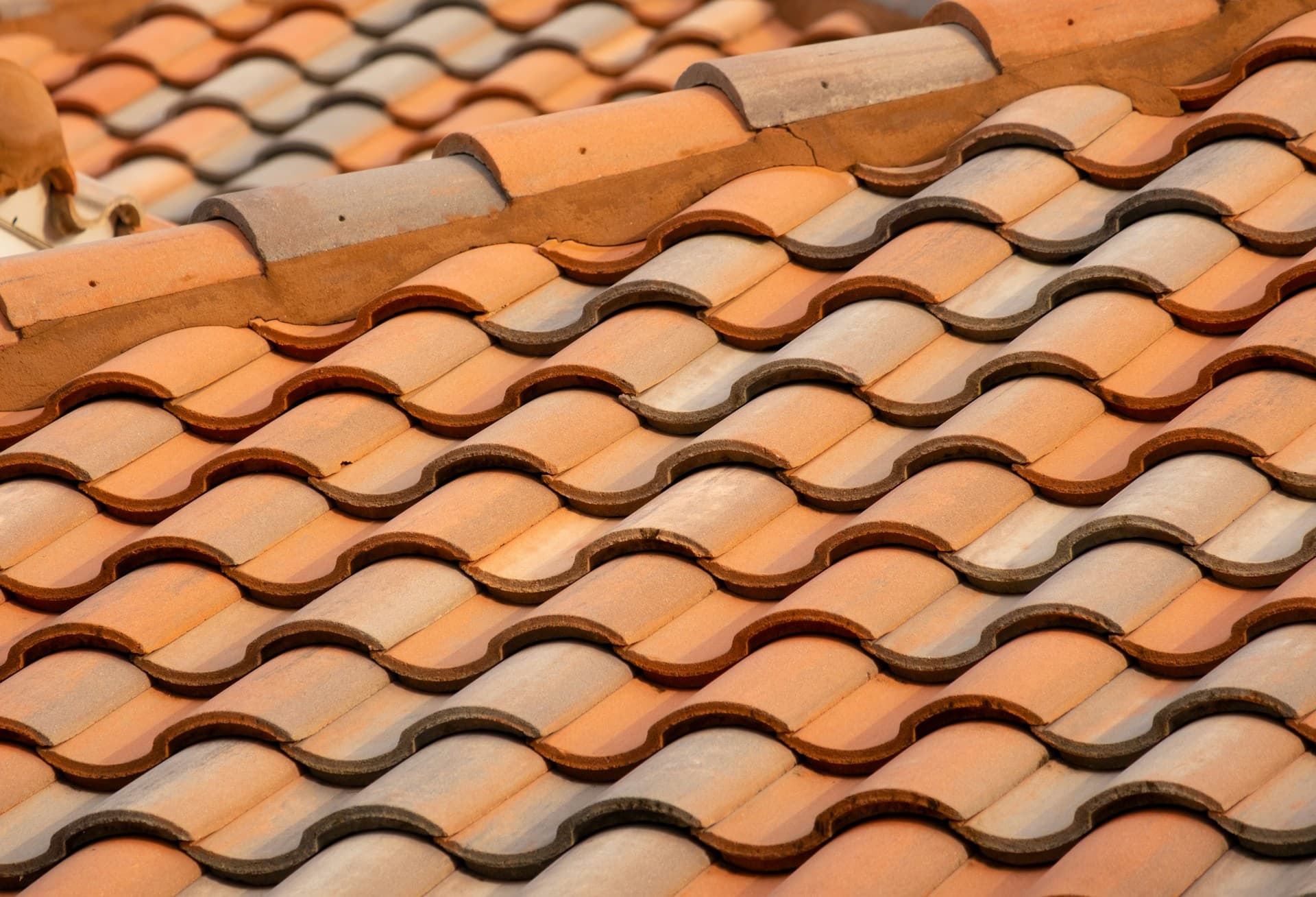
Roof Tile Installation
Installation of concrete or terracotta roof tiles on residential and commercial buildings, including tile cutting, laying, fixing, and ridge capping. Pre-filled hazards, controls, and risk ratings.
A new-build tile roof goes on with a crew of four to six, a tile elevator running at the gutter line, and a couple of thousand concrete or terracotta tiles to lay across a structured day. Concrete tiles weigh four to six kilograms each — across the day, that's the back-and-shoulder claim column. Terracotta runs lighter but more brittle, with breakage at the cut line driving up cost and respirable silica dust at the same time. Wet cutting on a guillotine or wet tile saw stays as the cutting standard regardless, and on-tool dust control under the SafeWork Australia silica WES of 0.05 mg/m³ is the floor for any operator on the saw.
Edge protection is usually already up from the framing trades on a new-build, and tile crews riding on existing perimeter scaffold often skip protection on the cut sides where the scaffold doesn't reach. AS/NZS 4994.1:2023 sets the temporary edge-protection requirement, and the Model Code of Practice on Managing the Risk of Falls in Housing Construction drives the broader fall plan — a fall arrest harness to AS/NZS 1891.1:2020 clipped to a AS/NZS 5532:2013 anchor handles the gap. Concrete tiles run notably slipperier than metal sheets when wet or dewy, and the morning start on a 25-degree pitch is the moment most slip injuries land.
Mortar bedding for ridge caps brings alkali burn risk into the trade — modern dry-ridge systems are taking over, but most existing housing stock still uses mortar, so alkali-resistant gloves and prompt skin flushing remain the practical controls. Heat stress on a black-tile roof in February runs to 60 degrees of surface temperature; rotation, hydration and a midday work-stop are not luxuries. Working at Heights under RIIWHS204E, a current White Card and a harness-wearer refresh complete the qualifications brought to the morning toolbox. The crew that tiles dewless rather than dewy gets through the day without a slide.
What's In Your SWMS
13 Hazards & Controls
Fatal injury, spinal cord injury, traumatic brain injury, multiple fractures
Pre-fabricate components at ground level where possible
Establish exclusion zones at ground level below work area with barricade tape and signage
- Install temporary edge protection compliant with AS/NZS 4994.1:2023 and AS/NZS 4994.2:2023 before any roof access
- Ensure guardrail height minimum 900mm above roof surface
- Use infill panels where roof pitch exceeds 26 degrees
- Scaffold to provide safe access with guardrails on all open sides
- Complete pre-start safety briefing covering fall hazards
- No roof access until edge protection inspection confirmed
- Work in pairs with visual contact maintained
- No work in wet conditions, frost, or winds exceeding 40km/h
Full body harness connected to certified anchor points when working beyond edge protection or during edge protection installation
19-Step Work Procedure
Equipment & PPE
Equipment (13)
- Temporary roof edge protection system
Compliant with AS/NZS 4994.1:2023 and AS/NZS 4994.2:2023.
- Safety mesh/fall through protection
Installed between battens to prevent fall through roof
- Scaffold system for roof access
Erected by licensed scaffolder, green tag current
- Tile hoist/elevator
Mechanical lifting device for tiles to reduce manual handling
- Wet tile cutter/saw
Electric or petrol with water suppression system for silica control
- Roof ladder/crawl boards
For safe movement on roof surface, especially steep pitches
- Extension ladder
Industrial rated, extends 1m above landing point
- Fall arrest anchor points and static lines
Certified single-point anchor devices to AS 5532:2025 (supersedes AS/NZS 5532:2013).
- Nail gun (pneumatic or gas)
For fixing battens and tile clips
- Hand tools (hammer, tape measure, chalk line, spirit level, tile nippers)
Tethered where working at heights
- First aid kit
Fully stocked, accessible at ground level
- Fire extinguisher
Dry chemical type, located at work area entry
- Water supply/containers
For wet cutting and worker hydration
PPE (11)
- Hard hat with brim attachmentAS/NZS 1801:2024
Wide brim attachment for sun protection, or hard hat compatible sun flap
- Safety boots with non-slip soleAS 2210.3:2019
Steel cap, soft rubber non-slip sole for roof grip
- Safety glasses/gogglesAS/NZS 1337.1:2010
Category O for UV protection when working outdoors
- High visibility vest/shirtAS 4602.1:2024
Class D/N for day and night visibility
- Work glovesAS/NZS 2161.1:2016
Cut-resistant for handling tiles and sharp edges
- Full body fall arrest harnessAS/NZS 1891.1:2020
Required for ridge work and when edge protection cannot be installed. Pre-use inspection required. Selection / use / maintenance per AS/NZS 1891.4:2025.
- Lanyard with shock absorberAS/NZS 1891.1:2020
Twin-tail lanyard recommended for continuous connection
- P2/N95 respiratorAS/NZS 1716:2012
Silica-rated, required during all tile cutting operations
- Hearing protection (earmuffs or plugs)AS/NZS 1270:2002
Required during tile cutting and nail gun operation
- Sunscreen SPF 50+
Broad spectrum, water resistant, reapply every 2 hours
- Long-sleeved shirt and long pants
UPF 50+ rated preferred for UV protection
Training & Emergency
Competency Requirements
- Construction Induction (White Card)training
Required for all workers on NSW construction sites
- Work Safely at Heights (RIIWHS204E)training
Required for all workers accessing roof. Refresher recommended every 2 years.
- Harness and Fall Arrest User Trainingtraining
All workers using fall arrest systems must be trained in correct use, inspection, and rescue
- Silica Awareness Trainingtraining
Required for workers involved in tile cutting operations
- Asbestos Awareness Trainingtraining
Required for work on buildings constructed before 1990
- Scaffolding Licence (Basic/Intermediate)
Required for workers erecting, altering, or dismantling scaffold where fall risk >4m
- First Aid Certificate
At least one person on site should hold current certificate (HLTAID011 or equivalent)
- Elevated Work Platform Licence
Required if using boom lifts (WP class) or scissor lifts >11m (WP class)
Emergency Procedures
FALL FROM HEIGHT RESCUE: Call 000 immediately. Do NOT move injured person unless in immediate danger. If worker suspended in harness, initiate rescue within 15 minutes to prevent suspension trauma. Maintain communication with casualty. Keep warm and monitor breathing.
SUSPENDED WORKER RESCUE: Time critical - rescue must occur within 15 minutes. Use pre-planned rescue method (ladder rescue, rescue descent device). Once rescued, place the worker in a flat / supine position (or recovery position if unconscious and breathing) per ANZCOR Guideline 9.1.5. Earlier advice to keep the rescued worker in a legs-bent / upright position to prevent orthostatic shock has been retracted as it lacks evidence and may be harmful. Seek medical attention even if the worker appears uninjured.
SILICA DUST EXPOSURE: If worker experiences coughing, difficulty breathing, or chest tightness during or after tile cutting, move to fresh air immediately. If symptoms persist, seek medical attention and inform doctor of silica exposure.
HEAT ILLNESS: Move worker to shade immediately, apply cool water to skin, provide cool water to drink (if conscious). If confusion, vomiting, or unconsciousness occurs, call 000 immediately - this is heat stroke.
ELECTRICAL CONTACT: Do NOT touch the victim if they are still in contact with electrical source. Call 000 and the electricity supply authority. Only approach when confirmed isolated.
Everything above, included in your SWMS document.
Get This TemplateWriting a SWMS from scratch?
That's 2-4 hours of research, formatting, and cross-referencing regulations.
We've done the starting work — pick your template, add your details, review.
Or just do this:
- Unlimited documents
- All 70+ templates
- Instant PDF & DOCX
- Cancel anytime
High-Risk Construction Work Categories
Under Australian WHS Regulations (Part 6.4 - High Risk Construction Work (Section 291) or Part 5.1 Construction (VIC)), this work is classified as high-risk due to:
- Work at height (>2m) with risk of fall (Primary hazard - all roof tile work involves working at heights greater than 2 metres with fall risk over roof edge and through fragile surfaces)
- Use of powered mobile plant (Tile cutting equipment, tile hoists/elevators, and potential use of EWPs for access)
- Work on/near energised electrical installations (Proximity to overhead service lines, roof-mounted electrical equipment, and potential for contact with building electrical systems)
Australian Standards Referenced
National Guidance Documents
- Safe Work Australia - Code of Practice: Managing the risk of falls at workplaces
- Safe Work Australia - Guide for managing the risks of working in heat
- Safe Work Australia - Guide on exposure to solar ultraviolet radiation (UVR)
- Safe Work Australia - Code of Practice: Construction work
- Safe Work Australia - Code of Practice: Managing risks of hazardous chemicals in the workplace (silica)
Who Needs This SWMS?
This template is designed for the following trades and roles performing roof tile installation work.
Frequently Asked Questions
What fall protection is required for roof tile installation?
Temporary edge protection compliant with AS/NZS 4994.1 and 4994.2 must be installed before any roof access. This typically includes guardrails minimum 900mm high around the full perimeter. Where roof pitch exceeds 26 degrees, infill panels are also required. Full body harnesses connected to certified anchor points (AS/NZS 5532) are required when installing/dismantling edge protection or working beyond its protection.
What training do roof tilers need?
All workers require a Construction Induction Card (White Card) and Working at Heights training (RIIWHS204E). Workers using fall arrest harnesses need harness user training including rescue procedures. Workers involved in tile cutting need Silica Awareness training. For buildings constructed before 1990, Asbestos Awareness training is also required. Note: In Victoria, refresher training is recommended every 2 years.
How should silica dust from tile cutting be controlled?
Wet cutting is mandatory - dry cutting of concrete or terracotta tiles is not permitted. The cutting station should be set up at ground level away from other workers, with continuous water suppression to the blade. Workers must wear P2/N95 respirators rated for silica during all cutting operations. Cleanup must use wet methods - never dry sweep tile dust. Queensland has Australia's first silica code of practice for construction (effective 1 May 2023) which requires health monitoring for at-risk workers. South Australia's crystalline silica substances regulations (effective 1 September 2024) require air monitoring, silica risk control plans, and training. In Victoria, exposure must be kept below 0.05mg/m³ (WorkSafe Victoria recommends below 0.02mg/m³ as a precautionary measure).
What are the weather restrictions for roof tile work?
Work must cease when roof surfaces are wet, frosty, or icy due to slip hazards. Work should stop in winds exceeding 40km/h as this affects worker stability and creates falling object hazards. During heat waves or when temperatures exceed 35°C, work hours should be adjusted to early morning and late afternoon, with additional rest breaks in shade.
Do I need an asbestos inspection before roof tiling?
If the building was constructed or renovated before 1990 (late 1980s), an asbestos inspection by a licensed assessor is strongly recommended before commencing work. Many older homes contain asbestos cement products in roofing, eaves, and wall cladding. If asbestos is identified, a management plan or removal by a licensed removalist may be required before tile work can proceed.
What should be included in a rescue plan for roof work?
The rescue plan must ensure a suspended worker can be rescued within 15 minutes to prevent suspension trauma. It should identify rescue equipment (ladder, rescue descent device), trained rescue personnel, emergency contact numbers, and step-by-step rescue procedure. The plan must be site-specific and practiced before harness work commences.
What are the Victorian No Go Zone requirements for powerlines?
In Victoria, work within 3m of overhead powerlines requires permission from the electricity company. Work between 3m and 6.4m requires a trained Spotter. Energy Safe Victoria and WorkSafe Victoria do not consider a Spotter adequate for scaffolding erection within No Go Zones - contact the distribution company (CitiPower, Powercor, Jemena, AusNet) for a permit. Use the Look Up and Live app to identify powerline locations.
What is the difference between NSW and Victorian legislation for roof work?
NSW operates under the Work Health and Safety Act 2011 and WHS Regulation 2017, while Victoria has the Occupational Health and Safety Act 2004 and OHS Regulations 2017. Both require SWMS for high-risk construction work including working at heights above 2m. Victoria uses "compliance codes" (equivalent to NSW codes of practice). The 19 high-risk work categories are similar across jurisdictions.
What are Queensland's exclusion zone requirements for overhead powerlines?
In Queensland, electrical exclusion zones are the minimum safe distance from live powerlines to reduce electric shock risk. Most powerlines have a 3m exclusion zone. High voltage lines between 132kV-330kV require 6m, and over 330kV require 8m. A trained safety observer must be used when there is any risk of entering exclusion zones (e.g., when raising scaffolding, using tile hoists, or cranes). Use the Look Up and Live app (lookupandlive.com.au) to identify Ergon Energy and Energex powerline locations.
What are the Queensland-specific SWMS requirements for roof work?
Queensland operates under the Work Health and Safety Regulation 2011, which identifies 18 activities as high-risk construction work requiring a SWMS. For roof tiling, work at heights above 2m (or 3m for housing construction) triggers SWMS requirements. The SWMS must be prepared before work starts, a copy given to the principal contractor, work carried out in accordance with it, and it must be reviewed if conditions change. Queensland also requires specific silica controls under the Managing RCS in Construction Code of Practice 2022 (effective 1 May 2023).
What height triggers fall protection requirements in Queensland housing construction?
In Queensland housing construction, fall prevention/arrest controls are mandatory where there is a potential fall of 3 metres or more. However, for falls between 2m and 3m, a risk assessment must still be conducted and control measures implemented if the risk warrants it. For all other construction work (non-housing), fall controls are required at 2 metres. Note that construction work over 2m high is classified as high-risk construction work requiring a SWMS.
What is the height threshold for high-risk construction work in South Australia?
In South Australia, high-risk construction work (HRCW) requiring a SWMS is construction work involving a risk of a person falling more than 3 metres - this is higher than most other Australian jurisdictions which use 2 metres. However, from 1 July 2026, SA will align with national model regulations and the threshold will change to 2 metres. Fall protection must still be provided for any work where there is a risk of falling, regardless of height, based on risk assessment.
What are the SA-specific requirements for asbestos removal during roof work?
South Australia has stricter asbestos requirements than the national model code. Air monitoring is required for BOTH Class A (friable) AND Class B (non-friable) licensed asbestos removal work - unlike other states where Class B air monitoring is optional. Buildings built or renovated before 31 December 2003 require an asbestos register. Before any roof work on older buildings, the asbestos register must be reviewed. For buildings before the mid-1980s, asbestos-containing materials are highly likely to be present.
What are the SA requirements for silica dust control during tile cutting?
From 1 September 2024, new crystalline silica substances (CSS) regulations apply in SA. For construction work involving tile cutting, the processing is classified as high-risk and requires: controlled processing using water suppression or local exhaust ventilation, a silica risk control plan (which can be incorporated into your SWMS), personal air monitoring within the workers breathing zone, health monitoring for workers at risk of RCS exposure, and crystalline silica training. Engineering controls are considered reasonably practicable in all but very rare situations.
What are SA's electrical safe approach limits for roof work near powerlines?
In SA, safe approach limits are based on powerline voltage. A person (including objects held) can only work to within 1 metre of a 415V powerline, or within 2 metres of an 11,000V powerline, and only with a SWMS based on a risk assessment. For scaffolding near overhead powerlines, use a 4-metre initial clearance distance. If safe clearance cannot be maintained, apply for a Network Access Permit from SA Power Networks (allow 28 business days). Contact the Office of the Technical Regulator on 8226 5500 for advice on authorisations.
Get Your Roof Tile Installation SWMS
Pre-filled. Risk-rated. Ready in 5 minutes.
Get Your SWMS PDFNo credit card required. First SWMS is free.
