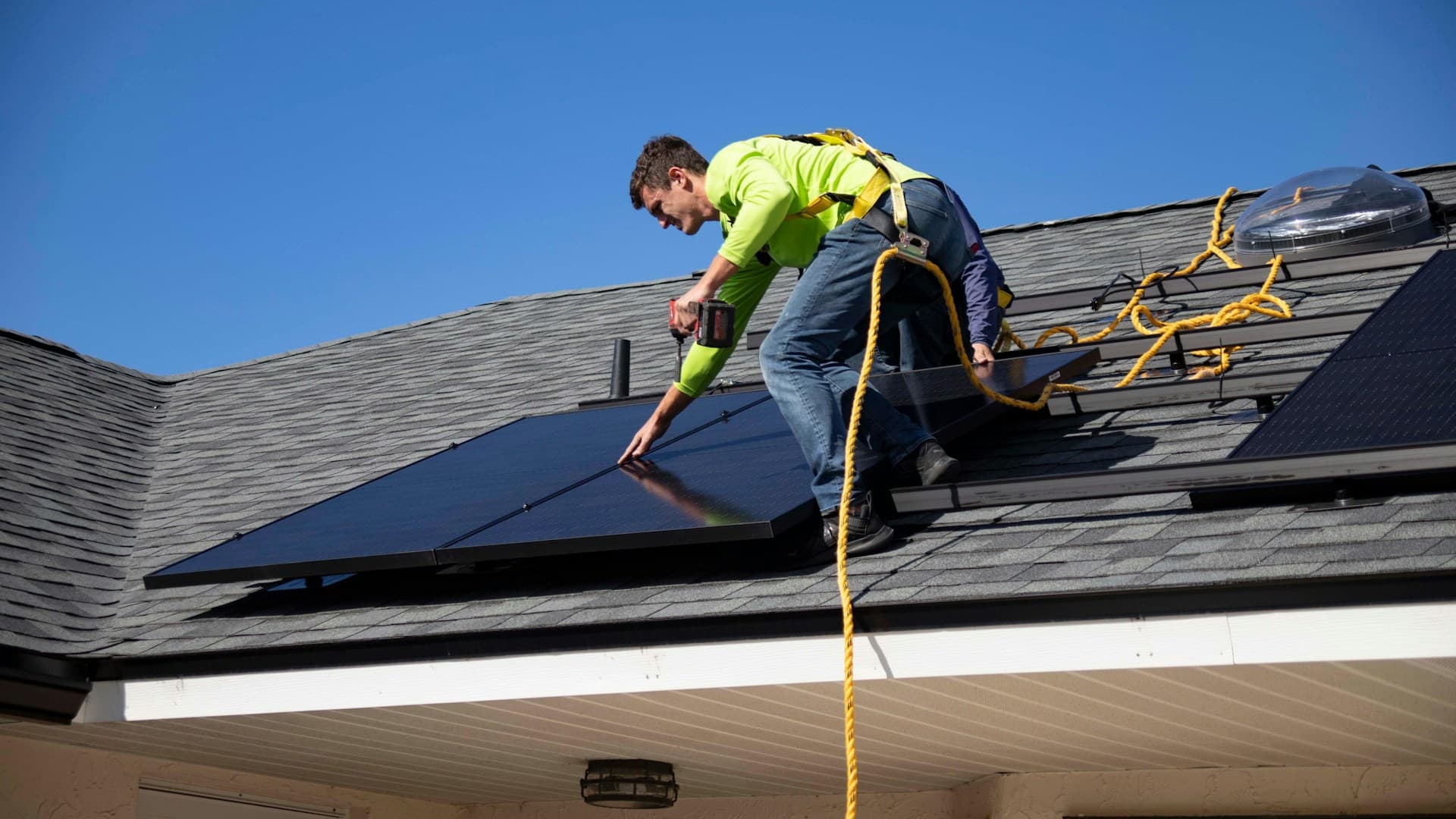
Rooftop Solar Panel Installation
Installation of photovoltaic (PV) solar panel systems on residential and commercial rooftops, including mounting hardware, DC wiring, inverter connection, and grid connection. Pre-filled hazards, controls, and risk ratings.
A solar installer can isolate the inverter, switch off the grid feed, lock out the main switchboard and the DC strings will still be live. Sunlight on the panels is the energy source — covering the modules with opaque blankets reduces voltage but doesn't take it to zero, and an MC4 connector mated or unmated under load can sustain a DC arc that, unlike AC, doesn't self-extinguish at the next zero-crossing. That property of DC is what makes solar work electrically more dangerous than the equivalent lighting circuit, and it's what sits at the top of any rooftop SWMS for this trade. AS/NZS 5033:2021 is the controlling standard for PV array installation and safety; AS/NZS 3000:2018 covers the AC side back to the switchboard.
Accreditation moved from the Clean Energy Council to Solar Accreditation Australia in 2024, and the SAA accreditation is what determines STC eligibility under the Small-scale Renewable Energy Scheme. Installers still listing CEC accreditation on their SWMS are out of date and ineligible for the rebate; the Clean Energy Regulator is the authority that confirms current accreditation. Battery installs to AS/NZS 5139:2019 add a separate GCBS endorsement on top of the standard GCPV ticket.
The roof itself runs the second hazard column. Pitched-roof solar installs sit among the highest fall-fatality categories in Australian construction, and panel handling in heat — black glass at midday clears 60 to 70 degrees of surface temperature — is a heat-stress trade by structure. A fall arrest harness to AS/NZS 1891.1:2020 clipped to a AS/NZS 5532:2013 anchor is the personal control; rotation, hydration and a midday work-stop manage the heat. Unrestricted electrical licence, SAA accreditation, Working at Heights under RIIWHS204E, LV rescue, and current first aid sit alongside the manufacturer training the warranty depends on. Cover the panels before any string work; the rest follows.
What's In Your SWMS
8 Hazards & Controls
Fatality, traumatic brain injury, spinal cord injury, multiple fractures
Design systems accessible from ground level using EWPs where practical
Use scaffold with guardrails instead of ladder access where practical
Establish 3m exclusion zone around roof edge and fragile materials; barricade ground-level drop zone
- Install temporary edge protection guardrails to AS/NZS 4994.1:2023 before roof access
- Use single-point anchor devices to AS 5532:2025 (typical residential single-person anchors are 15kN rated; double-person 21kN)
- Install static lines allowing continuous connection while traversing
- Cover and secure all skylights and roof openings with barriers capable of supporting 120kg
- Use panel lifting devices - carrying panels up ladders is prohibited
- Competent person to assess roof structural integrity before work
- Working at Heights training current for all rooftop workers
- Pre-start inspection of all fall protection equipment
- No work on wet, frosty, or icy roof surfaces
- Cease work if wind exceeds 25-30 km/h
- Tested rescue plan documented and practiced
Full body harness (AS/NZS 1891.1:2020) with shock-absorbing lanyard connected to single-point anchor device (AS 5532:2025) before stepping onto roof
19-Step Work Procedure
Equipment & PPE
Equipment (12)
- Solar PV panels
Listed on CEC Approved Products List; verify wattage, dimensions and weight for manual handling assessment
- Mounting rails and hardware
Roof-type specific fixings; include splice joiners for earthing continuity
- Inverter (string or micro)
Listed on CEC Approved Products List; verify DNSP requirements for grid connection
- DC isolator switches
IEC 60947.3 compliant; IP66 minimum for outdoor installation
- DC cabling and connectors
UV-stabilised solar cable; MC4 connectors; metal conduit for ceiling spaces
- Extension ladder (industrial rated)
AS 1892.1:2018 compliant; 120kg+ rating; inspect before each use
- Fall protection system
Temporary edge protection to AS/NZS 4994.1:2023, static lines, or single-point anchor devices to AS 5532:2025 (typical residential single-person anchors are 15kN rated; double-person 21kN).
- Panel lifting device
HYTILE, Solar Coaster, or similar - panels must not be carried up ladders
- Digital multimeter (CAT III 1000V DC)
For Voc, Isc testing; must be rated for DC solar voltages
- Insulation resistance tester
1000V DC test voltage capability for AS/NZS 5033 compliance testing
- Earth continuity tester
Low resistance ohmmeter for verifying ≤0.5Ω earth path
- Portable RCD (30mA)
Test before each use; required for all portable electrical equipment
PPE (8)
- Safety helmet with chin strapAS/NZS 1801:2024
Type 1 top impact protection; wide-brim attachment for sun protection
- Safety footwear (non-slip soles)AS 2210.3:2019
Steel toe; soft rubber soles for roof grip; ankle support
- Safety glasses (tinted)AS/NZS 1337.1:2010
Medium impact; tinted lens for glare; side shields
- Work gloves (cut resistant)AS/NZS 2161.1:2016
Cut Level 3 minimum for handling panels and rails
- Electrical insulating glovesAS 60903:2022
Class 00 or 0 for low voltage DC work; test before each use. AS 60903:2022 supersedes AS/NZS IEC 60903:2020 (which itself replaced AS/NZS 2225:1994).
- Full body harness with shock-absorbing lanyardAS/NZS 1891.1:2020
Rear dorsal attachment; suspension relief straps; inspect before each use. Selection / use / maintenance per AS/NZS 1891.4:2025.
- High visibility clothingAS 4602.1:2024
Day/Night Class D/N; long sleeves for UV protection (UPF 50+)
- Sun protection (sunscreen, hat)
SPF 50+ sunscreen; reapply every 2 hours; wide-brim hat attachment
Training & Emergency
Competency Requirements
- Construction Induction (White Card)training
CPCCWHS1001 - Required for all workers on construction sites
- Unrestricted Electrical Licence (Class A or equivalent)licence
Required for all electrical connection work; state-issued (ESV VIC, Fair Trading NSW, ESO QLD)
- Solar Accreditation Australia (SAA) Accreditationticket
GCPV (Grid-Connect PV) minimum; GCBS for battery; required for STC eligibility. Transferred from CEC May 2024.
- Working at Heightstraining
RIIWHS204E - Required for all rooftop workers; SAA accreditation prerequisite; 2-year refresh recommended
- EWP High Risk Work Licence (WP Class)
TLILIC0005 - Required only for boom-type EWPs over 11 metres working height
- First Aid Certificate
HLTAID011 - At least one person on site should hold current certificate; includes CPR
- Low Voltage Rescue
UETDRMP018 - Recommended for all electrical workers performing live work
- Asbestos Awareness
11084NAT - Mandatory in ACT; highly recommended for work on pre-1990 buildings
Emergency Procedures
FALL FROM HEIGHT - Call 000 immediately. Do NOT move injured person unless in immediate danger. If worker suspended in harness, initiate rescue within 15 minutes (suspension trauma). Once the worker is clear of suspension, place them in a flat / supine position (or recovery position if unconscious and breathing). Per ANZCOR Guideline 9.1.5, earlier advice to keep the rescued worker upright (W-position / "do not lay flat") has been retracted as it lacks evidence and may be harmful.
ELECTRICAL SHOCK - Do NOT touch victim if still in contact with electricity. For low voltage, use non-conductive object to separate victim from source. For high voltage (powerlines), stay 25m away until power confirmed off. Call 000. Begin CPR if unresponsive and not breathing. Use AED if available.
DC SYSTEM EMERGENCY ISOLATION - Turn OFF AC isolator at switchboard, then OFF DC isolator near inverter, then OFF rooftop DC isolator if installed. WARNING: Panels still generate open-circuit voltage in daylight even with all isolators off. Cover panels with opaque material if voltage elimination required.
BATTERY THERMAL EVENT - Alert all personnel and evacuate building immediately. Do NOT touch swollen/ruptured battery. Do NOT re-enter. Avoid inhaling gases - HIGHLY TOXIC. Call 000 and advise lithium battery fire. Establish 25m exclusion zone. Monitor for re-ignition for 60+ minutes.
HEAT STROKE (body temp >40°C, confusion, hot dry skin) - Call 000 immediately. Move to shade. Apply aggressive cooling - cold water immersion if possible, otherwise ice packs to neck, groin, armpits. Do NOT give fluids if unconscious.
Everything above, included in your SWMS document.
Get This TemplateWriting a SWMS from scratch?
That's 2-4 hours of research, formatting, and cross-referencing regulations.
We've done the starting work — pick your template, add your details, review.
Or just do this:
- Unlimited documents
- All 70+ templates
- Instant PDF & DOCX
- Cancel anytime
High-Risk Construction Work Categories
Under Australian WHS Regulations (291 - High Risk Construction Work (Sections 299-303 SWMS requirements)), this work is classified as high-risk due to:
- Work at height (>2m) with risk of fall (All rooftop solar work involves fall risk from roof edges, through fragile materials, or via access equipment)
- Work on/near energised electrical installations (Solar panels generate DC electricity whenever exposed to light and cannot be fully isolated during daylight)
- Use of powered mobile plant (Elevated Work Platforms (EWPs) commonly used for roof access and panel lifting)
- Temporary support for structural alterations (Roof penetrations for mounting hardware and conduit may require structural consideration)
Australian Standards Referenced
National Guidance Documents
- Safe Work Australia - Guide to Managing the Risks of Rooftop Solar Installation Work (September 2025)
- Safe Work Australia - Managing the Risk of Falls at Workplaces Code of Practice
- Clean Energy Council - Guidelines for Grid-Connected Solar PV Systems
- Solar Accreditation Australia - Accreditation Requirements
Who Needs This SWMS?
This template is designed for the following trades and roles performing rooftop solar panel installation work.
Frequently Asked Questions
Why is a SWMS required for solar panel installation?
Solar panel installation triggers multiple categories of high-risk construction work under WHS Regulation 2017 Section 291. This includes work at height exceeding 2 metres with risk of fall, and work on or near energised electrical installations. Solar panels uniquely generate DC electricity whenever exposed to light and cannot be fully isolated during daylight hours, making this work inherently high-risk requiring a documented SWMS before work commences.
What qualifications do solar installers need in Australia?
Solar installers require: an Unrestricted Electrical Licence (Class A or equivalent) issued by the state regulator, Solar Accreditation Australia (SAA) accreditation (formerly CEC) for STC eligibility, a Construction Induction (White Card), and current Working at Heights training. SAA accreditation requires passing an exam and maintaining 100 CPD points per renewal cycle.
Can solar panels be isolated during installation?
No - this is the critical safety difference from other electrical work. Solar panels generate DC electricity whenever exposed to light and cannot be fully isolated during daylight. Even with all DC isolators open, string voltages can reach 400-1000V DC. The only way to eliminate voltage is to cover panels with opaque material or wait for darkness. All DC work must be performed assuming circuits are live.
What fall protection is required for residential solar installation?
The hierarchy of controls must be followed: first eliminate or substitute (e.g., ground-level EWP access), then engineering controls (temporary edge protection, scaffold, static lines), then administrative controls (training, procedures), then PPE (harness) as last resort. Single-storey homes often lack sufficient fall clearance for fall arrest to work effectively, making fall prevention the priority. A tested rescue plan is mandatory.
What are the main electrical hazards specific to solar PV systems?
Key hazards include DC electrical shock from panels that are always live in daylight (400-1000V DC possible), DC arc flash reaching temperatures up to 1,085°C which is harder to extinguish than AC arcs, reverse polarity risks, and the inability to fully isolate the system. Over 250 domestic fires in Australia have been attributed to DC arc faults at connections.
Are there additional requirements for battery storage installation?
Yes - battery storage adds lithium-ion thermal runaway risks. Installation must comply with AS/NZS 5139:2019 including separation distances, ventilation requirements, and installation in non-habitable areas. Installers need SAA GCBS (Grid-Connect Battery Storage) accreditation in addition to standard GCPV accreditation. Emergency procedures must address toxic gas release and battery fire response.
Get Your Rooftop Solar Panel Installation SWMS
Pre-filled. Risk-rated. Ready in 5 minutes.
Get Your SWMS PDFNo credit card required. First SWMS is free.
