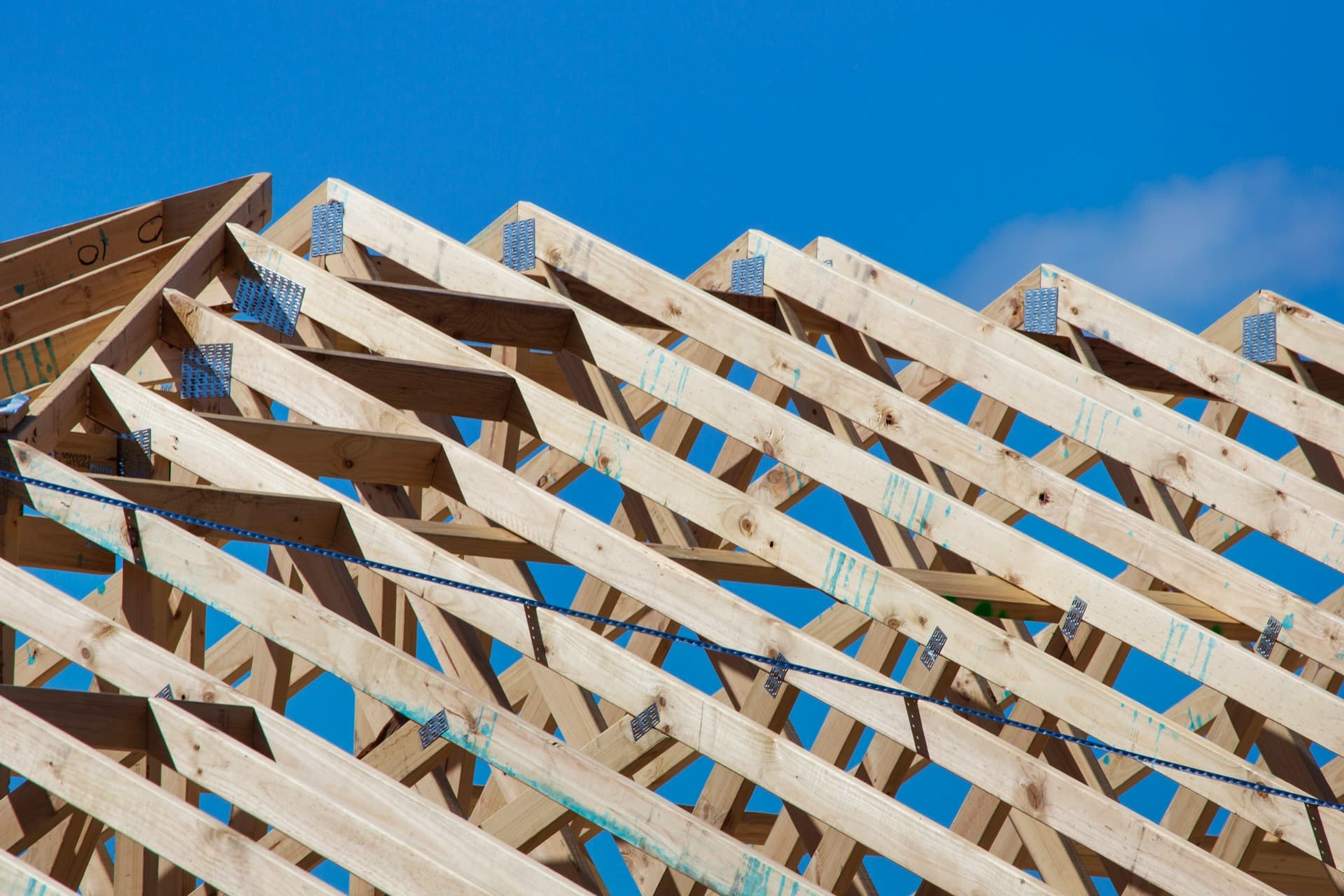
Roof Truss Installation
Installation of prefabricated nailplated timber roof trusses including crane/hiab delivery, sequential erection, temporary bracing, permanent fixing, and roof batten installation for residential and light commercial construction. Pre-filled hazards, controls, and risk ratings.
Truss day is the riskiest morning in residential framing. A Hiab arrives with a stack of 8-to-12-metre nailplated trusses, the crew climbs to the top plate at 2.7 metres without a deck below them, and the first three trusses sit on the wall with no permanent bracing while the next three get hauled into position. AS 4440-2004 sets the erection sequence — gable end first, the next three with diagonal cross-bracing complete before any further trusses go up — and the progressive-collapse incidents on Australian sites are almost all sequence-skipping, not workmanship.
Anchor points for fall arrest are the genuinely hard part of this work. Until the trusses are pulled into plumb and tied off to permanent fixings, there's nothing structural to clip onto, and a harness without an anchor is theatre. The practical sequence is perimeter scaffold to AS/NZS 1576.1:2019 deployed before truss day, an inertia-reel temporary anchor on the gable, and a AS/NZS 1891.1:2020 full-body harness on every climber. The Model Code of Practice on Managing the Risk of Falls in Housing Construction drives the baseline, and the gap between "we've done this before" and a written fall plan is what kills people.
Crane and dogging tickets are the third column. Hiab loads above any crew member need a HRWL holder on the controls, dogging where the load isn't in line of sight, and an exclusion zone the homeowner doesn't drift into. Cert III in Carpentry under CPC30220, Working at Heights, and a current first aid stack up to the qualifications a climber on the gable holds. The truss SWMS earns its keep when it specifies the bracing sequence by truss number, not "as per AS 4440" — the document does the thinking before the climb starts.
What's In Your SWMS
7 Hazards & Controls
Fractures, spinal injuries, traumatic brain injuries, death from falls greater than 2 metres
Pre-assemble truss sections at ground level where design permits to minimise time working at height
Use scaffold with full edge protection instead of ladders for sustained work at wall plate height
Establish exclusion zone below truss erection area, erect barriers to prevent unauthorised access
- Install temporary edge protection or guardrail systems at external wall top plates before truss erection commences
- Fall arrest system with engineered anchor points (15kN minimum) for workers on trusses
- Industrial safety nets below truss working areas where practicable
- Secure ladders at top and base, maintain 4:1 angle ratio, extend 1m above landing platform
- Working at Heights ticket required for all workers above 2m
- No worker to stand or work from external wall top plate without fall prevention device
- Rescue plan documented and communicated before heights work commences
- Weather assessment before starting - no work at heights in wet, windy (>40 km/h), or icy conditions
- Two-person minimum for all heights work
- Three points of contact when climbing
Full body harness (AS/NZS 1891.1:2020) with twin-tail lanyard or retractable fall arrester, safety helmet with chin strap, anti-slip footwear
16-Step Work Procedure
Equipment & PPE
Equipment (15)
- Pneumatic framing nail gun
Sequential trigger only (bump/contact fire prohibited), 75-90mm framing nails, with air compressor
- Air compressor with hoses
Minimum 2.5 CFM at 100 PSI for framing nailer, moisture trap fitted, hoses inspected for damage
- Circular saw
185mm minimum blade, riving knife fitted, blade guard functioning, for trimming trusses and battens
- Speed brace / diagonal bracing timber
90x45mm minimum for temporary diagonal bracing per AS 4440, pre-cut to required lengths
- TrussSpacers or temporary ties
Proprietary spacer bars or 70x35mm timber ties at max 3m centres along top chord, 4m along bottom chord per AS 4440
- Spirit level (1200mm minimum)
For checking plumb of first truss and subsequent trusses during erection
- Tape measure (8m)
For verifying truss spacing, overhang dimensions, and bracing centres
- Industrial rated ladder
Fibreglass preferred, minimum 150kg Industrial rating per AS 1892.1:2018, secured at top and base
- Mobile scaffold or trestle scaffold
For sustained work at wall plate height, full edge protection required, castors locked when in use
- Fall arrest system with anchor points
Engineered anchor points to AS 5532:2025 (typical residential single-point anchors are 15kN rated); full body harness to AS/NZS 1891.1:2020 with twin-tail lanyard or retractable fall arrester. Selection / use / maintenance per AS/NZS 1891.4:2025.
- Tag lines for crane operations
Non-conductive rope minimum 6m length, for guiding trusses during crane placement, never wrap around hands
- Hand tools (hammers, crow bars, shifters)
For truss alignment, temporary fixing, and adjustment during erection
- Tool belt with tool lanyards
Lanyards mandatory for all tools when working at height to prevent dropped objects
- Two-way radios or communication system
For communication between ground crew and workers at height during crane lifts and truss placement
- First aid kit
Construction-grade kit with trauma dressings, eye wash, and burns treatment. Checked and stocked.
PPE (8)
- Safety helmetAS/NZS 1801:2024
Type 1 minimum with chin strap for heights work, replace after impact or every 3 years
- Safety glassesAS/NZS 1337.1:2010
Medium impact rating, clear lens for indoor/overcast, tinted for outdoor sun glare
- Hearing protectionAS/NZS 1270:2002
Class 4-5 for nail gun (95-110 dB) and circular saw (95-105 dB) operations
- Safety footwearAS 2210.3:2019
Steel/composite toe, ankle support, anti-slip sole essential for walking on top plates and trusses
- Leather work glovesAS/NZS 2161.1:2016
For manual handling of trusses, timber, and bracing. Remove when operating nail gun trigger.
- High-visibility clothingAS 4602.1:2024
Day class minimum, mandatory when crane operations in progress and on construction sites
- Full body fall arrest harnessAS/NZS 1891.1:2020
Required for work on trusses and at external wall top plates where other controls insufficient. Inspect before each use. Replace after fall arrest event.
- Sun protection (sunscreen, hat brim attachment)
SPF 50+ sunscreen, hard hat brim attachment, long sleeves. Reapply sunscreen every 2 hours.
Training & Emergency
Competency Requirements
- Construction Induction (White Card)training
CPCCWHS1001 - Required for all workers on construction sites. Nationally recognised.
- Working at Heightsticket
CPCCCM2012 or RIIWHS204E - Required for all workers above 2m. Recommended revalidation every 2 years.
- Certificate III in Carpentrycertificate
CPC30220 - Trade qualification for timber framing work. Apprentices must work under direct supervision of qualified carpenter.
- Crane Operator Licence (HRWL)
Required for crane operator only. Class determined by crane capacity. For slewing mobile cranes: C2 (up to 20 tonnes), C6 (up to 60 tonnes), C1 (up to 100 tonnes), C0 (unlimited). The hierarchy is encompassing (C0 covers C1 covers C6 covers C2). Not required for vehicle-loading cranes (hiab) under 10 t-m capacity.
- Dogman / Rigger Licence (HRWL)
DG class licence required if slinging loads to crane. Required if directing crane operator during lifts.
- First Aid Certificate
HLTAID011 or equivalent. Recommended at least one person on site holds current certificate (valid 3 years).
- Truss Erection Competency Training
Manufacturer-specific or industry training (HIA SWMS No.10, Pryda/MiTek installation training). Covers AS 4440 requirements, bracing procedures, and safe erection methods.
Emergency Procedures
FALL FROM HEIGHT: Call 000 immediately. Do not move casualty unless in immediate danger. If worker suspended in harness, rescue within 5 minutes (suspension trauma risk). Once on ground, loosen harness straps. Monitor breathing and circulation. Commence DRSABCD if required.
TRUSS COLLAPSE: Evacuate area immediately. Account for all workers. Call 000. Do not attempt to enter collapse zone until structure is assessed as stable by competent person. Preserve scene for investigation.
CRANE INCIDENT / POWERLINE CONTACT: If crane contacts powerlines, DO NOT touch crane or load. Operator to stay in cab. Call 000 and electricity authority. Establish 10m exclusion zone. If operator must evacuate (fire), JUMP clear - do not step down (step potential).
NAIL GUN INJURY: Do NOT remove embedded nails. Apply pressure around wound to control bleeding. Call 000 for deep tissue injuries. Transport to hospital with nail in situ for surgical removal.
HEAT STROKE (CALL 000): Move person to cool shaded area. Remove clothing. Apply cold water/ice packs to neck, armpits, groin. Fan vigorously. This is a medical emergency - do not delay calling 000.
Everything above, included in your SWMS document.
Get This TemplateWriting a SWMS from scratch?
That's 2-4 hours of research, formatting, and cross-referencing regulations.
We've done the starting work — pick your template, add your details, review.
Or just do this:
- Unlimited documents
- All 70+ templates
- Instant PDF & DOCX
- Cancel anytime
High-Risk Construction Work Categories
Under Australian WHS Regulations (291 - High Risk Construction Work), this work is classified as high-risk due to:
- Work at height (>2m) with risk of fall (Working on wall top plates at 2.4-3.0m, walking on trusses during erection and bracing, positioning trusses at ridge height 4-7m)
- Use of powered mobile plant (Crane or hiab truck for truss delivery, unloading, and placement onto wall frames)
- Temporary support for structural alterations (Temporary bracing of trusses during sequential erection before permanent roof structure is complete per AS 4440)
- Work on/near energised electrical installations (Crane operations near overhead powerlines during truss delivery and placement, particularly on suburban sites)
Australian Standards Referenced
Who Needs This SWMS?
This template is designed for the following trades and roles performing roof truss installation work.
Frequently Asked Questions
Do I need a SWMS for roof truss installation?
Yes. Roof truss installation is classified as high-risk construction work under WHS Regulation 2017 Section 291 because it involves work at height above 2 metres with risk of fall, use of powered mobile plant (crane), and temporary support of structural elements. A SWMS must be prepared before work commences.
What is AS 4440 and why does it matter for truss installation?
AS 4440:2004 is the Australian Standard for installation of nailplated timber roof trusses. It specifies mandatory requirements for temporary bracing, sequential erection procedures, fixing methods, and handling. Compliance with AS 4440 is essential to prevent truss collapse during and after erection. Key requirements include bracing the first truss back to ground, maintaining max 3m spacing for top chord ties, and not removing temporary bracing until permanent roof structure is complete.
What qualifications are needed for roof truss installation?
All workers need a White Card (CPCCWHS1001) for construction site access and a Working at Heights ticket (CPCCCM2012 or RIIWHS204E) for work above 2 metres. Carpenters should hold CPC30220 Certificate III in Carpentry. If a crane is used, the operator needs the appropriate HRWL class licence, and a Dogman licence is required for slinging loads. Apprentices must work under direct supervision of a qualified carpenter.
How should trusses be temporarily braced during erection?
Per AS 4440, the first truss must be braced back to ground level with diagonal braces at both ends, checked for plumb and position. Each successive truss is braced to the first using TrussSpacers or temporary ties at maximum 3m centres along the top chord and 4m along the bottom chord (3m if supporting installer weight). Gable end trusses require specific bracing per AS 4440 Appendix C. Temporary bracing must not be removed until all permanent roof structure is installed.
What are the crane safety requirements near powerlines?
Minimum safe approach distances for plant operators: 3 metres for powerlines up to 132kV, 6 metres for 132-330kV, and 8 metres above 330kV (per the WorkSafe Queensland Electrical Safety Code of Practice 2020 and equivalent state schemes). Closer working requires written authority from the network operator. The electricity supply authority must be contacted before crane work near powerlines. A dedicated spotter is required, non-conductive tag lines must be used, and an exclusion zone must be established around the crane operating area.
What happens if wind picks up during truss erection?
Un-braced trusses act as sails and are extremely vulnerable to wind loading. Truss erection should cease if wind gusts exceed 30 km/h. If trusses are partially erected, all available temporary bracing must be secured immediately. Workers should descend from height until conditions improve. The competent person on site should make the call to stop work based on conditions.
Can apprentices work on roof truss installation?
Yes, but apprentices must work under the direct supervision of a qualified carpenter (CPC30220 holder) at all times. They must hold a White Card and Working at Heights ticket. Apprentices should not operate nail guns in bump-fire mode and should receive specific training on truss erection procedures and fall prevention before commencing work at height.
What fall prevention is required when working on wall top plates?
No worker may stand or work from an external wall top plate without a suitable fall prevention device. Options include scaffold with full edge protection, temporary guardrail systems attached to wall frames, industrial safety nets, or a fall arrest harness system with engineered anchor points rated to 15kN minimum. Travel restraint systems alone are not considered adequate fall prevention for external wall top plate work.
How should trusses be stored on site before erection?
Trusses should be stored upright (not flat), supported at regular intervals to prevent distortion, on level ground, and secured against wind loading. They should be arranged in sequential erection order to minimise re-handling. Trusses should not be stored against un-braced wall frames as this can cause wall collapse. Protect from weather if prolonged storage is expected.
What PPE is mandatory for roof truss installation?
Mandatory PPE includes: safety helmet with chin strap (AS/NZS 1801:2024), safety glasses (AS/NZS 1337.1:2010), hearing protection Class 4-5 for nail gun and saw use (AS/NZS 1270:2002), safety footwear with toe protection and anti-slip soles (AS 2210.3:2019), high-visibility clothing (AS 4602.1:2024), leather work gloves for manual handling, full body fall arrest harness (AS/NZS 1891.1:2020) for work at height, and sun protection including SPF 50+ sunscreen.
Get Your Roof Truss Installation SWMS
Pre-filled. Risk-rated. Ready in 5 minutes.
Get Your SWMS PDFNo credit card required. First SWMS is free.
