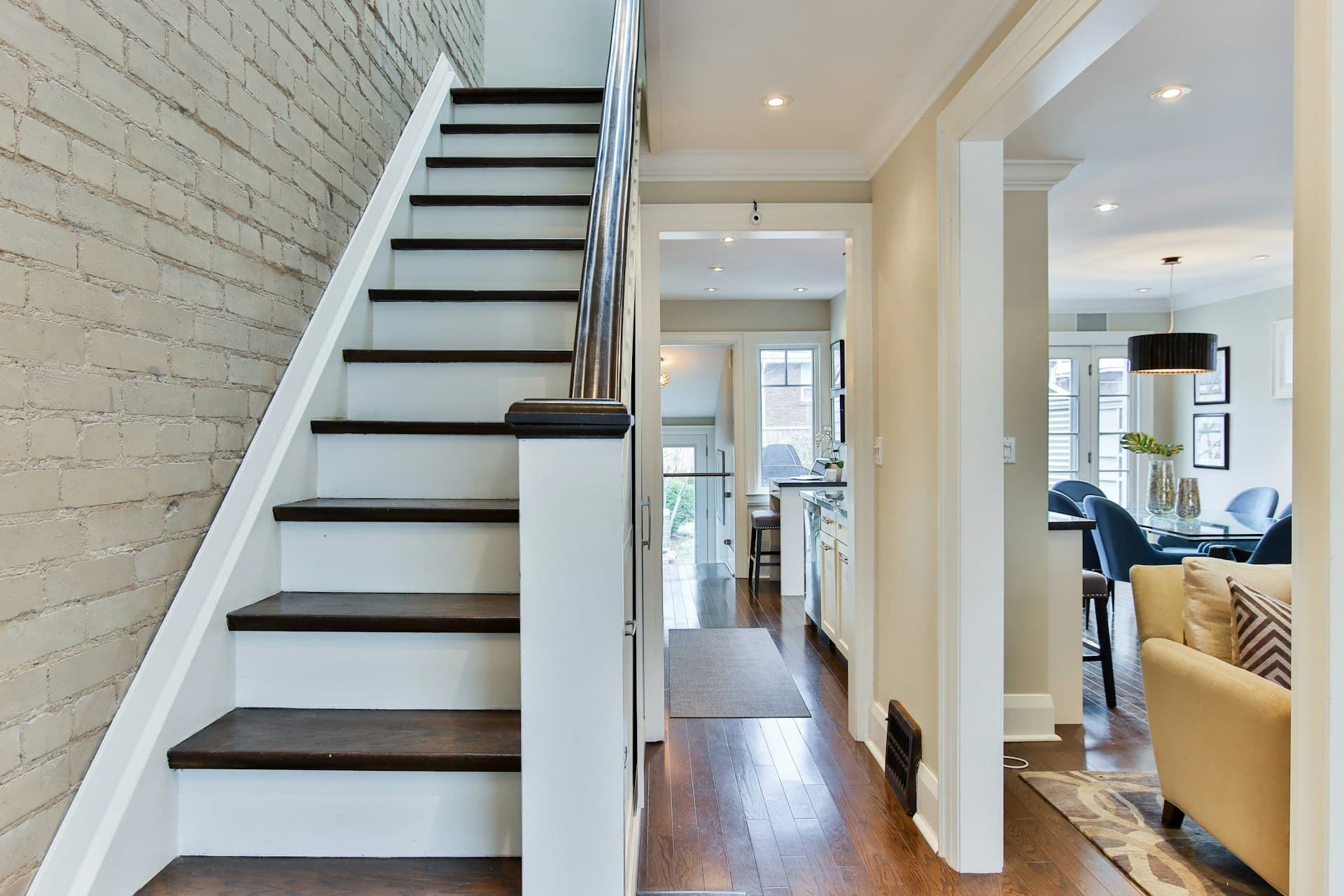
Stair Construction
Construction of internal and external timber stairs in residential buildings. Covers stringer layout and cutting, tread and riser installation, handrail and balustrade fitting, and finishing. Includes controls for falls from open stairwells (leading cause of construction fatalities), circular saw kickback during stringer cutting (47% of saw injuries per WorkSafe Victoria data), nail gun injuries (77% to apprentices per SafeWork SA), manual handling of heavy stringers, falling objects through stairwell voids, wood dust exposure, and noise from power tools. Designed to support compliance with NCC 2022 Housing Provisions Part 11.2 (Stairway and ramp construction) and AS 1684 series for the structural framing. Pre-filled hazards, controls, and risk ratings.
A building inspector running a tape over a domestic stair is checking arithmetic before they look at anything else. The National Construction Code sets rise and going limits — broadly, rise within a defined range, going within another, and a slope-relationship quantity (2R + G) within a calculated band — with strict ±5mm uniformity within a single flight. The stairs that fail certification fail it on the second-to-last riser where the carpenter ran out of stringer and "fudged it half a millimetre" across twelve steps. There is no fudging at handover.
Above the arithmetic, AS 1657:2018 covers the structural elements of fixed platforms, walkways and stairways for non-domestic work, and balustrade detailing requires baluster spacing tight enough to reject a 125mm sphere — typically 100mm or less, not "looks about right". The void during construction is the safety hazard most often missed: an open stairwell at level one is a 3-metre fall onto concrete, and the Model Code of Practice on Managing the Risk of Falls in Housing Construction requires physical fall prevention until the stair is sheeted and the balustrade is up.
Stringer cutting brings a quieter set of injuries. Circular saw kickback during plumb-line and skew cuts puts the operator's leg in the line of the blade — a riving knife, sharp blade, clamped workpiece and the saw guard never tampered with is the practical control. Wood dust during sanding falls under the SafeWork Australia softwood exposure standard and on-tool dust extraction beats sweeping at the end of the shift. Cert III in Carpentry under CPC30220 and a current White Card are the trade ticket on the job. Get the arithmetic right first; the rest of the stair is detail.
What's In Your SWMS
7 Hazards & Controls
Traumatic brain injury, spinal cord injury, multiple fractures, internal injuries, death
Use pre-fabricated stair systems to minimise on-site work at height. Complete as much assembly as possible at ground level.
Install void scaffolding or catch platforms across stairwell opening to provide working platform and fall prevention.
Install temporary guardrails (minimum 1000mm height) around stairwell perimeter before any work at height commences. Barricade and sign incomplete stairwells to restrict unauthorised access.
- Install temporary handrails (865mm above nosing) on at least one side immediately after stringers are fixed
- Use scaffold platforms with guardrails and toe boards for working within stairwell void
- Install safety mesh or solid infill panels on temporary guardrails to prevent objects and persons passing through
- Provide secured ladders or temporary stairs for safe access between levels — minimum one access point per stairwell
- Prepare SWMS addressing fall hazards before work commences — brief all workers at pre-start
- Fall protection plan required for all work at heights >2m: identify anchor points, safe work positions, rescue procedures
- Daily inspection of temporary guardrails, barriers, and access equipment before work commences
- Restrict access to incomplete stairwells — only authorised workers with fall protection training permitted
Fall arrest harness and lanyard (AS/NZS 1891) when working at heights >2m without adequate edge protection. Anchor to rated point (15kN minimum). Safety helmet (AS/NZS 1801). Safety boots with anti-slip sole (AS/NZS 2210.3).
16-Step Work Procedure
Equipment & PPE
Equipment (13)
- Circular saw with dust extraction
For stringer cutting. Sharp blade, correct for timber. Blade guard functional. Cutting guide/straight edge for controlled cuts. Anti-kickback features.
- Drop saw (compound mitre saw)
For repetitive tread, riser, and baluster cuts. Reduces kickback risk compared to circular saw. Blade guard and dust extraction required.
- Jigsaw
For completing internal corner cuts on stringers and cutting curved sections. Anti-splinter insert recommended.
- Framing nailer (pneumatic or gas)
Sequential trigger (one-shot mode) ONLY. Bump-fire mode prohibited. Daily inspection of safety mechanisms. Apprentices must use one-shot mode exclusively.
- Router with dust extraction
For profiling handrails, nosing edges, and decorative details. Guard and dust collection required.
- Cordless drill-driver and impact driver
For pre-drilling pilot holes and driving fasteners. Pre-drill all hardwood to prevent splitting.
- Orbital sander with dust extraction
For finishing treads, stringers, and handrails. HEPA-filtered dust extraction mandatory. 180-220 grit for finish work.
- Spirit level (600mm and 1200mm)
For checking stringer pitch, tread levelness, and handrail alignment. ±2mm tolerance on all measurements.
- Tape measure, combination square, and stair gauges
For accurate layout of rise and going on stringers. Stair gauges clamp to framing square for consistent marking.
- Scaffolding or mobile work platform
For safe access during upper-level stairwell work. Guardrails minimum 1000mm. Toe boards to prevent falling objects.
- Temporary guardrails and void protection
Install at stairwell perimeter before work commences. Minimum 1000mm height. Withstand 0.55kN outward force. Mesh or solid infill to prevent objects falling through.
- Clamps and work supports
For securing stringers, treads, and workpieces during cutting and assembly. F-clamps, bar clamps, and saw horses.
- HEPA vacuum / dust extraction system
Connected to power tools during cutting and sanding. HEPA filtration mandatory for hardwood dust. Empty collection bags before half full.
PPE (7)
- Safety helmet (hard hat)AS/NZS 1801:2024
Mandatory when working below others in stairwell, near falling object zones, and during stringer installation. Chin strap if fall risk present.
- Safety glasses (impact rated)AS/NZS 1337.1:2010
Mandatory during all cutting, drilling, routing, sanding, and nail gun operations. Clear lens for indoor work, tinted for outdoor.
- Hearing protection (earplugs or earmuffs)AS/NZS 1270:2002
Mandatory when operating circular saw, drop saw, router, or nail gun (85-100+ dB(A)). Class 5 earmuffs for sustained power tool use.
- P2 respiratorAS/NZS 1716:2012
Mandatory during all timber cutting and sanding operations. Hardwood WEL: 1 mg/m³, softwood WEL: 5 mg/m³. Fit-tested for each worker.
- Steel cap safety boots with anti-slip soleAS 2210.3:2019
Mandatory at all times on site. Puncture-resistant mid-sole. Anti-slip sole essential on incomplete stairs and scaffolding.
- Work gloves (leather or cut-resistant)AS/NZS 2161.3:2020
For handling rough timber, sheet materials, and sharp edges. Remove before operating rotating power tools (entanglement risk).
- High-visibility clothingAS 4602.1:2024
Required on multi-trade construction sites. Minimum Class D for daytime work.
Training & Emergency
Competency Requirements
- General Construction Induction (White Card)training
CPCCWHS1001. Mandatory for all personnel on construction sites in all Australian states.
- Certificate III in Carpentry (CPC30220)certificate
Trade-level qualification covering residential carpentry. 34 units of competency including stair construction, WHS, tool safety, structural knowledge, and measurement. 3-4 year apprenticeship.
- Working at Heights Trainingtraining
Required for all work above 2m with risk of fall. Covers hierarchy of controls, fall protection systems, harness use, and rescue procedures. Annual refresher recommended.
- Power Tool and Machinery Safety Trainingtraining
Covers circular saw, drop saw, router, jigsaw, and nail gun safe operation. Includes blade selection, guarding, kickback prevention, and dust extraction. Practical assessment required.
- Nail Gun Operation Trainingtraining
Specific training on sequential trigger (one-shot mode), safety mechanisms, jam clearing, and safe carrying procedures. Apprentices require additional supervised training.
- First Aid Certificate
HLTAID011. At least one person on site should hold current certificate. Recommended for all carpentry crews.
- Scaffold User Training
Required if accessing work via scaffolding within stairwell. Covers safe use, inspection, load limits, and access procedures.
Emergency Procedures
Fall from stairwell: Call 000 immediately. Do NOT move injured worker if spinal injury suspected. Apply first aid and maintain airway. Keep worker warm and monitored until ambulance arrives. If worker was using harness and is suspended after arrested fall, initiate rescue as soon as safely possible — suspension trauma symptoms typically develop within 5–30 minutes (industry consensus ~15 min) per ANZCOR Guideline 9.1.5. Once rescued, place worker in flat / supine position (or recovery position if unconscious and breathing); earlier advice to keep worker upright post-rescue has been retracted.
Circular saw laceration: Apply direct pressure to wound with clean dressing. If severe or finger/hand amputation, wrap severed part in moist gauze, place in sealed bag on ice, and transport with patient to hospital. Call 000.
Nail gun penetrating injury: Do NOT remove nail from wound. Stabilise nail in position to prevent further damage. Control bleeding around entry site. Call 000 or transport to emergency department immediately.
Wood dust respiratory reaction: Move worker to fresh air immediately. If breathing difficulties persist, call 000. Administer bronchodilator (asthma inhaler) if available and worker is known asthmatic.
Everything above, included in your SWMS document.
Get This TemplateWriting a SWMS from scratch?
That's 2-4 hours of research, formatting, and cross-referencing regulations.
We've done the starting work — pick your template, add your details, review.
Or just do this:
- Unlimited documents
- All 70+ templates
- Instant PDF & DOCX
- Cancel anytime
High-Risk Construction Work Categories
Under Australian WHS Regulations (291 - High Risk Construction Work), this work is classified as high-risk due to:
- Work at height (>2m) with risk of fall (Open stairwell voids present fall hazards exceeding 2m. Workers access upper levels via temporary platforms before handrails are installed. Falls from stairwells are a leading cause of construction fatalities.)
- Temporary support for structural alterations (Temporary bracing required to support stringers during construction before permanent fixings are completed. Structural collapse risk if bracing fails.)
Australian Standards Referenced
National Guidance Documents
- Safe Work Australia - Model Code of Practice: Construction Work
- Safe Work Australia - Model Code of Practice: Managing the Risk of Falls at Workplaces
- Safe Work Australia - Model Code of Practice: Managing Risks of Plant in the Workplace
- Safe Work Australia - Model Code of Practice: Hazardous Manual Tasks
Who Needs This SWMS?
This template is designed for the following trades and roles performing stair construction work.
Frequently Asked Questions
What are the NCC requirements for residential stair dimensions in Australia?
The National Construction Code (NCC) 2022 Part 3.9.1 requires: individual rise height of 130-225mm per step, going (tread depth) of 215-335mm per step, and the product of rise × going must fall between 45,000-48,000mm². All risers and goings on the same flight must be uniform within ±5mm tolerance. Minimum 2 risers and maximum 18 risers per flight.
What is the minimum handrail height for residential stairs?
Per AS 1657:2018 and NCC Part 3.9.2, handrails must be installed at minimum 865mm above the nosing line on stairs, and minimum 1000mm above floor level on landings and platforms. Handrail diameter must be 30-50mm for graspability. A transition zone is permitted between stair height (865mm) and landing height (1000mm). Handrails must extend the full length of the flight.
How do I prevent circular saw kickback when cutting stringers?
47.1% of saw injuries are caused by kickback. Prevention measures include: always clamp workpiece securely, use a cutting guide or straight edge, ensure blade is sharp and correct for timber, set blade depth to minimum (no more than 10mm below stock), never force the saw through the cut, let blade reach full speed before starting, use jigsaw for completing internal corner cuts instead of forcing circular saw, and use a drop saw for repetitive straight cuts on treads and risers.
Can apprentices use nail guns in bump-fire mode on construction sites?
No. Bump-fire mode is prohibited on construction sites. SafeWork SA data shows 77% of serious nail gun injuries over 5 years were to apprentices in residential construction. Apprentices and all workers must use sequential trigger (one-shot mode) only, where the trigger must be reset after each shot. Apprentices require additional supervision during nail gun use.
What fall protection is required for stair construction in open stairwells?
Stairwell voids exceeding 2m fall height require: temporary guardrails (minimum 1000mm) around the stairwell perimeter before work commences, toe boards (150mm) to prevent falling objects, temporary handrails on at least one side as soon as stringers are fixed, scaffold platforms with guardrails for working within the void, and fall arrest harness systems where guardrails cannot be installed. A fall protection plan and SWMS are mandatory.
What is the maximum spacing between balusters on residential stairs?
Per AS 1657:2018 and NCC Part 3.9.2, balusters must be spaced so that a 125mm sphere cannot pass through any opening when tested above the nosing line. This typically results in maximum 100mm spacing between balusters. This requirement prevents children from getting their heads trapped or falling through openings.
What wood dust exposure limits apply to stair construction?
Australian workplace exposure limits (8-hour TWA): hardwood dust 1 mg/m³, softwood dust 5 mg/m³. Wood dust exposure can cause nasal cavity cancer, sinus cancer, asthma, and COPD. Controls include HEPA-filtered dust extraction on all power tools, P2 respirators during cutting and sanding, designated cutting areas, wet cleaning or HEPA vacuuming (no dry sweeping), and limiting continuous cutting sessions to 30 minutes.
Do I need a SWMS for residential stair construction?
Yes. Residential stair construction typically qualifies as high-risk construction work (HRCW) under WHS Regulations due to the risk of falls exceeding 2m from open stairwell voids. A written SWMS must be prepared before work commences, identifying all hazards, risk ratings, and control measures. The SWMS must be available on site and all workers must be briefed before starting work.
What temporary bracing is required during stair construction?
Stringers must be temporarily braced with diagonal members after positioning and before permanent fixings are completed. Bracing must prevent lateral movement, rotation, and collapse. A competent person must verify bracing stability before workers load the stairs. Temporary bracing must be inspected daily and after any weather event or vibration that could affect stability. Do not remove bracing until all permanent connections are verified secure.
What qualifications do carpenters need for stair construction?
Minimum requirements: General Construction Induction (White Card — CPCCWHS1001) mandatory for all construction sites, Certificate III in Carpentry (CPC30220) or equivalent trade qualification, Working at Heights training for work above 2m, and power tool safety training. Additionally, nail gun operation training is required, and at least one person on site should hold a current First Aid Certificate. Apprentices require direct supervision during stair construction.
Get Your Stair Construction SWMS
Pre-filled. Risk-rated. Ready in 5 minutes.
Get Your SWMS PDFNo credit card required. First SWMS is free.
