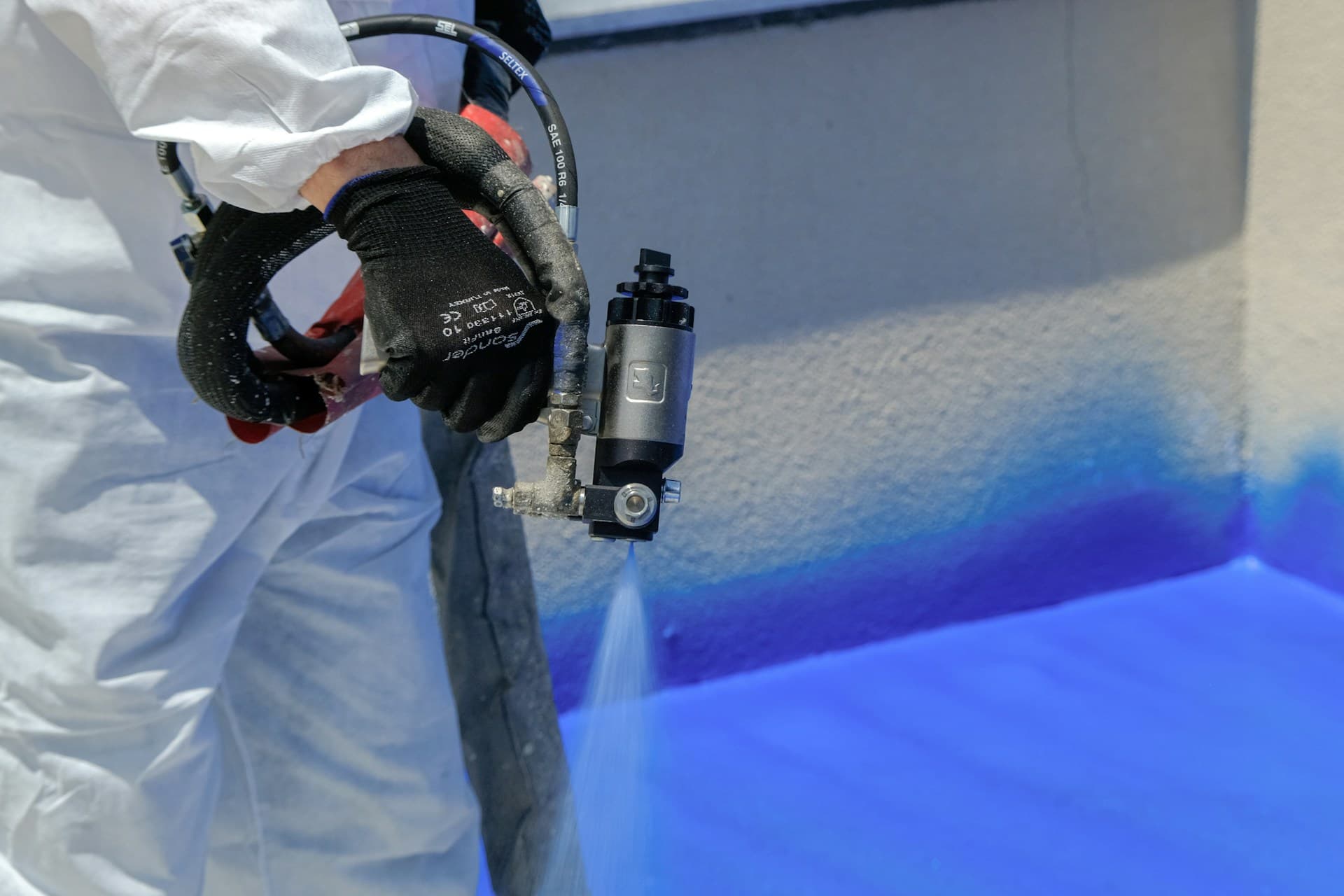
Spray Painting
Spray painting operations including airless, HVLP, and conventional spray application for residential, commercial, and industrial surfaces. Covers surface preparation, masking, spray application, and cleanup. Includes isocyanate controls for 2-pack paints and flammable atmosphere management. Pre-filled hazards, controls, and risk ratings.
Spray painting two-pack polyurethane with a cartridge respirator is the single largest health-monitoring failure in this trade. Two-pack contains isocyanates — HDI, MDI or TDI depending on the system — and isocyanates are potent respiratory sensitisers that, once a worker reacts to them, trigger severe asthma at trace exposure for life. Sensitisation is irreversible. The Model Code of Practice on Spray Painting and Powder Coating is unambiguous on this point: a supplied-air respirator is mandatory for isocyanate work, and Schedule 14 of the WHS Regulations requires statutory health monitoring (spirometry) for the operator. Sub-trades that turn up to a fit-out with cartridge masks for a 2-pack job are operating outside the law.
The second risk is injection injury. An airless spray gun runs at 1,500 to 3,500 PSI, and the entry wound when the tip contacts skin is small and looks minor — until the surgical team explains that without immediate decompression and debridement, the limb loses tissue rapidly. Trigger guards, tip guards, the safety lock engaged when not actively spraying, and a 3-metre exclusion zone are the engineering controls; a clearly-rehearsed "hospital now, this minute" response is the procedural one. The injection injury treatment window is hours, not days.
The third is the atmosphere. Solvent vapours sit at lower flammable limit thresholds within minutes in poorly-ventilated areas, and a single ignition source — a static spark, a power tool brushed against a metal surface, a smoker walking through — can take a job to a deflagration. AS/NZS 4114.1:2020 governs spray-booth design with the airflow and explosion-proof electrical requirements; AS 1940:2017 covers flammable-liquid storage on site. White Card, spray painting trade competency, Working at Heights under RIIWHS204E for elevated work, isocyanate health monitoring under Schedule 14, and current first aid make the operator side complete. Spraying from a ladder is implicitly prohibited — you can't manage hose, pressure and steady passes from one. That gets caught at audit every time.
What's In Your SWMS
7 Hazards & Controls
Occupational asthma (irreversible sensitisation), respiratory failure, skin sensitisation, dermatitis, death in extreme cases
Use single-pack water-based coatings where performance requirements allow
Substitute isocyanate-free 2-pack systems (e.g., epoxy or acrylic 2-pack) where suitable finish can be achieved
Spray isocyanate paints only in dedicated spray booth with filtered extraction per AS/NZS 4114.1:2020 + AS/NZS 4114.2:2020. Exclude all non-essential personnel from spray area.
- Supplied air respirator (positive pressure) mandatory — cartridge respirators are NOT adequate for isocyanate spray
- Local exhaust ventilation maintaining minimum 0.5 m/s airflow across spray zone
- Spray booth with filtered extraction and make-up air per AS/NZS 4114.1:2020 + AS/NZS 4114.2:2020
- Continuous air monitoring for isocyanate concentration
- Health monitoring under Schedule 14 WHS Regulation — lung function testing before exposure and at 6-monthly intervals
- Read SDS for all coating products — identify isocyanate content (Part A hardener/catalyst)
- Workers with known respiratory sensitisation must not spray isocyanate paints
- Maintain exposure register for all workers handling isocyanate products
- Post warning signs: "DANGER — Isocyanate spraying in progress — Authorised persons only"
- Minimum 30-minute re-entry time after spraying ceases (or until air monitoring confirms safe)
Supplied air respirator (AS/NZS 1716:2012 + AS/NZS 1715:2009) for spraying. Type 5/6 disposable spray suit (EN ISO 13982-1 / EN 13034) with hood. Chemical-resistant nitrile gloves (AS/NZS 2161.10.1:2024) - double gloving. No skin exposure permitted.
16-Step Work Procedure
Equipment & PPE
Equipment (10)
- Airless spray unit
Operating pressures 1,500-3,500 PSI. Fitted with trigger guard, tip guard, and safety lock. Inspect hoses and fittings before each use.
- Spray tips, guards, and filters
Correct tip size for coating type. Tip guard mandatory on airless equipment. Clean filters daily.
- High-pressure spray hoses
Rated for operating pressure. Inspect for wear, kinks, and damage before each use. Secure connections with whip checks.
- Masking tape, plastic sheeting, and paper
For overspray protection. Use flame-retardant masking material near heat sources.
- Mechanical ventilation fans and ducting
Explosion-proof fans for solvent-based spray areas. Minimum 0.5 m/s airflow across spray zone per AS/NZS 4114.1:2020.
- LEL (Lower Explosive Limit) monitor
Calibrated combustible gas detector. Continuous monitoring during spray operations. Alarm set at 10% LEL.
- Fire extinguisher (dry chemical or CO2)
Minimum 4.5kg ABE dry chemical. Within 5m of spray area. Annual service and 6-monthly inspection.
- Drop sheets and floor protection
Overspray protection for floors and adjacent surfaces. Non-slip canvas for walkways.
- Equipment cleaning solvents and waste containers
Appropriate solvent for paint system. Self-closing waste containers for contaminated rags. No open containers during spraying.
- First aid kit with eye wash station
Include sterile eye wash (minimum 500ml), burn dressings, and chemical splash treatment. Emergency shower if available.
PPE (7)
- Full-face respirator with A1B1E1K1P3 combination cartridgesAS/NZS 1716:2012 (device); AS/NZS 1715:2009 (selection/use/fit testing)
Mandatory for all spray painting. A-class (organic vapour) minimum per AS/NZS 1716 cartridge classification (A/B/E/K/Hg for gases/vapours; P1/P2/P3 for particulates - NOT N/R-series which are U.S. NIOSH or FFP-series which are European EN 149). P3 particulate filter for paint mist. Replace cartridges per manufacturer schedule or if breakthrough detected.
- Disposable spray suit (Type 5/6)AS/NZS 4501.1:2008 (selection/use); Type 5/6 performance per EN ISO 13982-1 / EN 13034 (Type 5/6 designation is from European EN ISO standards, not AS/NZS 4501)
Full body coverall with hood. Chemical splash resistant. Prevents skin absorption of isocyanates and solvents. Replace when contaminated. Note: AS/NZS 4501 is a guideline for selection/use - the Type 5/6 designation is from European EN ISO standards.
- Chemical-resistant gloves (nitrile or neoprene)AS/NZS 2161.10.1:2024 (chemical/microorganism protection - aligned to ISO 374-1:2024); AS/NZS 2161.1:2016 (general requirements). Note: previous "AS/NZS 2161.2" reference was incorrect - Part 2 covers sampling and testing methodology, not chemical resistance.
Solvent-resistant nitrile minimum. Double gloving for isocyanate paints. Check SDS for glove compatibility with coating system.
- Safety goggles (chemical splash)AS/NZS 1337.1:2010
Indirect ventilation goggles for spray mist protection. If using full-face respirator, goggles integrated.
- Safety footwear (anti-static, non-slip)AS 2210.3:2019
Anti-static soles mandatory to prevent static discharge in flammable atmosphere. Non-slip on paint-covered surfaces.
- Hearing protection (earmuffs or plugs)AS/NZS 1270:2002
Required when using compressors (85-100 dB(A)) or airless sprayers. Class 4 (SLC80 26-29 dB) or Class 5 (SLC80 ≥30 dB) for compressor operation per AS/NZS 1270 SLC80 classification.
- Head cover or hood
Disposable hood or head cover to protect hair and scalp from overspray. Integrated with spray suit where possible.
Training & Emergency
Competency Requirements
- Construction Induction Card (White Card)training
CPCCWHS1001 — mandatory for all construction site work
- Certificate III in Painting and Decorating (CPC30620)certificate
Includes CPCCPD3026A — Apply spray painting equipment. Trade qualification for professional spray painters.
- Isocyanate Awareness and Safety Trainingtraining
Mandatory for all workers handling or exposed to isocyanate-containing paints (2-pack polyurethane). Covers health effects, controls, health monitoring requirements.
- Respirator Fit Testingtraining
Quantitative fit test for all respiratory protection. Annual retesting. Workers must be clean-shaven in seal area.
- Health Monitoring (Schedule 14 — Isocyanates)
Baseline lung function test (spirometry) before exposure. Repeat at 6-monthly intervals. Required under WHS Regulation Schedule 14 for all isocyanate-exposed workers.
- Working at Heights Training
RIIWHS204E — required if spray painting from scaffold, EWP, or at heights above 2m
- First Aid Certificate (HLTAID011)
Recommended for at least one crew member. Must include injection injury awareness for airless spray operations.
Emergency Procedures
INJECTION INJURY: Apply pressure bandage. Do NOT elevate limb above heart. Transport to hospital surgical unit URGENTLY. Delay increases tissue necrosis and amputation risk. Show SDS to surgeon.
ISOCYANATE EXPOSURE (respiratory): Move to fresh air. If wheezing or breathing difficulty, call 000. Administer bronchodilator if available and trained. Worker must not return to isocyanate exposure until medically cleared.
SOLVENT SPLASH TO EYES: Immediate irrigation with clean water for minimum 20 minutes. Remove contact lenses if present. Cover eye with clean pad. Seek ophthalmology review.
FIRE IN SPRAY AREA: Activate fire alarm. Evacuate immediately. Account for all personnel at assembly point. Do NOT re-enter. Advise fire brigade of materials present (SDS sheets).
LEL ALARM ACTIVATION: Stop all spray operations immediately. Shut off spray equipment. Evacuate spray area. Increase ventilation. Do not re-enter until LEL confirmed below 5%.
Everything above, included in your SWMS document.
Get This TemplateWriting a SWMS from scratch?
That's 2-4 hours of research, formatting, and cross-referencing regulations.
We've done the starting work — pick your template, add your details, review.
Or just do this:
- Unlimited documents
- All 70+ templates
- Instant PDF & DOCX
- Cancel anytime
High-Risk Construction Work Categories
Under Australian WHS Regulations (Chapter 7 — Hazardous Chemicals; Schedule 14 — Health Monitoring; Part 6.4 — Construction Work), this work is classified as high-risk due to:
- Work involving hazardous chemicals (Spray painting generates airborne paint mist containing VOCs, isocyanates (2-pack paints), and solvents. Schedule 14 WHS Regulation requires health monitoring for isocyanate-containing paints.)
- Work in area with contaminated/flammable atmosphere (Spray painting creates flammable atmosphere from solvent vapours and paint mist. Lower Explosive Limit (LEL) monitoring required. No ignition sources within 3m of spray area.)
Australian Standards Referenced
Who Needs This SWMS?
This template is designed for the following trades and roles performing spray painting work.
Frequently Asked Questions
Do I need a SWMS for spray painting?
Yes, if spray painting on a construction site where hazardous chemicals are used, a SWMS is required under WHS Regulation. Spray painting involves hazardous chemicals (Schedule 14 chemicals including isocyanates) and may create flammable atmospheres, both of which are high-risk construction work categories.
What respiratory protection is required for spray painting?
For solvent-based spray painting: full-face respirator with organic vapour (A-class) and P3 particulate cartridges (AS/NZS 1716). For isocyanate 2-pack paints: supplied air respirator is MANDATORY — cartridge respirators are NOT adequate for isocyanate spray. All respirators must be fit-tested annually.
What is an isocyanate and why is it dangerous?
Isocyanates (HDI, MDI, TDI) are chemical hardeners/catalysts in 2-pack polyurethane paints and clear coats. They are potent respiratory sensitisers — once a worker becomes sensitised, even trace exposure triggers severe asthma attacks. Sensitisation is irreversible. Schedule 14 of WHS Regulation requires health monitoring (lung function tests) for all exposed workers.
What is a spray injection injury?
A spray injection injury occurs when an airless spray gun operating at 1,500-3,500 PSI injects paint through the skin, typically into a finger or hand. The entry wound appears minor but paint spreads through tissue causing rapid necrosis. This is a SURGICAL EMERGENCY requiring immediate hospital treatment. Delay increases the risk of amputation.
What ventilation is required for spray painting?
Spray painting requires mechanical ventilation maintaining minimum 0.5 m/s airflow across the spray zone per AS/NZS 4114. Fans must be explosion-proof when used with flammable coatings. Position air intake behind the painter and exhaust downwind of spray direction. Enclosed spray painting requires a spray booth compliant with AS/NZS 4114.1:2020 + AS/NZS 4114.2:2020.
What fire safety precautions are needed for spray painting?
Establish a 3m exclusion zone — no smoking, naked flames, or ignition sources. Use explosion-proof electrical equipment within the spray zone. Earth and bond all metal equipment. Monitor LEL continuously (alarm at 10% LEL). Keep fire extinguisher (dry chemical or CO2) within 5m. Store flammable liquids in AS 1940 compliant cabinet.
Is health monitoring required for spray painters?
Yes, if workers are exposed to isocyanate-containing paints (2-pack polyurethane), Schedule 14 of WHS Regulation requires health monitoring including baseline lung function testing (spirometry) before exposure, then at 6-monthly intervals. The employer must provide health monitoring at no cost to the worker.
What is the difference between airless, HVLP, and conventional spray?
Airless spray uses hydraulic pressure (1,500-3,500 PSI) to atomise paint — fast coverage but high overspray and injection injury risk. HVLP (High Volume Low Pressure) uses low-pressure air for gentler atomisation — less overspray, better transfer efficiency, lower hazard. Conventional air spray uses compressed air — suitable for fine finishes but moderate overspray.
Can I spray paint from a ladder?
No. Spray painting from ladders is unsafe due to restricted movement, hose management difficulties, and the need to maintain steady spray passes. Use mobile scaffold, fixed scaffold, or an EWP (elevated work platform) for spray painting at height. Fall protection (harness and lanyard per AS/NZS 1891) required above 2m without guardrails.
How should spray painting waste be disposed of?
Paint-contaminated rags must go in self-closing metal containers — they can spontaneously combust. Solvent waste, empty containers, and used filters must be collected and disposed of at a licensed waste facility. Never pour solvents down drains. Contact local council or EPA for hazardous waste collection points.
Get Your Spray Painting SWMS
Pre-filled. Risk-rated. Ready in 5 minutes.
Get Your SWMS PDFNo credit card required. First SWMS is free.
