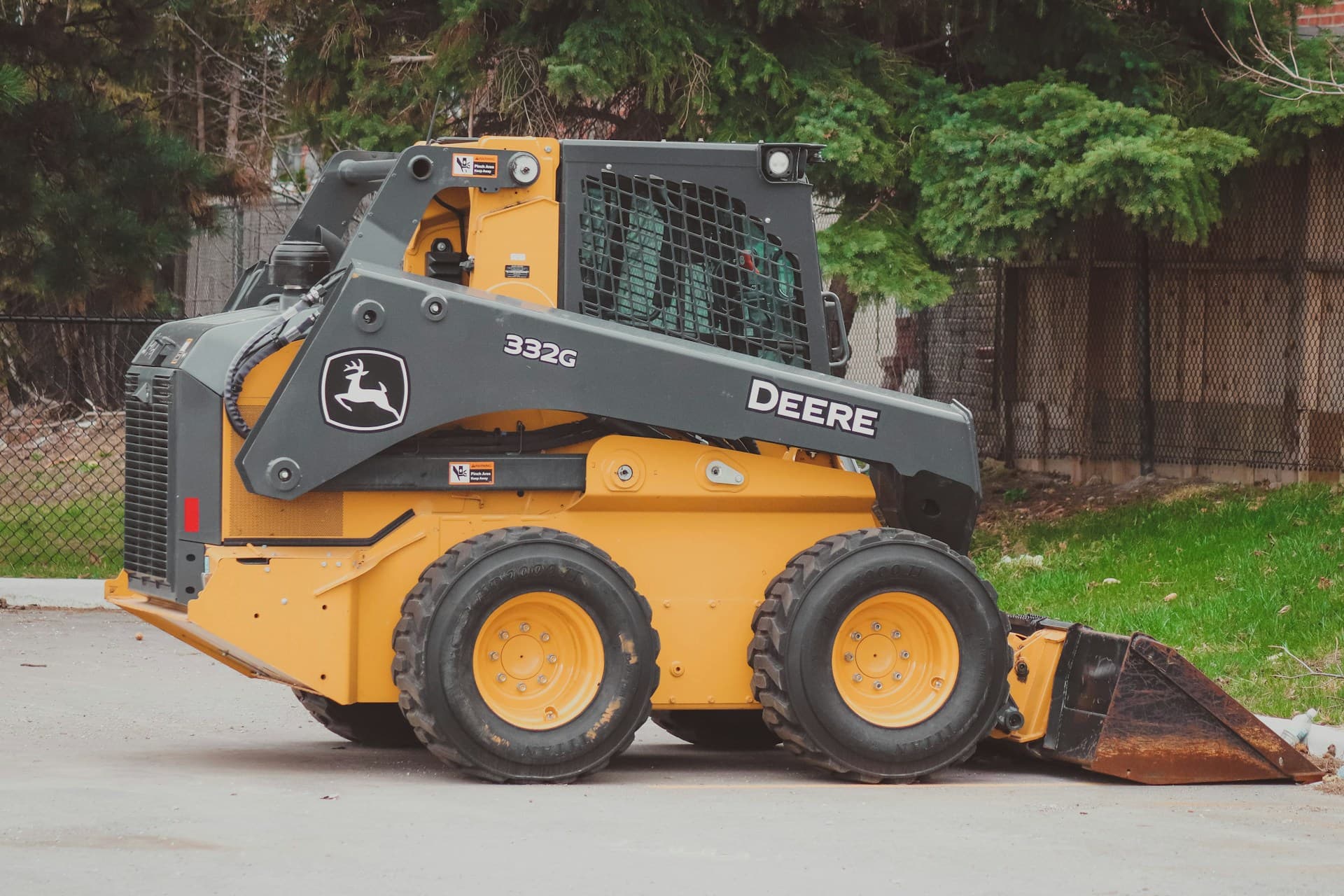
Bobcat and Skid Steer Loader Operation
Operating bobcat and skid steer loaders for loading, hauling, distributing materials, excavation, and site preparation on construction and civil sites. Covers pre-start inspections, ROPS/FOPS requirements, exclusion zones, attachment operations, and underground/overhead service hazards. Requires RIIMPO318F competency. Pre-filled hazards, controls, and risk ratings.
Two Queensland bobcat fatalities in five years happened in the same scenario: a worker entered the space under raised lifting arms while the engine was running and a hydraulic line gave way. In 2019 the operator hadn't installed a safety prop; in 2023 a second worker entered the bucket and the first dropped the arms by accident from the cab. Hydraulic safety props rated for the machine's specific arm load, fitted before any work under raised arms and never removed while a worker is in the danger zone, separate routine maintenance from the WorkSafe Queensland report. The seat-bar interlock and the seat pressure sensor that should deactivate the controls when the operator leaves the seat are the second line — daily functional test before start-up, because a stuck switch or a tampered sensor is what makes the second worker's accident possible.
The operating profile carries pedestrian and vehicle risk bobcats specifically generate. The 3-metre exclusion zone for any pedestrian around the machine — including the homeowner who wanders out of the house to talk to the operator — is the discipline most often skipped on residential and light commercial work. Spotters with two-way radios and pre-agreed hand signals matter on restricted-visibility sites; the "I'll just walk past quickly" tolerance is the failure pattern flagged in the Model Code of Practice on Managing the Risks of Plant in the Workplace. ROPS and FOPS fitted to the machine and not modified, restraint bars functional, reversing camera or mirrors used at every direction change, and the operator wearing the seatbelt are the cab-side controls that keep the rollover column off the claims register.
The site-context column runs under all of it. BYDA referrals catch underground service corridors before the bucket goes near them, and overhead powerline clearance widens with line voltage — a spotter watching the boom against the line is the discipline that prevents the strike. RIIMPO318F is the controlling unit of competency for skid-steer operation. White Card, machine-specific familiarisation, BYDA awareness and current first aid fill out the qualifications brought to the job. The operator who treats the prop, the interlock and the exclusion zone as the start of the day's work — not the items everyone races through to get the machine moving — is the one whose machine sits in the depot at knock-off.
What's In Your SWMS
7 Hazards & Controls
Crush injuries, spinal injuries, traumatic brain injury, death
Assess ground conditions and avoid operations on slopes exceeding machine rated capability
Use tracked skid steer on soft or uneven ground for improved stability
Barricade slopes and unstable areas to prevent machine access
- ROPS (Rollover Protective Structure) fitted and undamaged - mandatory
- Seatbelt functional and worn at all times - keeps operator in ROPS protection zone
- Restraint bar/seat bar interlock system functional
- Machine stability rated for intended work conditions
- Pre-start ground condition assessment before commencing work
- Reduce speed on slopes and uneven terrain
- Keep bucket/load low during travel (300mm above ground)
- Avoid sudden direction changes at speed
- Do not operate on slopes exceeding manufacturer limits
- Operator competency (RIIMPO318F) verified before operation
Seatbelt worn at all times. Hard hat when outside cabin.
14-Step Work Procedure
Equipment & PPE
Equipment (11)
- Bobcat/skid steer loader with ROPS and FOPS
Rollover Protective Structure and Falling Object Protective Structure must be factory-fitted and undamaged. Seatbelt functional.
- Bucket attachment (standard)
Rated for machine capacity. Inspect attachment pins, locking mechanisms, and hydraulic connections before use.
- Pre-start inspection checklist
Documented daily pre-start inspection form. Complete before each shift.
- BYDA (Dial Before You Dig) service plans
Current plans (within 28 days) for all underground services in work area. Must be on site.
- Barricades, safety mesh, and exclusion zone signage
For establishing 3m minimum pedestrian exclusion zone around operating machine.
- Two-way radio or communication system
For communication between operator and ground crew/spotter.
- Fire extinguisher (dry chemical)
Mounted on machine or immediately accessible. Check charge monthly.
- Spill kit
For hydraulic fluid and fuel spills. Contains absorbent pads, booms, and disposal bags.
- Traffic cones and delineators
For marking exclusion zones, travel paths, and hazard areas.
- Hydraulic safety prop/arm support
Must be installed under raised arms before any maintenance or attachment changes. Never work under unsupported arms.
- First aid kit
Include crush injury supplies, burn treatment, and eye wash.
PPE (8)
- Safety helmet (hard hat)AS/NZS 1801:2024
Required for ground crew and when outside cabin. Operator wears when exiting machine.
- High-visibility vest/shirt (Class D/N)AS 4602.1:2024
Mandatory for all personnel on site including operator when outside cabin.
- Steel cap safety bootsAS 2210.3:2019
Mandatory for all personnel. Lace-up style with ankle support.
- Safety glassesAS/NZS 1337.1:2010
Required when outside cabin and during maintenance/inspection activities.
- Hearing protection (earplugs or earmuffs)AS/NZS 1270:2002
Required when noise exceeds 85 dB(A). Skid steers operate at 80-85+ dB(A).
- Rigger glovesAS/NZS 2161.1:2016
For handling attachments, chains, and during maintenance. Remove when operating controls.
- P2 dust mask/respiratorAS/NZS 1716:2012
Required when operating in dusty conditions without enclosed cabin filtration.
- Sun protection (sunscreen, hat)
SPF 50+ sunscreen for outdoor work. Wide brim hat when not wearing hard hat.
Training & Emergency
Competency Requirements
- Construction Induction Card (White Card)training
Required for all workers on construction sites
- RIIMPO318F - Conduct Civil Construction Skid Steer Loader Operationscertificate
Nationally recognised competency unit. Statement of Attainment from accredited RTO required.
- Machine-Specific Familiarisationtraining
Operator must be familiar with the specific make and model of machine being operated, including controls and safety features.
- Underground Services Awareness (BYDA)training
Training on identifying and working near underground services. BYDA enquiry procedures.
- Work Near Overhead Powerlines Awarenesstraining
Approach distances, emergency procedures, and safety observer requirements.
- First Aid Certificate
Recommended for at least one team member on site
- Traffic Management Awareness
Required if machine operating near public roads or in shared traffic areas
Emergency Procedures
ROLLOVER: Call 000 immediately. Do not attempt to right the machine. Check operator for injuries. Do not remove operator from cabin unless immediate danger (fire, flooding). Secure area to prevent further incidents.
CRUSH INJURY (HYDRAULIC ARMS): Call 000 immediately. Do NOT attempt to move machine parts manually. If engine is accessible, attempt to lower arms using hydraulic controls. Apply tourniquets only as absolute last resort.
POWERLINE CONTACT: Operator STAY IN CABIN - do not touch any metal parts of machine. Warn all personnel to stay clear (minimum 8m). Call 000 and electricity distributor. If cabin is on fire and evacuation necessary: JUMP clear (do not step) and bunny-hop away from machine.
UNDERGROUND SERVICE STRIKE - GAS: Evacuate area immediately (minimum 100m). No ignition sources (phones, vehicles, cigarettes). Call 000 and gas authority emergency number.
UNDERGROUND SERVICE STRIKE - ELECTRICAL: Do not touch affected area. Operator stay in cabin. Evacuate all personnel. Call 000 and electricity distributor emergency number.
Everything above, included in your SWMS document.
Get This TemplateWriting a SWMS from scratch?
That's 2-4 hours of research, formatting, and cross-referencing regulations.
We've done the starting work — pick your template, add your details, review.
Or just do this:
- Unlimited documents
- All 70+ templates
- Instant PDF & DOCX
- Cancel anytime
High-Risk Construction Work Categories
Under Australian WHS Regulations (291 - High Risk Construction Work), this work is classified as high-risk due to:
- Use of powered mobile plant (Bobcat/skid steer loaders are powered mobile plant. RIIMPO318F competency required for operators.)
- Work on/near energised electrical installations (Underground electrical services and overhead powerlines present hazards during earthmoving operations.)
- Work on/near traffic or adjacent to road (Bobcat operations on construction sites may involve traffic interaction with delivery trucks and other plant.)
Australian Standards Referenced
Who Needs This SWMS?
This template is designed for the following trades and roles performing bobcat and skid steer loader operation work.
Frequently Asked Questions
What licence or competency do I need to operate a bobcat/skid steer?
Operators must hold RIIMPO318F - Conduct Civil Construction Skid Steer Loader Operations (or equivalent). This is a nationally recognised competency unit obtained from an accredited RTO. A High-Risk Work Licence is generally not required for standard operations, but from August 2025 in WA, a HRWL is required if the machine is used to suspend loads (crane use).
What is the minimum exclusion zone around an operating bobcat?
A minimum 3-metre pedestrian exclusion zone should be maintained around an operating skid steer loader. This zone should be expanded when loads are elevated, in confined spaces, or when visibility is restricted. Physical barriers, cones, and signage should mark the zone.
What pre-start checks are required for a bobcat/skid steer?
A documented daily pre-start inspection must be completed before each shift. This includes a walk-around (engine OFF) checking ROPS/FOPS, fluid levels, tracks/wheels, attachments, and safety devices. Then functional tests (engine ON) checking controls, reversing beeper, lights, park brake, and restraint bar interlock.
Why are ROPS and FOPS important on a skid steer?
ROPS (Rollover Protective Structure) protects the operator from being crushed during a rollover by creating a survival space. FOPS (Falling Object Protective Structure) protects from falling materials. Both must be factory-fitted, undamaged, and never modified. Combined with a seatbelt, ROPS significantly reduces the risk of fatal injury in a rollover.
What should I do if my bobcat contacts an overhead powerline?
STAY IN THE CABIN - do not touch any metal parts of the machine. Warn all personnel to stay at least 8 metres clear. Call 000 and the electricity distributor. If the cabin catches fire and evacuation is absolutely necessary, JUMP clear (do not step down) and bunny-hop away to avoid step potential electrocution.
Do I need BYDA plans before operating a bobcat for earthworks?
Yes. A BYDA (Before You Dig Australia) enquiry must be completed before any ground disturbance work — required before any mechanical excavation deeper than 150mm or hand excavation deeper than 300mm under NSW law (Electricity Supply (Safety and Network Management) Regulation 2014 / Gas Supply (Safety and Network Management) Regulation 2013). Lodge at least 1 business day before; allow up to 5 days for asset-owner responses. Plans must be on site, briefed to the operator, and renewed if expired before digging (validity is set per asset owner).
What is the restraint bar interlock on a skid steer?
The restraint bar (also called seat bar or safety bar) is a protective barrier that the operator lowers before operation. When connected to an interlock system, it prevents the machine controls from operating unless the bar is in the down position. This prevents unintended machine movement when the operator is entering, exiting, or not properly seated.
When must hydraulic safety props be used?
Hydraulic safety props must be installed under the raised lift arms whenever anyone needs to access the area beneath them - including for maintenance, cleaning, attachment changes, or any inspection. The engine must be OFF before installing props. Never work under unsupported hydraulic arms.
What are the main causes of bobcat/skid steer fatalities in Australia?
The main causes are crush injuries from the lift arms and frame (operator or bystander caught between moving parts), rollover incidents (especially on slopes or uneven ground), and being struck by the machine (pedestrians in blind spots). Recent Australian fatalities include a 2022 WA crush between body and arms, a 2023 QLD worker entering raised bucket, and a 2019 QLD maintenance death.
What PPE is required when operating a bobcat?
The operator must wear a seatbelt at all times in the cabin. Outside the cabin: hard hat, high-visibility clothing, steel cap safety boots, and safety glasses. Hearing protection is required when noise exceeds 85 dB(A). Ground crew require hard hat, hi-vis, steel caps, and safety glasses at minimum.
Get Your Bobcat and Skid Steer Loader Operation SWMS
Pre-filled. Risk-rated. Ready in 5 minutes.
Get Your SWMS PDFNo credit card required. First SWMS is free.
