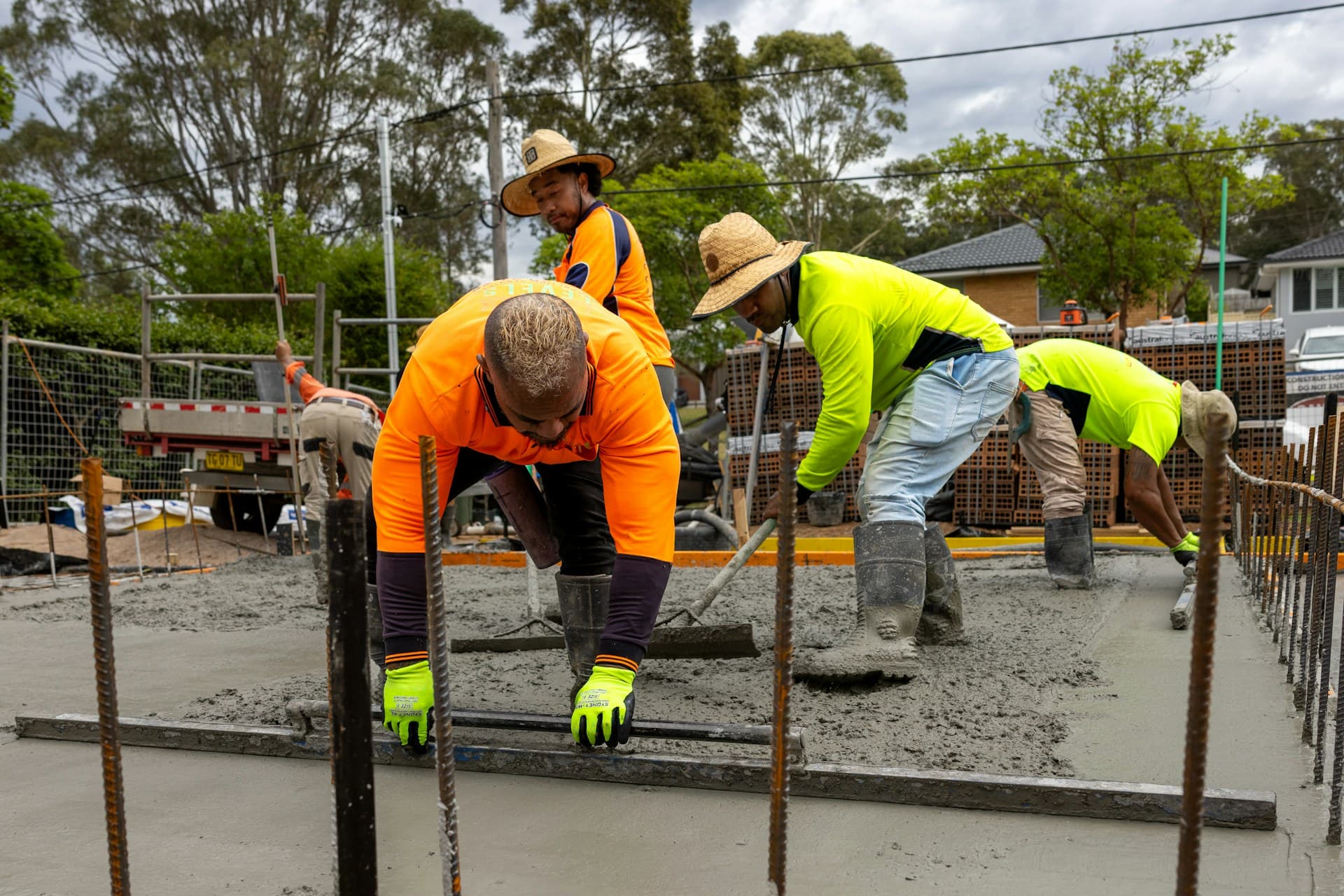
Concrete Footings Pouring
Pouring concrete into strip footings, pad footings, pier holes, and stump holes for residential and commercial foundations. Covers trench safety, formwork inspection, concrete placement, vibration compaction, and finishing. Includes work near excavations and underground services; designed to support compliance with AS 2870:2011 (residential slabs and footings) and AS 3600:2025 (concrete structures). Pre-filled hazards, controls, and risk ratings.
A concreter's knees in a freshly placed footing for half an hour absorb wet concrete at pH 12–13 through ordinary cotton drill trousers, and the chemical burn that develops over the next three to four hours doesn't read as urgent at the time — the worker feels heat, stings a bit, and keeps going because the pour timing won't wait. By the time the trousers come off back at the depot, the burn is full-thickness and the conversation is about skin grafts. Alkali-resistant nitrile or butyl gloves with cuffs taped over the sleeves, steel-cap gumboots rather than leather boots, and waterproof knee pads with chemical-resistant outer fabric are the difference between a finished pour and a hospital admission. The same chemistry runs in the eye-splash column — a 30-second emergency eye flush at the truck and an eyewash within ten metres of the pour are practical, not optional. Beyond the chemical hazard, the work runs trench collapse risk on strip and pier footings (soil at 1.5 tonnes per cubic metre, shoring or benching to AS 4744.1-2000 above 1.5m, ladder access for any trench the worker drops into), pump line surge and boom strike during placement (concrete pump operator licence required, not just plant familiarity), respirable crystalline silica from dry handling and finishing of the cured surface (WES 0.05 mg/m³, P2 minimum), and underground services strike during dowel placement or footing extension (BYDA where applicable). AS 2870-2011 covers residential slab and footing design, AS 3600:2018 the structural concrete, and AS 1379-2007 the supply and specification of concrete. Concreting competency, formwork inspection competency where the carpenters have handed over the box, concrete pump operator licence on pumped jobs, and current first aid sit beneath the operating side. The pour is uneventful when the chemistry is treated as the dominant hazard and the remaining controls are matched to the trench depth, the pump method and the formwork on site.
What's In Your SWMS
7 Hazards & Controls
Burial, suffocation, crush injuries, death. A cubic metre of soil weighs approximately 1.5 tonnes.
Design footings to minimise trench depth where engineering allows
Use bored piers instead of strip footings to reduce open trench requirements where soil conditions and design permit
Barricade trench edges with at minimum 1m setback. No spoil or materials stored within 1m of trench edge.
- Trench shoring, shielding, or battering required for trenches exceeding 1.5m depth
- Benching or battering walls to stable angle in cohesionless soils
- Dewatering pumps for waterlogged trenches
- Ladder access/egress within 9m travel distance for trenches deeper than 1m
- Competent person to inspect trench conditions before any person enters
- Reinspect trench after rain, overnight, or following any ground disturbance
- Monitor trench walls continuously during pour for signs of movement
- No person in trench during concrete placement unless absolutely necessary
- Emergency rescue plan for trench engulfment documented before work starts
- Toolbox talk on trench collapse risks before commencing
Hard hat, safety boots, high-visibility clothing when near trenches
16-Step Work Procedure
Equipment & PPE
Equipment (13)
- Concrete pump (boom or line pump)
Operated by licensed pump operator. Required for pours where truck cannot access footing directly.
- Concrete vibrator (poker/immersion type)
For compacting concrete in footings and removing air voids around reinforcement
- Concrete rakes and shovels
For spreading and distributing concrete within footing trenches
- Screed board or straightedge
For levelling concrete to formwork or peg heights
- Hand trowels and floats
For finishing top surfaces of footings and pier caps
- Laser level or dumpy level
For checking footing levels during pour and confirming finished heights
- Water hose and supply
For tool cleaning, dust suppression, and curing
- Trench shoring or support equipment
Required for trenches exceeding 1.5m depth or unstable soil. Hydraulic shores, timber shoring, or trench boxes.
- Barricades and safety mesh
For securing trench edges and preventing falls into excavations
- Two-way radio or communication system
For communication with pump operator and concrete truck driver
- Before You Dig Australia (BYDA, formerly Dial Before You Dig) service plans
Current plans for all underground services in the footing area. Must be on site.
- Ladder for trench access
Adequate length to extend 1m above trench edge. Required for trenches deeper than 1m.
- First aid kit
Include burn treatment, eye wash station, and wound dressings
PPE (8)
- Alkali-resistant gloves (nitrile or butyl rubber)AS/NZS 2161.10.1:2024 (chemical/microorganism risks); AS/NZS 2161.1:2016 (general)
Essential - wet concrete pH 12-13 causes chemical burns. Replace if torn.
- Waterproof safety boots (steel cap gumboots)AS 2210.3:2019
Essential - prevent concrete entering footwear. Steel cap for crush protection near trucks and plant.
- Safety glasses or gogglesAS/NZS 1337.1:2010
Essential - concrete splashes cause severe eye irritation and burns
- Safety helmet (hard hat)AS/NZS 1801:2024
Required when working near concrete trucks, pumps, and in trench areas
- High-visibility vest/shirtAS 4602.1:2024
Required on construction sites and near mobile plant (concrete trucks)
- Long pants and long-sleeved shirt
Minimise skin exposure to wet concrete. Tuck sleeves into gloves.
- Hearing protectionAS/NZS 1270:2002
Required when operating concrete vibrators, near pump, or near concrete trucks
- Sun protection (hat, sunscreen)
SPF 50+ sunscreen for outdoor work. Wide brim hat when not wearing hard hat.
Training & Emergency
Competency Requirements
- Construction Induction Card (White Card)training
Required for all workers on construction sites. CPCCWHS1001 - Prepare to work safely in the construction industry.
- Concreting Competencycertificate
Experience in concrete placing and finishing. Certificate III in Concreting or equivalent experience.
- Formwork Inspection Competencytraining
Competent person to inspect and sign off formwork before pour. Knowledge of AS 3610.
- Concrete Pump Operator Licencelicence
Pump operator must hold appropriate licence for boom pump operation. Line pump operator must be trained.
- Trenching and Excavation Safety Trainingtraining
All workers must understand trench collapse risks, shoring requirements, and emergency procedures
- First Aid Certificate
Recommended for at least one team member on site. Include concrete burns treatment.
- Traffic Management Awareness
Required if concrete trucks accessing public roads or pedestrian areas on site
Emergency Procedures
TRENCH COLLAPSE: Call 000 immediately. Do NOT enter collapsed trench - risk of secondary collapse. Do not attempt manual digging. Account for all workers. Keep bystanders clear. Wait for emergency services with appropriate rescue equipment.
CONCRETE BURN: Wash affected area with clean water for minimum 20 minutes. Remove contaminated clothing (cut off if stuck to skin). Cover with clean sterile dressing. Seek medical attention - burns may be deeper than they appear.
CONCRETE IN EYES: Immediately irrigate with clean water for minimum 20 minutes. Hold eyelids open. Do not rub. Cover eye with clean dressing. Seek immediate medical attention.
STRUCK BY VEHICLE/PLANT: Call 000 immediately. Do not move injured person unless in immediate danger. Secure all plant and vehicles. Clear area of non-essential personnel.
UNDERGROUND SERVICE STRIKE - GAS: Evacuate area immediately (minimum 100m). Do not use phones, vehicles, or ignition sources near leak. Call 000 and gas authority emergency number.
UNDERGROUND SERVICE STRIKE - ELECTRICAL: Do not touch affected area. Evacuate and establish exclusion zone. Call 000 and electricity distributor emergency number.
Everything above, included in your SWMS document.
Get This TemplateWriting a SWMS from scratch?
That's 2-4 hours of research, formatting, and cross-referencing regulations.
We've done the starting work — pick your template, add your details, review.
Or just do this:
- Unlimited documents
- All 70+ templates
- Instant PDF & DOCX
- Cancel anytime
High-Risk Construction Work Categories
Under Australian WHS Regulations (291 - High Risk Construction Work), this work is classified as high-risk due to:
- Work in/on trench deeper than 1.5m (Strip footings and pier holes may exceed 1.5m depth. Trench collapse risk during concrete placement.)
- Use of powered mobile plant (Concrete trucks, concrete pumps (boom or line), and excavators used during footing operations.)
- Work on/near energised electrical installations (Underground electrical services may be present near footing excavations. Before You Dig Australia (BYDA, formerly Dial Before You Dig) enquiry required.)
Australian Standards Referenced
Who Needs This SWMS?
This template is designed for the following trades and roles performing concrete footings pouring work.
Frequently Asked Questions
What are the main hazards when pouring concrete footings?
The main hazards include trench collapse (especially in sandy or waterlogged soils), concrete burns from alkaline wet concrete (pH 12-13), struck-by from concrete trucks and pump booms, manual handling injuries from heavy work in confined trenches, underground services strikes, silica dust from cutting operations, and noise/vibration from concrete vibrators.
When do footing trenches require shoring?
Under WHS Regulations, any trench deeper than 1.5m requires shoring, shielding, or battering unless a geotechnical assessment confirms the soil is stable. However, all trenches should be assessed by a competent person regardless of depth, as shallow trenches in sandy or waterlogged soil can also collapse.
Why is wet concrete dangerous to skin?
Wet concrete has a pH of 12-13 (highly alkaline) due to calcium hydroxide content. This causes severe chemical burns that may not be immediately painful. Burns can progress to third-degree within 2 hours of skin contact. Always wear alkali-resistant gloves, waterproof boots, and cover all skin.
What is BYDA and why is it required for footing work?
BYDA (Before You Dig Australia, formerly Dial Before You Dig) is a free referral service that provides plans showing the location of underground services (electrical, gas, water, telecommunications). It is a legal requirement to check for underground services before any excavation work. Over 20,000 underground utility strikes occur in Australia annually.
Can workers enter a trench during the concrete pour?
Workers should avoid entering trenches during concrete placement wherever possible. The weight of wet concrete (approximately 2.4 tonnes per cubic metre) and vibration from concrete vibrators can destabilise trench walls. If entry is necessary, the trench must be shored and a competent person must assess conditions.
What PPE is required for pouring concrete footings?
Essential PPE includes alkali-resistant gloves (nitrile or butyl rubber), waterproof safety boots with steel caps, safety glasses, hard hat near plant and trucks, high-visibility vest, and long clothing covering all skin. Add hearing protection when operating concrete vibrators and P2 respirator for any cutting operations.
What concrete standards apply to residential footings in Australia?
AS 2870:2011 (Residential Slabs and Footings) is the primary standard for residential footing design. AS 3600:2018 (Concrete Structures) covers concrete quality and placement requirements. AS 1379:2007 specifies concrete supply requirements including maximum placement temperature of 35°C.
How long should footings cure before building on them?
Concrete footings should cure for minimum 7 days under Australian conditions before any loading. Full design strength is typically achieved at 28 days. Curing should begin immediately after finishing - apply curing compound or cover with wet hessian and plastic sheeting to retain moisture.
What should you do if a trench collapses during a pour?
Call 000 immediately. Do NOT enter the collapsed trench as there is a high risk of secondary collapse. Do not attempt manual digging to rescue buried workers. Account for all workers on site. Keep bystanders clear. Wait for emergency services with appropriate technical rescue equipment.
What formwork checks are needed before pouring footings?
A competent person must inspect and sign off formwork before concrete is ordered. Checks include: formwork dimensions match engineering drawings, bracing is secure, bearing surfaces are stable, connections are tight, no damage or warping, reinforcement is correctly positioned and tied, cover blocks are in place, and formwork is clean and oiled.
Get Your Concrete Footings Pouring SWMS
Pre-filled. Risk-rated. Ready in 5 minutes.
Get Your SWMS PDFNo credit card required. First SWMS is free.
