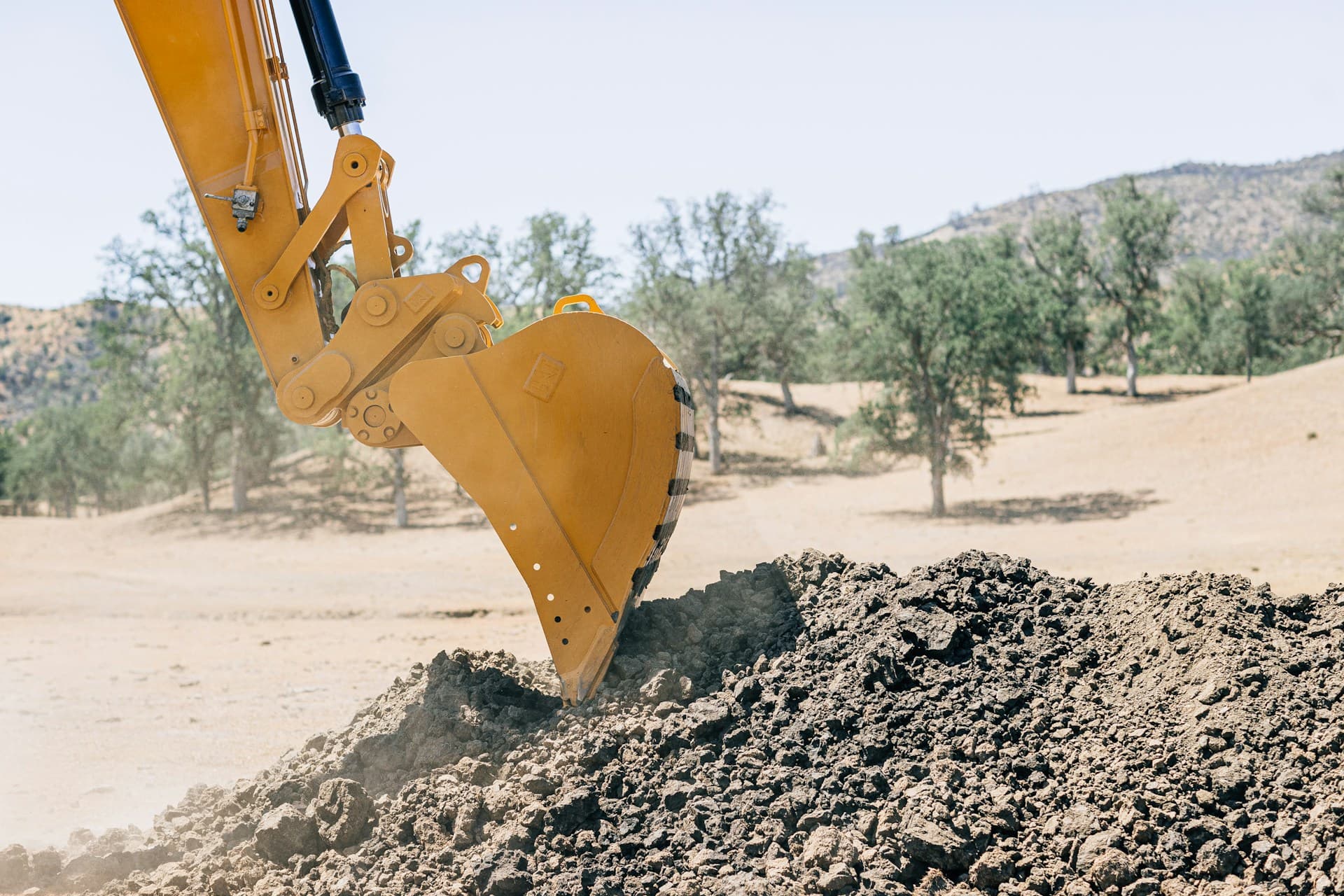
Excavator Operation
Operation of hydraulic excavators (mini 1.5T to standard 30T) for trenching, bulk excavation, site clearing, loading, and demolition on construction sites. Covers underground services strike prevention (BYDA mandatory), rollover and tip-over on slopes and soft ground, struck-by hazards from swing radius and bucket movement, overhead powerline proximity, trench collapse near excavation, quick-hitch attachment failures, and operator noise and vibration exposure. Includes pre-start inspection procedures, exclusion zone management, and spotter requirements. Pre-filled hazards, controls, and risk ratings.
A quick-hitch attachment that drops a 200kg excavator bucket onto a worker on the ground is a documented Australian fatality pattern — the locking pin not fully engaged, the visual check skipped because the operator has done the swap a hundred times, and the bucket becomes a falling object the moment the slew starts. The control set on a hitch swap reads short and gets shortened further: locking pin engaged with the secondary safety check applied, visual confirmation of the pin position from the cab, a tap-test on the bucket before any movement clears the exclusion zone, and the operator's eyes on the ground crew during the first lift. That sequence has to live on the paperwork for every machine, every operator, every shift; the single skipped visual check is where the next fatality comes from.
Around the swap moment, the broader operating profile carries the rest of the risk. Underground service strikes arrive when BYDA referrals get treated as final rather than starting points; an electromagnetic cable and pipe locator pass through the corridor before the bucket goes in is what catches the under-recorded Telstra duct or the abandoned gas service. Overhead powerline contact runs separate clearance distances that widen with line voltage, and the operator who works under a transmission line without spotter and ground mats is making the rollover/electrocution risk their problem. Lifting with the bucket pushes the SWL into HRWL Crane class once the load clears 3 tonnes; many operators don't realise their lift duty crosses that line. AS 2550.1-2011 covers crane-style use, AS 1742.3:2019 covers traffic control on road work, and RIIMPO320F covers the excavator operator licence itself. White Card, BYDA awareness, spotter training and HLTAID011 first aid back the rest of the qualifications. The operator who runs the pre-start, the BYDA verification and the hitch check before each swap is the one whose shift ends without a phone call to the boss.
What's In Your SWMS
7 Hazards & Controls
Explosion and fire (gas), electrocution and death (electrical), flooding and property damage (water), service disruption affecting hospitals and emergency services (communications)
Avoid excavation in areas with known dense underground services where alternative methods exist (e.g., directional boring, trenchless technology)
Use vacuum excavation (non-destructive digging) to expose and verify service locations before mechanical excavation
Establish 500mm minimum exclusion zone around all marked services. Hand dig only within exclusion zone.
- BYDA referral lodged minimum 1 business day before excavation (call 1100 or www.byda.com.au) — required before any mechanical excavation deeper than 150mm or hand excavation deeper than 300mm. Plan validity is set per asset owner; renew if expired before digging.
- Electromagnetic cable and pipe locator used to scan entire excavation area
- Physical service marks from utility companies verified on ground
- Ground-penetrating radar (GPR) for high-density service areas
- BYDA response plans reviewed with operator and all ground personnel before work starts
- Service locations physically marked on ground with paint and pegs
- Operator briefed on all service types, locations, and depths from BYDA plans
- Hand dig within 500mm of any marked service - no mechanical excavation
- Stop work immediately if unmarked service encountered - contact utility provider
- Emergency contact numbers for all utility providers displayed in cab and on site board
- Toolbox talk on underground services before each new excavation area
Insulated gloves if electrical cable strike suspected. Steel cap boots. Hard hat.
14-Step Work Procedure
Equipment & PPE
Equipment (11)
- Hydraulic excavator (mini to standard)
ROPS and FOPS must be fitted and maintained. Reversing camera and audible alarm operational. Fire extinguisher mounted in cab. Seatbelt functional.
- Excavator bucket (sized for machine)
Weight within machine rated capacity. Teeth in serviceable condition. Quick-hitch safety pin engaged and cotter pin fitted.
- Quick hitch (if fitted)
Safety pin MUST be engaged after every attachment change. ~50% non-compliance reported in audits. Inspect hydraulic lock cylinder daily. Never assume hydraulic lock alone will hold attachment.
- Cable and pipe locator
Electromagnetic locator for detecting underground services. Use in conjunction with BYDA plans. Scan excavation area before any digging.
- Trench shoring equipment
Trench shields, hydraulic shores, or timber shoring for trenches exceeding 1.5m depth. Must be rated for trench depth and soil type.
- Two-way radios (operator and spotter)
Clear communication between operator and spotter essential. Charged and tested before each shift. Agreed channel and call signs.
- Exclusion zone barriers and signage
High-visibility tape, star pickets, and "DANGER - EXCAVATOR OPERATING - NO ENTRY" signs. Establish before operations commence.
- Laser level or dumpy level
For establishing excavation depths and trench grades. Protect from machine vibration and accidental contact.
- Fire extinguisher (cab-mounted and ground)
Dry chemical minimum 2kg mounted in cab. Additional extinguisher at ground level for refuelling area.
- Spill kit (fuel and hydraulic oil)
For hydraulic hose burst or fuel spill. Contains absorbent pads, booms, and disposal bags. Located near machine parking area.
- First aid kit
Include wound dressings, burn treatment, eye wash, CPR face shield, and emergency blanket.
PPE (8)
- Hard hatAS/NZS 1801:2024
MANDATORY for all personnel outside cab at all times. Protects from falling objects, spoil, and overhead hazards.
- High-visibility clothing (Class D minimum)AS 4602.1:2024
Class D minimum for daytime work. Class N required for night work. All personnel within 50m of operating excavator.
- Safety footwear (steel cap, puncture-resistant sole)AS 2210.3:2019
Steel cap for crush protection. Puncture-resistant sole for debris. Slip-resistant tread for muddy conditions. Ankle support for uneven ground.
- Hearing protection (Class 5)AS/NZS 1270:2002
Required for all personnel near operating excavator if noise exceeds 85 dB(A). Operators in acoustically insulated cabs may not require if cab noise <85 dB(A).
- Safety glassesAS/NZS 1337.1:2010
Required during pre-start inspections, attachment changes, and refuelling. Protects from hydraulic fluid spray, dust, and flying debris.
- P2 dust maskAS/NZS 1716:2012
Required for ground personnel during dry excavation with visible dust. Minimum P2 rated if silica-bearing soil.
- Work gloves (mechanics style)AS/NZS 2161.1:2016
Required during pre-start inspections, quick-hitch pin engagement, attachment changes, and refuelling. Protects from sharp edges and pinch points.
- Sun protection (hat, long sleeves, sunscreen)
For ground personnel and spotter during extended outdoor work. SPF 50+ sunscreen every 2 hours. Wide-brim attachment for hard hat.
Training & Emergency
Competency Requirements
- Construction Induction Card (White Card)training
Required for all workers on construction sites. CPCWHS1001.
- Excavator Operation Competency (RIIMPO320F)certificate
Conduct Civil Construction Excavator Operations. No weight class differentiation - covers mini to standard machines. Statement of Attainment from accredited RTO. Annual VOC (Verification of Competency) recommended.
- Spotter/Observer Trainingtraining
Spotter must be competent in excavator operations, exclusion zone management, hand signals, and radio communication with operator.
- High Risk Work Licence - Crane Class (if lifting >3T SWL)
Required from 10 August 2025 when an excavator (or other earthmoving machinery) is used to suspend a load where the machinery has a Safe Working Load exceeding 3 tonnes. Per Safe Work Australia / state regulator guidance, the relevant HRWL classes are CN (non-slewing mobile crane) for non-slewing earthmoving machinery and C2 (slewing crane up to 20 tonne capacity) for slewing earthmoving machinery used to suspend loads.
- Verification of Competency (VOC) - Excavator
Annual VOC recommended by industry. Required by most major contractors and tier 1 builders. Conducted by independent assessor testing practical skills and safety knowledge.
- Traffic Management Awareness
Required if operating on or adjacent to public roads. Understanding of AS 1742.3 traffic control requirements and traffic management plans.
- First Aid Certificate
HLTAID011 Provide First Aid. Recommended for at least one team member. Critical given crush injury and electrical hazard risks.
Emergency Procedures
UNDERGROUND ELECTRICAL CABLE STRIKE: Stop machine immediately. Do NOT exit cab. Call 000 and electricity distributor. All ground personnel maintain 10m exclusion. Wait for electricity to be isolated before any person approaches machine.
GAS MAIN STRIKE: Stop machine immediately. Evacuate all personnel upwind. No ignition sources (phones, engines, switches). Call 000 and gas emergency number. Do not attempt to stop gas flow. Establish 50m exclusion zone.
EXCAVATOR ROLLOVER: If operator in cab with seatbelt - stay restrained until machine stops moving. Call for help. Do not attempt to right machine without qualified rigger and crane. Check for fuel/hydraulic leaks before approach.
PERSON STRUCK BY BUCKET/MACHINE: Call 000 immediately. Operator stops machine and shuts down. Do NOT move patient if spinal injury suspected. Control bleeding. Keep patient warm and still until paramedics arrive.
QUICK-HITCH ATTACHMENT DROP: Stop all work. Evacuate area. Inspect hitch mechanism. Do not re-attach without determining cause of failure. Report to supervisor for investigation.
Everything above, included in your SWMS document.
Get This TemplateWriting a SWMS from scratch?
That's 2-4 hours of research, formatting, and cross-referencing regulations.
We've done the starting work — pick your template, add your details, review.
Or just do this:
- Unlimited documents
- All 70+ templates
- Instant PDF & DOCX
- Cancel anytime
High-Risk Construction Work Categories
Under Australian WHS Regulations (Section 291 - High Risk Construction Work; Part 4.2 - Excavation Work; Part 5.3 - Powered Mobile Plant), this work is classified as high-risk due to:
- Involves use of powered mobile plant (Hydraulic excavator is powered mobile plant. SWMS mandatory for all excavator operations on construction sites under WHS Regulations.)
- Work in or on trench deeper than 1.5 metres (Excavation work commonly involves trenches exceeding 1.5m depth for drainage, footings, and service connections. Shoring or battering required.)
- Work on or near energised electrical installations (Underground electrical cables and overhead powerlines present electrocution risk. BYDA enquiry mandatory. Safe approach distances apply to overhead lines.)
Australian Standards Referenced
National Guidance Documents
- Safe Work Australia - Model Code of Practice: Excavation Work
- Safe Work Australia - Model Code of Practice: Managing Risks of Plant in the Workplace
- Safe Work Australia - Quick Hitches for Earthmoving Machinery Information Sheet
- Safe Work Australia - Overhead and Underground Electric Lines General Guide
- Before You Dig Australia (BYDA)
- Safe Work Australia - Model Code of Practice: Managing Noise and Preventing Hearing Loss at Work
Who Needs This SWMS?
This template is designed for the following trades and roles performing excavator operation work.
Frequently Asked Questions
Do you need a licence to operate an excavator in Australia?
There is no universal "excavator licence" in Australia. However, operators must be competent, typically demonstrated through RIIMPO320F (Conduct Civil Construction Excavator Operations) Statement of Attainment from an accredited RTO. This covers all excavator sizes from mini to standard. From 10 August 2025, a High Risk Work Licence (HRWL) is required when an excavator (or other earthmoving machinery) is used to suspend a load where the machinery has a Safe Working Load exceeding 3 tonnes — CN (non-slewing) or C2 (slewing, up to 20 tonne capacity) class. Most major contractors also require annual Verification of Competency (VOC).
Is Before You Dig Australia (BYDA) mandatory before excavation?
Yes in NSW — it is a legal requirement under the Electricity Supply (Safety and Network Management) Regulation 2014 and the Gas Supply (Safety and Network Management) Regulation 2013. In other states, it is strongly recommended and effectively mandatory through WHS obligations, SWMS requirements, and contractual conditions. BYDA enquiries must be lodged at least 1 business day before excavation. The service is free (call 1100 or visit www.byda.com.au). Mechanical excavation deeper than 150mm and hand excavation deeper than 300mm both trigger BYDA requirements (per the NSW regulations above). Plan validity is set per asset owner — renew if expired before digging.
What is the exclusion zone around an operating excavator?
The exclusion zone must cover the entire swing radius of the excavator plus a 2-3 metre safety margin. This is typically 10-12m for mini excavators, 15-18m for standard machines, and 18-25m for large excavators. The zone should be physically marked with high-visibility barrier tape and warning signs. Zero tolerance applies - no personnel inside the exclusion zone during operation. A dedicated spotter with radio communication to the operator is required.
What is a quick-hitch safety pin and why is it critical?
A quick-hitch allows rapid bucket and attachment changes on excavators. The safety pin is a physical locking pin that must be manually inserted through the hitch after every attachment change to prevent the attachment from detaching. Safe Work Australia and state regulator audits have consistently identified missing safety pins as the dominant cause of quick-hitch incidents — operators skip pin installation to save time. Multiple fatalities have resulted from attachments (300-2,000kg) dropping from unsecured hitches. The operator must personally exit the cab to install and verify the pin after every changeover.
When is trench shoring required during excavation?
Trench shoring (shields, hydraulic shores, or timber shoring) is required for all trenches exceeding 1.5m depth, which is classified as high-risk construction work under WHS Regulations. For trenches in unstable ground, written geotechnical advice is also required. Alternative methods include battering (per the Safe Work Australia Excavation Work Code of Practice, typically a maximum of 45° from horizontal without geotechnical engineer certification — steeper requires written certification) or benching. One cubic metre of soil weighs approximately 1,300-1,800kg depending on moisture and composition — trench collapse is almost always fatal.
What are the safe approach distances for overhead powerlines?
Safe approach distances depend on powerline voltage: minimum 3m for low voltage (under 1,000V), 5-10m for high voltage (1,000-100,000V), and 10m+ for extra-high voltage. The full design envelope of the excavator (maximum reach of boom + stick + bucket at all swing angles) must be calculated against powerline clearance. Wind sway and heat sag must be factored in. Contact the electricity distributor to confirm voltage before commencing work near powerlines.
When does a bucket lift cross from plant operation into HRWL crane work?
From 10 August 2025, an excavator lifting a suspended load above 3 tonnes Safe Working Load requires the operator to hold a High Risk Work Licence in the relevant crane class on top of RIIMPO320F. Below 3T SWL, the excavator competency plus the manufacturer's lift duty chart is sufficient — but the load has to be slung from a certified lifting point on the machine, not the bucket teeth. Many operators don't realise their excavator's bucket SWL exceeds 3T at short reach. Checking the load chart against the planned lift weight before slinging is what tells the operator whether the day is HRWL-class or not.
Why is a quick-hitch failure a documented Australian fatality cause?
Quick-hitch attachment failure — a 200kg+ bucket dropped onto a worker on the ground because the locking pin wasn't fully engaged — has killed multiple operators in Australia, and the failure mode is the same in nearly every case: the visual check was skipped because the operator has done the swap a hundred times. The Model Code of Practice on Managing Risks of Plant in the Workplace treats hitch swaps as a high-risk routine. Sequence: locking pin engaged with the secondary safety check applied, visual confirmation from the cab, a tap-test on the bucket before any slew, and the operator's eyes on the ground crew during the first lift. The single skipped check is what makes the next swap fatal.
What pre-start checks are required on an excavator?
A daily 10-15 minute pre-start inspection covers: fluids (oil, coolant, hydraulic, fuel levels and leaks), electrical systems (lights, reversing camera, alarms, emergency stop), tracks (tension, condition, road wheels), hydraulic controls (boom, stick, bucket, swing operation), safety equipment (seatbelt, ROPS, FOPS, fire extinguisher), and quick-hitch condition (safety pin, hitch plate, hydraulic lines). Any major defects require machine to be tagged out and not operated until repaired.
Can an excavator be used as a crane for lifting?
Yes, but with specific requirements. From 10 August 2025, operators must hold a High Risk Work Licence (HRWL) if the machinery has a Safe Working Load exceeding 3 tonnes — CN (non-slewing) for non-slewing machines or C2 (slewing, up to 20 tonne capacity) for slewing machines. The excavator must have a certified lifting point with marked load rating. Certified slings and shackles are required. A lifting plan is needed for complex lifts. No personnel are permitted under suspended loads. The machine must be on level, stable ground during lifting operations.
Get Your Excavator Operation SWMS
Pre-filled. Risk-rated. Ready in 5 minutes.
Get Your SWMS PDFNo credit card required. First SWMS is free.
