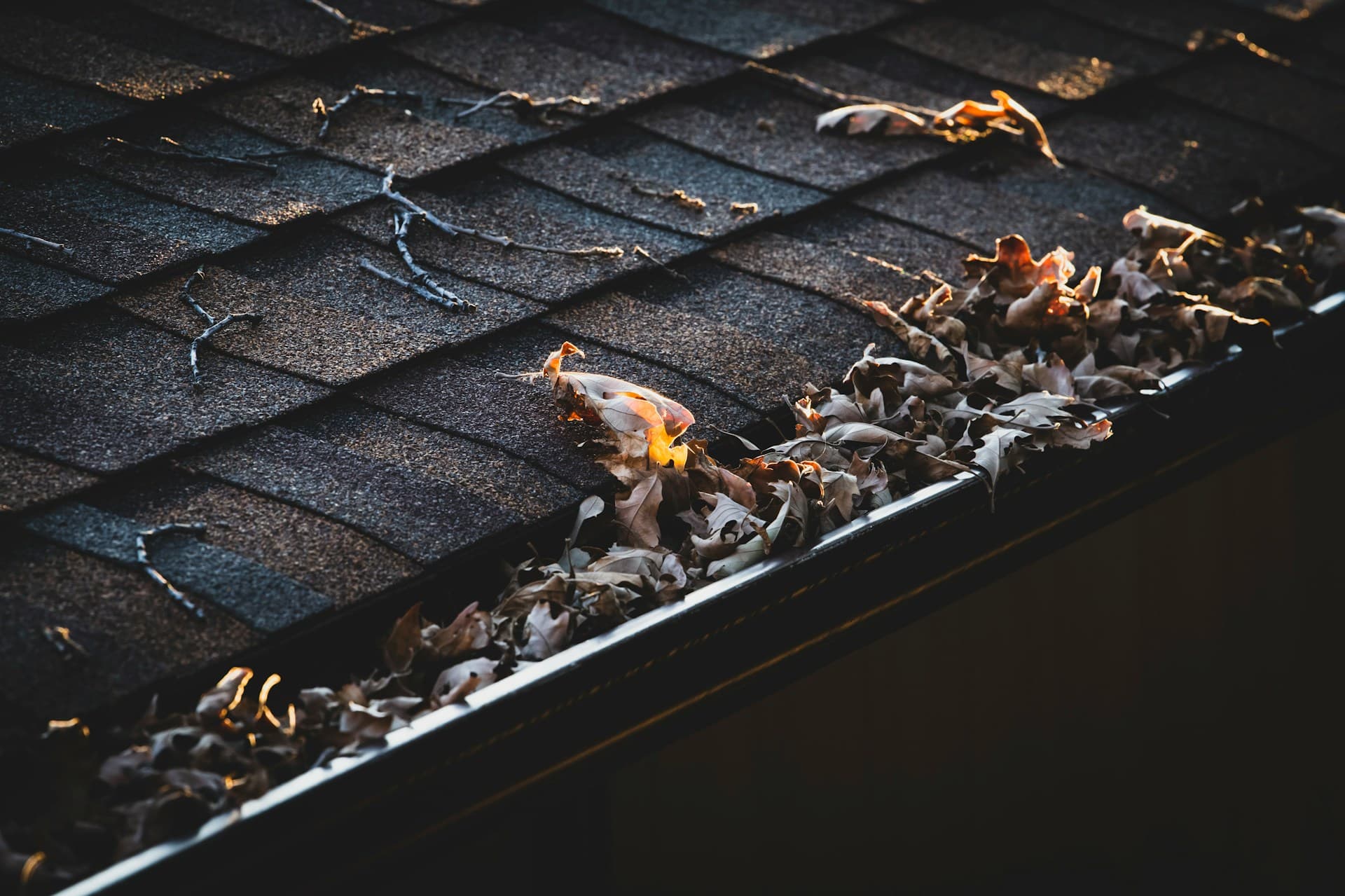
Gutter Cleaning and Roof Debris Removal
Cleaning of roof gutters, valleys, and downpipes and removal of accumulated leaf litter, silt, and debris from residential and commercial roofs. Covers ladder access and elevated work platform (EWP) use at typical single and two-storey heights (3–8 m), manual removal of debris by hand and scoop, gutter vacuum systems operated from ground level, leaf blower clearing, and downpipe flushing with garden hose. Includes controls for falls from height (29 fatalities in 2023, 45 % in construction), falls from ladders (leading cause of serious home-maintenance injury), falls through fragile roofing materials such as aged fibro-cement and polycarbonate sheeting, biological hazards from bird and possum droppings (histoplasmosis, cryptococcosis, psittacosis), mould and stagnant water (Legionella risk), lacerations from rusted metal gutter edges and sharp debris, electrical hazards from overhead power lines and rooftop solar PV systems, manual handling of heavy wet debris buckets (15–25 kg), and prolonged UV and heat exposure during outdoor roof work. Compliant with WHS Regulation 2017 Section 291, AS/NZS 1891 fall-arrest series, and Safe Work Australia Model Code of Practice for Managing the Risk of Falls at Workplaces. Pre-filled hazards, controls, and risk ratings.
Routine gutter cleaning sits at the highest fall-fatality category in residential maintenance work — usually a homeowner or small contractor on a leaning extension ladder, with no harness, on a one-hour job. The Model Code of Practice on Managing the Risk of Falls at Workplaces sets the rule cleanly: physical fall prevention or fall arrest where the work is more than 2 metres up. A ladder standoff bracket that holds the ladder off the gutter face turns a slipping side-load into a fixed contact, and a fall arrest harness to AS/NZS 1891.1:2020 clipped to a roof anchor handles the gap when the worker steps onto the roof.
Two hazards that don't read as obvious from ground level matter. The first is biological. Bird droppings carrying histoplasmosis spores, possum scat in the valleys, stagnant water in blocked downpipes harbouring Legionella — dry debris disturbed by a leaf blower puts those into the breathing zone. A P2 respirator under AS/NZS 1716:2012, nitrile gloves, and a rinse routine before lunch are the practical set, not theatre. The second is solar PV. Rooftop arrays remain live in daylight regardless of the building's main switch — DC strings sit at hundreds of volts, and a contractor leaning a metal ladder against a panel or stepping on a bracket is operating in a live circuit they can't switch off.
Asbestos-cement roof sheeting on pre-2004 buildings is fragile and walking on it is the well-known fall-through scenario. Crawl boards across the ceiling structure where the roof is sus, ladder selection to AS/NZS 1892.1:2018 (industrial rating, 120kg minimum, fibreglass for any electrical risk), and a 4:1 angle on the lean keep the ladder where it was set. White Card, Working at Heights under RIIWHS204E, asbestos awareness, and an EWP HRWL where the boom hits 11 metres carry the day. Standoff, harness, P2 — three items, one quick decision.
What's In Your SWMS
8 Hazards & Controls
Fractures, spinal cord injuries, traumatic brain injuries, death. Falls from ladders are a leading cause of serious home-maintenance injuries in Australia; thousands of ladder-related hospitalisations annually (per AIHW injury data).
Use gutter vacuum system operated from ground level, eliminating the need for ladder access entirely. Use telescoping pole tools where practicable.
Substitute ladder with elevated work platform (EWP) — scissor lift or boom lift — providing a stable guardrailed platform. Use platform ladder (A-frame with guardrails) instead of single extension ladder for stationary work.
Establish exclusion zone at base of ladder (minimum 2 m radius) to prevent interference. Barricade area below with safety cones and barrier tape.
- Industrial-rated ladder minimum 120 kg capacity compliant with AS/NZS 1892
- Ladder standoff stabiliser to prevent gutter crushing and increase lateral stability
- Non-slip rubber feet on firm level surface; use leg levellers on uneven ground
- Ladder must extend minimum 1 m above gutter line for safe transition
- Secure ladder at top with ladder brackets or have second person foot the ladder
- Pre-use ladder inspection: check rungs, locking mechanisms, feet, stiles for damage
- Maintain three points of contact at all times while climbing
- Never overreach — move ladder instead (belt buckle rule: keep navel between stiles)
- One person on ladder at a time; do not carry heavy loads while climbing
- Set ladder angle at 75° (1:4 ratio — base 1 m out for every 4 m of height)
- Working at Heights training (RIIWHS204E) mandatory for all workers
- Do not use ladders in wind gusts exceeding 35 km/h
- Never stand on top three rungs of extension ladder
Safety helmet, safety boots with slip-resistant soles, fall-arrest harness if working above 2 m without guardrailed platform
13-Step Work Procedure
Equipment & PPE
Equipment (7)
- Extension ladder (industrial rated)
Minimum 120 kg load rating; compliant with AS/NZS 1892.1 (metal) or AS/NZS 1892.5 (selection and safe use). Fibreglass preferred near electrical hazards. Must extend at least 1 m above gutter line.
- Step ladder / A-frame platform ladder
Industrial rated 120 kg minimum. Platform ladder with guardrails preferred for extended stationary work. Compliant with AS/NZS 1892 series.
- Gutter scoops and hand tools
Plastic gutter scoops (avoid metal scoops that may damage gutter lining), stiff-bristle brush, garden trowel, bucket with rope lanyard for lowering debris.
- Garden hose with adjustable high-pressure nozzle
For flushing gutters and downpipes after debris removal. Check water pressure does not damage gutter seals or connections.
- Debris collection tarp, bags, and bins
Ground-level tarp to catch falling debris; heavy-duty garden bags or wheelie bin for green waste collection and disposal.
- Ladder standoff stabiliser / gutter guard bracket
Prevents ladder from resting on and crushing gutter. Increases stability by widening base. Must be compatible with ladder model.
- First aid kit
Stocked and checked; include wound dressings for lacerations, eye wash for debris/biological splash, and antiseptic for contaminated cuts.
PPE (6)
- Safety helmet / hard hatAS/NZS 1801:2024
Mandatory for all workers on or below the roof. Protects against falling debris dislodged during cleaning and head strikes against fascia and roof edges. Type 1 minimum; Type 4 (top, front, side, back impact) recommended.
- Safety glasses — impact and UV ratedAS/NZS 1337.1:2010
Medium impact minimum. Clear lens for shaded conditions; tinted UV-rated lens for direct sun. Protects against debris, biological splash, and UV reflection from metal roofing.
- P2 disposable respiratorAS/NZS 1716:2012
Mandatory when handling dried bird/possum droppings, disturbing mould, or working with accumulated silt dust. Protects against histoplasmosis, cryptococcosis, and mould spores. Use AS/NZS 1716 P2 (Australian designation); N95 is the US NIOSH equivalent and not interchangeable for AS/NZS compliance. Fit-check each use. Upgrade to P3 half-face respirator if heavy biological contamination present.
- Heavy-duty work gloves — puncture and cut resistantAS/NZS 2161.3:2020
Minimum cut resistance Level C (EN 388). Protects against rusted metal edges, nails, sharp debris, broken tiles, and biological contaminants in gutter sludge. Nitrile-dipped palms for wet grip recommended.
- Safety boots — steel/composite toe, non-slip soleAS/NZS 2210.3:2019
Slip-resistant sole essential for wet roof surfaces and ladder rungs. Puncture-resistant mid-sole for roof work with nails and screws. Ankle support recommended for ladder climbing.
- Sun protection — SPF 50+ sunscreen, broad-brimmed hat, long sleeves
Broad-brimmed hat (7.5 cm minimum brim) compatible with hard hat or integrated sun brim attachment. SPF 50+ broad-spectrum water-resistant sunscreen reapplied every 2 hours. UPF 45+ long-sleeve shirt and long pants. Australia has the highest skin cancer rate in the world — over 200 melanomas and 34,000 non-melanomas annually from workplace UV.
Training & Emergency
Competency Requirements
- General Construction Induction (White Card)ticket
CPCCWHS1001 — Prepare to Work Safely in the Construction Industry. Mandatory for all workers performing construction work. Recognised nationally across all Australian states and territories.
- Working at Heights Trainingtraining
RIIWHS204E — Work Safely at Heights. Mandatory for all workers accessing gutters or roofs at heights exceeding 2 m. Covers fall prevention, harness use, ladder safety, and emergency rescue. Refresher recommended every 2 years.
- EWP Operator — EWPA Yellow Card
Required if operating scissor lifts, vertical lifts, or boom-type EWPs under 11 m working height. Industry licence issued by Elevated Work Platform Association (EWPA). Nationally recognised.
- High Risk Work Licence — Class WP (Boom-type EWP ≥11 m)
Required for operating boom-type EWPs with a working height of 11 m or more. Government-issued High Risk Work Licence. Renewed every 5 years.
- Asbestos Awareness Training
Recommended for all workers performing gutter cleaning on pre-2003 buildings. Enables identification of potential asbestos-containing materials. Does NOT authorise asbestos removal — licensed removalist required.
- First Aid Certificate
HLTAID011 — Provide First Aid. At least one worker on site should hold current certificate. Includes fall injury response and CPR. Recommended for all workers.
Emergency Procedures
FALL FROM HEIGHT: Call 000 immediately. Do NOT move casualty if spinal injury suspected. Keep casualty warm and still. Apply first aid for visible injuries. Clear area for paramedic access. If fall-arrest harness has arrested fall and worker is suspended: initiate rescue as soon as it is safe to do so — suspension trauma symptoms typically begin within 5–30 minutes (industry consensus ~15 minutes) per ANZCOR Guideline 9.1.5. Once rescued, place the worker in a flat / supine position (or recovery position if unconscious and breathing). Earlier advice to keep the worker upright post-rescue has been retracted by ANZCOR. Lower worker using pre-planned rescue procedure.
ELECTRICAL CONTACT: Do NOT touch casualty if still in contact with electrical source. Isolate power at main switch if safe to do so. Call 000 immediately. If casualty is clear of electrical source: check breathing and begin CPR if required. Use AED if available. Even if casualty appears uninjured, they MUST receive medical assessment — cardiac arrhythmia can develop hours after electrical shock.
ASBESTOS DISTURBANCE: STOP WORK immediately. Leave the area — do not disturb material further. Prevent other workers and bystanders from entering. Seal off area with barrier tape and signage. Do not attempt cleanup. Notify supervisor and client. Engage licensed asbestos assessor. Record names of potentially exposed workers for health monitoring.
BIOLOGICAL EXPOSURE (eyes/mouth): Flush affected area with clean water for minimum 15 minutes. If bird/bat dropping dust inhaled and respiratory symptoms develop (cough, fever, chest tightness within 1–3 weeks), seek medical attention and inform doctor of occupational exposure to bird/bat droppings.
HEAT STROKE: Remove worker from sun/heat immediately. Call 000. Move to cool shaded area. Remove outer clothing. Apply cool water or ice packs to neck, armpits, and groin. Fan the casualty. Do NOT give fluids if unconscious or confused. Monitor until paramedics arrive.
Everything above, included in your SWMS document.
Get This TemplateWriting a SWMS from scratch?
That's 2-4 hours of research, formatting, and cross-referencing regulations.
We've done the starting work — pick your template, add your details, review.
Or just do this:
- Unlimited documents
- All 70+ templates
- Instant PDF & DOCX
- Cancel anytime
High-Risk Construction Work Categories
Under Australian WHS Regulations (Section 291 — High Risk Construction Work), this work is classified as high-risk due to:
- Work at height >2m with risk of fall (Single-storey gutters typically 3–4 m above ground; two-storey 6–8 m. Falls from height caused 29 worker fatalities in Australia in 2023, with 45 % occurring in the construction industry. Gutter cleaning at any height above 2 m triggers high-risk construction work requirements under WHS Regulation 2017 s 291.)
- Work on/near energised electrical installations (Overhead power line service cables frequently run directly above or adjacent to roof gutters. Aluminium ladders and metal gutter tools can conduct electricity. Rooftop solar PV systems produce live DC voltage during daylight hours and cannot be fully isolated at the switchboard. Minimum safe approach distances apply per state Codes of Practice and network-operator no-go zones (e.g. WorkSafe Queensland Electrical Safety Code of Practice 2020; SafeWork NSW Code of Practice — Work Near Overhead Power Lines).)
- Work involving asbestos removal (Pre-2003 buildings may have asbestos-cement (fibro) gutters, downpipes, fascia, eaves linings, or roof sheeting. Disturbance during cleaning can release airborne asbestos fibres. If asbestos-containing materials (ACM) are identified, work must stop and a licensed asbestos removalist engaged. Not applicable to confirmed asbestos-free buildings.)
Australian Standards Referenced
National Guidance Documents
- Safe Work Australia — Model Code of Practice: Managing the Risk of Falls at Workplaces
- Safe Work Australia — Model Code of Practice: Preventing Falls in Housing Construction
- Safe Work Australia — Safe Work on Roofs Information Sheet
- Safe Work Australia — General Guide for Working in the Vicinity of Overhead and Underground Electric Lines
Who Needs This SWMS?
This template is designed for the following trades and roles performing gutter cleaning and roof debris removal work.
Frequently Asked Questions
Do I need a SWMS for gutter cleaning?
Yes, if the work involves a risk of falling more than 2 metres, it is classified as high-risk construction work under WHS Regulation 2017 Section 291 and a SWMS is mandatory. Most residential gutter cleaning involves working from ladders at 3–8 metres, which exceeds the 2 m threshold. Even for single-storey buildings, gutters are typically 3–4 m above ground. The only exception is gutter cleaning performed entirely from ground level using vacuum systems or telescoping pole tools where no worker is at risk of falling more than 2 m.
What is the safest method for cleaning gutters?
The safest method is using a gutter vacuum system operated from ground level, which completely eliminates the risk of falling. These systems use telescoping carbon-fibre poles with suction attachments to remove debris without anyone leaving the ground. Where ground-level methods are not practicable, an elevated work platform (EWP) with guardrails is the next safest option. Ladders should be the last resort and must only be used with proper ladder safety controls including standoff stabilisers, correct angle (75°), firm level footing, and three-point contact at all times.
What qualifications do I need for gutter cleaning?
All workers must hold a current White Card (CPCCWHS1001 — General Construction Induction). If working at heights above 2 metres (which applies to most gutter cleaning), Working at Heights training (RIIWHS204E) is also required. If using an elevated work platform, an EWPA Yellow Card is needed for machines under 11 m, or a High Risk Work Licence Class WP for boom-type EWPs 11 m or longer. Asbestos awareness training is recommended when working on pre-2003 buildings.
How do I manage asbestos risk when cleaning gutters on older buildings?
Asbestos-cement (fibro) was commonly used for gutters, downpipes, fascia, eaves, and roof sheeting in buildings constructed before December 2003. One in three Australian homes built before 1990 contains asbestos. Before commencing work: confirm the building construction date; for pre-2003 buildings, obtain the asbestos register or engage a licensed asbestos assessor to inspect. If asbestos-containing materials are identified, do not disturb them — engage a licensed asbestos removalist (Class B minimum for non-friable ACM). If you encounter suspected asbestos during work, stop immediately, leave the area, prevent others from entering, and notify the client.
What biological hazards are present in gutters?
Gutters accumulate bird and possum droppings that harbour dangerous pathogens including Histoplasma capsulatum (causing histoplasmosis lung infection), Cryptococcus neoformans (causing cryptococcal meningitis), and Chlamydia psittaci (causing psittacosis/atypical pneumonia). Blocked gutters with stagnant water can harbour Legionella bacteria and serve as mosquito breeding sites. Mould growth in damp gutter sludge releases airborne spores causing allergic respiratory reactions. Always wet down dry droppings before disturbing them, wear a P2 respirator minimum, and avoid touching your face until hands are thoroughly washed.
Can I use an aluminium ladder near power lines?
No — aluminium ladders are excellent conductors of electricity and must not be used near overhead power lines. Use a fibreglass ladder (non-conductive) when working within the vicinity of electrical hazards. Regardless of ladder material, minimum safe approach distances must be maintained at all times: 1.0 m for insulated low-voltage service lines, 3.0 m for bare low-voltage lines, and greater distances for high-voltage as specified in AS/NZS 4853. If the gutter is directly below or adjacent to the power line service entry, contact the electricity distributor to arrange insulation or isolation of the line before work commences.
What PPE is required for gutter cleaning?
Essential PPE includes: safety helmet (AS/NZS 1801), safety glasses with impact and UV rating (AS/NZS 1337.1), P2 respirator for biological hazards (AS/NZS 1716), heavy-duty cut-resistant gloves minimum Level C (AS/NZS 2161.3), and safety boots with non-slip soles (AS/NZS 2210.3). Sun protection is also essential: SPF 50+ sunscreen, broad-brimmed hat, and UPF 45+ long-sleeve shirt. A full-body fall-arrest harness (AS/NZS 1891.1) is required when working at heights above 2 m without guardrailed platforms. Hearing protection (AS/NZS 1270) is required when using leaf blowers or gutter vacuum systems.
What should I do if a worker falls from a ladder during gutter cleaning?
Call 000 immediately. Do NOT move the casualty unless they are in immediate danger — suspect spinal injury until medically assessed. Keep the casualty warm and still. Apply first aid for any visible bleeding or injuries. Clear the area for paramedic access. If the worker is wearing a fall-arrest harness and is suspended after an arrested fall, rescue must be initiated within 6 minutes to prevent suspension trauma (blood pooling in the legs). Follow your pre-planned rescue procedure to lower the worker to the ground in a controlled manner.
How often should gutters be cleaned professionally?
Most Australian homes require gutter cleaning at least twice per year — typically in late autumn after leaf fall and in spring before the storm season. Properties surrounded by trees (particularly eucalyptus, pine, and deciduous species) may require quarterly cleaning. Commercial properties should follow their maintenance schedule, often quarterly or as specified in building management plans. Blocked gutters cause water damage to fascia, eaves, and foundations, and create biological hazards from stagnant water.
Do I need to check for solar panels before cleaning gutters?
Yes. Rooftop solar PV systems produce live DC voltage during daylight hours and cannot be fully isolated at the household switchboard. Before cleaning gutters on buildings with solar installations: identify the location of all panels, mounting rails, and DC cabling runs on the roof; do not walk on, lean ladders against, or place tools on solar panels; do not disturb, step on, or damage DC cabling; maintain clearance from panel edges and junction boxes. If panels extend to the gutter edge, you may need to clean from an EWP positioned to avoid contact with the system, or consult the solar installer about safe access.
Get Your Gutter Cleaning and Roof Debris Removal SWMS
Pre-filled. Risk-rated. Ready in 5 minutes.
Get Your SWMS PDFNo credit card required. First SWMS is free.
