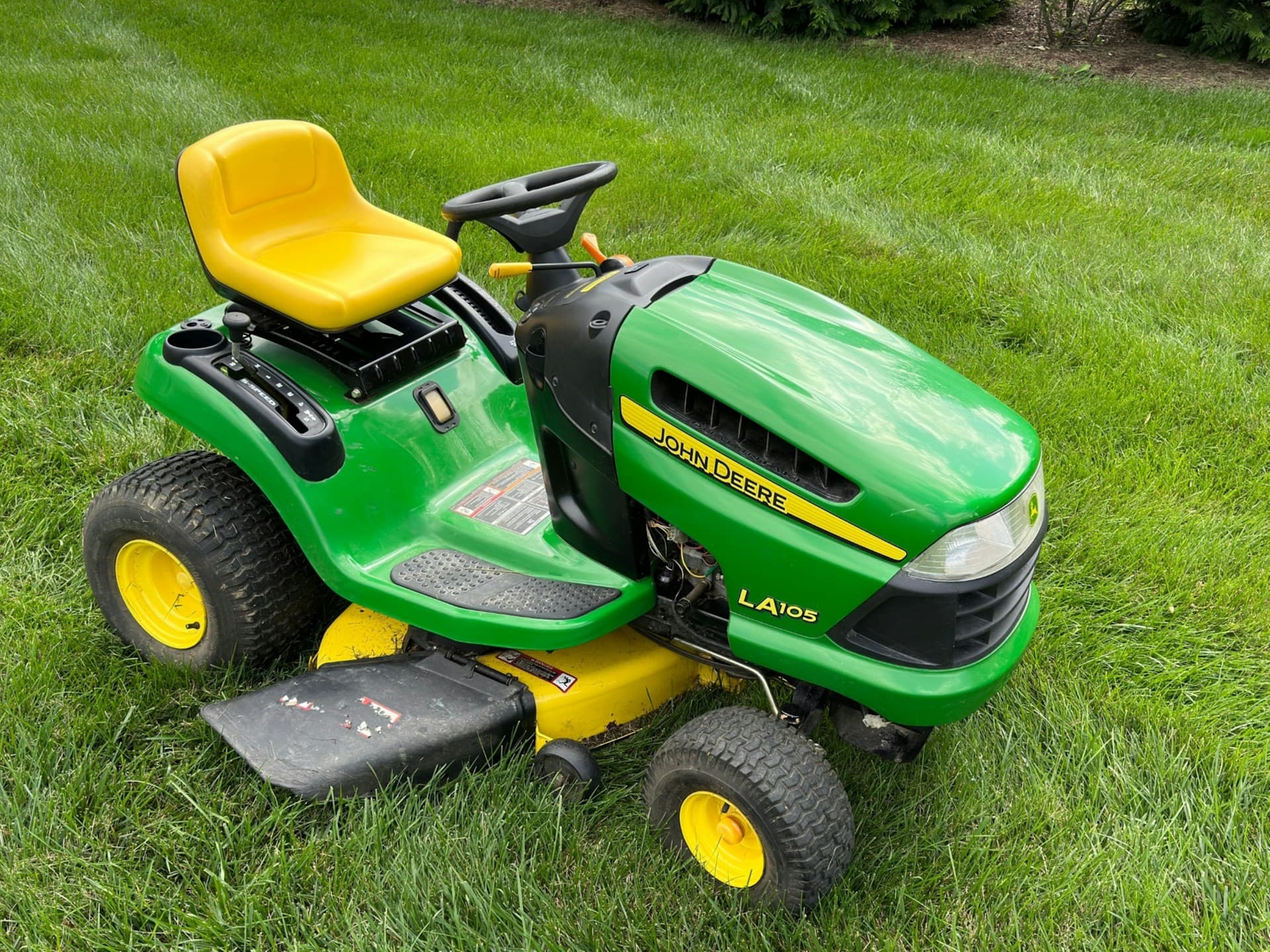
Lawn Mowing — Ride-On Mower
Commercial and residential lawn mowing using ride-on rotary mowers (including zero-turn mowers) for large properties, sports grounds, council parks, and commercial estates. Covers rollover hazards on slopes (the leading cause of ride-on mower fatalities — approximately 2 deaths per year in Australia), run-over injuries from reversing (especially children), power take-off (PTO) entanglement, projectile debris ejection at up to 300 km/h, blade engagement and contact injuries, noise exposure (90–100 dB(A)), whole-body vibration from extended operation, fuel handling for larger tank capacities, UV and heat stress during full-day outdoor work, and operation near embankments, ditches, and retaining walls. Ride-on mower injuries have a hospitalisation rate of 40 % — nearly double the rate for other garden equipment. Zero-turn mowers pose specific backflip risk on uphill slopes due to short wheelbase, rear-mounted engine, and two-wheel drive configuration. Compliant with AS 3792.1, AS 4024 series, and Safe Work Australia Model Code of Practice for Managing Risks of Plant in the Workplace. Pre-filled hazards, controls, and risk ratings.
Ride-on mower fatalities in Australia run at roughly two a year, and the mechanism in nearly all of them is rollover — typically on a slope steeper than the operator estimated, or a zero-turn whose short wheelbase and rear-mounted engine flips backward on an uphill leg. ROPS (Roll-Over Protective Structures) are the engineering control that turns rollover into a survivable event; deployed and the seatbelt fastened on a slope, the operator stays within the cage. Counter-intuitively, the seatbelt is mandatory only when ROPS is up — wearing it with ROPS lowered prevents jumping clear and increases the fatality risk. The Model Code of Practice on Managing Risks of Plant in the Workplace drives the broader frame.
Run-over of bystanders is the second mechanism, particularly on commercial parks and council mowing where children and pedestrians are present. Operator presence control (the engine stops when the operator leaves the seat), the reverse-mowing lockout, and a 1.5-metre setback from any embankment edge limit the most documented incidents. The 15-metre projectile exclusion zone applies to a wider 42-to-72-inch deck the same way it does to a push mower, with concomitantly worse public-liability outcomes when the spotter wasn't watching.
PTO entanglement at 540 to 1,000 RPM is the maintenance-moment hazard. Engine off, key removed, and the deck dropped or supported on a hydraulic prop before any worker reaches into the moving-parts envelope. Hot exhaust on dry stubble starts grass fires; an ABE dry-chemical extinguisher in arm's reach of the operator is the practical control. Hearing protection to AS/NZS 1270:2002 on machines running 90-100 dB(A); whole-body vibration mitigation with a suspension seat and a 2-hour continuous-operation cap. White Card on construction sites only, traffic management awareness for verge mowing, manufacturer familiarisation on the specific machine, and current first aid round out the qualifications. ROPS up, slope under the limit, no children within sight before the deck engages — three reads before the throttle goes wide.
What's In Your SWMS
7 Hazards & Controls
Death from crushing, traumatic head and spinal injuries, multiple fractures, internal organ injuries. Without ROPS and seatbelt, operator is ejected and crushed beneath overturned mower.
Do not mow slopes exceeding manufacturer's maximum specified gradient (typically 15° for ride-on, 10° for zero-turn). Use push mower, line trimmer, or dedicated slope mower for steep areas.
Use mower models fitted with ROPS as standard. Substitute zero-turn mowers with wider-wheelbase conventional ride-on on sloped properties. Use geo-fencing technology to prevent mower accessing identified steep zones.
Mark all no-go zones with cones, flags, or safety tape before mowing commences — steep slopes, embankments, ditches, retaining wall edges, soft ground.
- ROPS fitted and in raised position at all times during operation (mandatory for zero-turn >400 kg, non-zero-turn >600 kg)
- Seatbelt worn at all times when ROPS is raised — keeps operator in protective zone
- Sequential interlocked seatbelt system (mower will not start without seatbelt, shuts down if removed)
- Tyres maintained at manufacturer-specified pressure for maximum traction and stability
- Brakes and steering maintained in good working order per manufacturer schedule
- Low centre of gravity — do not add aftermarket accessories that raise centre of gravity
- Pre-start ground condition inspection: identify slopes, embankments, ditches, soft ground, wet areas
- Mark no-go zones before mowing — steep slopes and edges cut with line trimmer instead
- Do not operate ride-on mower within 1.5 m (5 ft) of unprotected edges of embankments, retaining walls, ditches, or culverts
- Mow across slopes (side-to-side) with conventional ride-on; mow up and down with zero-turn (manufacturer-specific — check manual)
- Reduce speed when travelling downhill or around sharp corners
- Do not mow wet grass — reduced traction increases rollover risk on slopes
- Never turn sharply on slopes — use wide gradual turns
- Operator training specific to mower model and slope operation
- Brief all operators on rollover emergency procedure: do not jump off — stay seated with seatbelt, ROPS protects
Seatbelt mandatory with ROPS raised; safety helmet recommended on ROPS-equipped mowers; safety boots; safety glasses
12-Step Work Procedure
Equipment & PPE
Equipment (9)
- Ride-on rotary mower (conventional or zero-turn)
Pre-start inspection mandatory: ROPS condition and security (if fitted), seatbelt function, blade engagement mechanism, brakes, steering, tyre pressure and tread, oil and fuel levels, PTO guards intact, all safety interlocks operational. Must comply with AS 3792.1.
- Line trimmer / whipper snipper
For areas inaccessible to ride-on: fence lines, garden edges, around obstacles, near embankments. Guard must be intact. 15 m debris exclusion zone.
- Leaf blower (backpack)
For post-mow cleanup of paths, driveways, and hard surfaces. Noise 85–100 dB(A) — hearing protection required.
- Approved fuel containers (AS/NZS 2906:2001 compliant)
AS/NZS 2906:2001 - Fuel containers - Portable - Plastics and metal. Metal or approved plastic safety containers with self-closing lids. Maximum 25 L per portable container. Carry spill containment kit. Larger ride-on fuel tanks (10–30 L capacity) require careful refuelling procedures.
- Plant trailer with ramps for mower transport
Rated for mower weight. Ramps rated for wheel loading. Mower secured with ratchet straps during transport. Trailer compliant with state registration requirements.
- Fire extinguisher — ABE dry chemical
Mounted on vehicle or trailer. For fuel fires and grass fires ignited by mower exhaust or sparks from blade contact with rocks. Check service date current.
- Hazard markers — cones, safety tape, flags
For marking no-go zones (steep slopes, embankments, soft ground, hidden hazards). Essential for pre-mow hazard identification.
- First aid kit
Stocked and checked. Must include pressure bandages for crush and laceration injuries, burns dressings, eye wash, and snake bite compression bandages.
- Two-way radio or mobile phone
Essential for communication between ride-on operator and ground crew, especially on large properties where visual contact may be lost.
PPE (8)
- Safety glasses — high impact ratedAS/NZS 1337.1:2010
High impact minimum. Full wrap-around style to prevent lateral debris entry. Tinted for UV protection outdoors. Mandatory during all mowing operation.
- Hearing protection — earmuffsAS/NZS 1270:2002
Class 4–5 earmuffs recommended for ride-on mowers (90–100 dB(A)). At 95 dB(A), maximum exposure without protection is approximately 47 minutes. Full-day ride-on operation requires hearing protection for entire duration.
- Safety boots — steel/composite toe, non-slip soleAS 2210.3:2019
Steel or composite toe mandatory. Non-slip sole for dismounting on wet grass and slopes. Enclosed ankle support. Must be worn at all times including when seated on mower. AS 2210.3:2019 is the Australian-only re-designation (supersedes the joint AS/NZS form).
- Seatbelt — worn at all times when ROPS fitted
MANDATORY when ride-on mower is fitted with ROPS in the raised position. Seatbelt keeps operator within the protective zone during rollover. Some mowers have sequential interlocked seatbelts that prevent starting without seatbelt engagement. Never wear seatbelt if ROPS is lowered or absent — risk of being trapped under mower in rollover.
- Sun protection — SPF 50+ sunscreen, broad-brimmed hat, long sleeves
Essential for full-day outdoor operation. SPF 50+ applied 20 minutes before exposure, reapplied every 2 hours. Broad-brimmed hat compatible with hearing protection. UPF 45+ long-sleeve shirt. Light-coloured breathable fabrics to manage heat during seated operation.
- High-visibility clothingAS 4602.1:2024
Required when operating near roadways, car parks, shared spaces, or on construction sites. AS 4602.1:2024 (Australian-only re-designation; supersedes AS/NZS 4602.1:2011) covers garments for high-risk applications; AS/NZS 1906.4:2023 covers the retro-reflective and fluorescent material requirements. Class D minimum for daytime; Class D/N for combined day/night use. Flashing amber beacon on mower recommended for roadside work.
- Work gloves — vibration-dampeningAS/NZS 2161.3:2020
Anti-vibration gloves for extended ride-on operation. Provides grip on steering controls. Remove during refuelling for dexterity.
- Long pants — heavy-duty work trousers
Protects legs from projectile debris, UV, and contact with hot engine components. Close-fitting — avoid loose clothing near PTO and moving parts.
Training & Emergency
Competency Requirements
- Ride-On Mower Operation Trainingtraining
Model-specific training covering: pre-start inspection, safe starting/shutdown, ROPS and seatbelt use, slope limits and techniques, reversing procedures, blade engagement, PTO safety, emergency procedures. Training must cover zero-turn specific hazards if operating zero-turn mowers. Training records maintained by PCBU.
- General Construction Induction (White Card)
CPCCWHS1001 — Required only when operating on active construction sites.
- First Aid Certificate
HLTAID011 — At least one worker in crew should hold current certificate. Essential for responding to rollover, run-over, and entanglement injuries.
- Traffic Management / Traffic Controller
Required when mowing road verges, median strips, or operating near active traffic. Traffic controller ticket or traffic management plan may be required by council or road authority.
Emergency Procedures
MOWER ROLLOVER: Call 000 immediately. Do NOT attempt to right the mower with person trapped underneath — wait for emergency services. If operator is clear of mower: do not move if spinal injury suspected, keep warm and still, apply first aid. Shut off fuel supply if accessible to prevent fire. Turn off ignition if accessible.
RUN-OVER INJURY: Call 000 immediately. Do NOT move the mower off the victim unless engine is off and blades stopped — risk of further blade contact. Apply direct pressure to bleeding. Keep victim still and warm. Do NOT remove embedded objects.
PTO ENTANGLEMENT: STOP ENGINE IMMEDIATELY — do NOT attempt to reverse the entanglement. Call 000. If clothing is wrapped around shaft, cut clothing free if possible without moving the victim. Do NOT attempt to rotate shaft backwards to unwrap. Keep victim calm and still.
BLADE CONTACT / AMPUTATION: Stop engine immediately. Apply direct pressure with clean cloth. Elevate limb. Call 000. For amputations: wrap severed part in damp cloth, seal in plastic bag, place on ice — transport with patient.
HEAT STROKE: Remove from sun immediately. Call 000. Cool with water/ice packs to neck, armpits, groin. Do NOT give fluids if unconscious.
MOWER FIRE: Dismount immediately. Do not attempt to fight fire if spreading. Call 000. Move at least 30 m away from burning mower (fuel explosion risk).
Everything above, included in your SWMS document.
Get This TemplateWriting a SWMS from scratch?
That's 2-4 hours of research, formatting, and cross-referencing regulations.
We've done the starting work — pick your template, add your details, review.
Or just do this:
- Unlimited documents
- All 70+ templates
- Instant PDF & DOCX
- Cancel anytime
High-Risk Construction Work Categories
Under Australian WHS Regulations (WHS Act 2011 Sections 19-22 (general duties); WHS Reg Chapter 5 Part 5.1 - Plant; WHS Reg Chapter 6 Part 6.1 - Construction Work, Reg 291 - High Risk Construction Work (applicable when mowing on or adjacent to active roadways or on construction sites)), this work is classified as high-risk due to:
- Use of powered mobile plant (Ride-on mowers are powered mobile plant under WHS regulations. Machines weigh 150–600+ kg with rotating blades at 3,000+ RPM. Zero-turn mowers exceeding 400 kg and non-zero-turn mowers exceeding 600 kg require roll-over protective structures (ROPS). Rollover is the leading cause of ride-on mower fatalities.)
- Work on/near traffic or adjacent to road (Applicable when mowing road verges, median strips, nature strips, or transitioning between properties via public roads. Ride-on mowers operating on or crossing roadways require traffic management. Hi-vis clothing and flashing beacons required.)
Australian Standards Referenced
Who Needs This SWMS?
This template is designed for the following trades and roles performing lawn mowing — ride-on mower work.
Frequently Asked Questions
What is the maximum safe slope for a ride-on mower?
The maximum safe slope for most ride-on mowers is 15 degrees (approximately 27 % grade). Some manufacturers specify lower limits — always check your specific mower's manual. Zero-turn mowers are generally limited to 10–15 degrees due to their short wheelbase and rear-mounted engine, which increases backflip risk on uphill grades. Never mow wet slopes with a ride-on mower — reduced traction significantly increases rollover risk. Slopes exceeding your mower's limit should be maintained with a push mower, line trimmer, or dedicated slope mower.
When is a ROPS required on a ride-on mower?
Under Australian WHS regulations, roll-over protective structures (ROPS) are required on zero-turn mowers weighing over 400 kg and non-zero-turn ride-on mowers weighing over 600 kg. However, ROPS is strongly recommended on all ride-on mowers used on properties with any slopes, embankments, or uneven terrain, regardless of weight. When ROPS is fitted and in the raised position, the operator MUST wear the seatbelt — the seatbelt keeps the operator within the protective zone during a rollover. Never wear a seatbelt if the ROPS is lowered or absent, as this prevents the operator from jumping clear.
Are children allowed on ride-on mowers?
No. Children under 16 years old must not operate a ride-on lawn mower. Children must never be carried as passengers on ride-on mowers under any circumstances — there is no safe way to carry a passenger. Ride-on mower injuries in children have a 40 % hospitalisation rate, with 38 % of injuries requiring amputation. Children are also at extreme risk of run-over injuries when playing near operating ride-on mowers. All children and bystanders must be cleared from the mowing area before operations commence.
What are the specific hazards of zero-turn mowers?
Zero-turn mowers pose unique hazards compared to conventional ride-on mowers: (1) Backflip risk — the short wheelbase, rear-mounted engine, and torque applied to rear wheels can cause the mower to flip backwards when driving up steep slopes; (2) Reduced traction — two-wheel drive provides less grip than four-wheel drive ride-on mowers, increasing slide risk on slopes and wet grass; (3) Rapid reversing — lap-bar steering allows very quick reverse movements, increasing run-over risk if the operator is not vigilant about checking behind; (4) Lower ROPS threshold — zero-turn mowers require ROPS at 400 kg compared to 600 kg for conventional ride-on mowers.
How do I manage noise and vibration during all-day ride-on mower operation?
Ride-on mowers produce 90–100 dB(A) — at 95 dB(A), unprotected exposure causes hearing damage in under 1 hour. Hearing protection (Class 4–5 earmuffs) must be worn for the entire duration of operation. For vibration management: use a mower with a suspension seat, limit continuous operation to 2-hour blocks with 15-minute rest breaks, maintain tyres at correct pressure, keep mowing paths smooth, and rotate operators between ride-on and ground duties. Annual hearing checks are recommended for regular operators.
What pre-start checks are required for ride-on mowers?
A comprehensive pre-start inspection must be completed before each use: ROPS condition (no dents, drill holes, cuts, or welds), seatbelt function and security, brake operation, steering response, tyre pressure and tread condition, engine oil and fuel levels, all guards intact (PTO shaft, drive belts, blade deck), blade engagement mechanism, operator presence control (engine stops when operator leaves seat), and reverse mowing lockout function. Any non-functional safety system must be reported and repaired before the mower is operated.
Get Your Lawn Mowing — Ride-On Mower SWMS
Pre-filled. Risk-rated. Ready in 5 minutes.
Get Your SWMS PDFNo credit card required. First SWMS is free.
