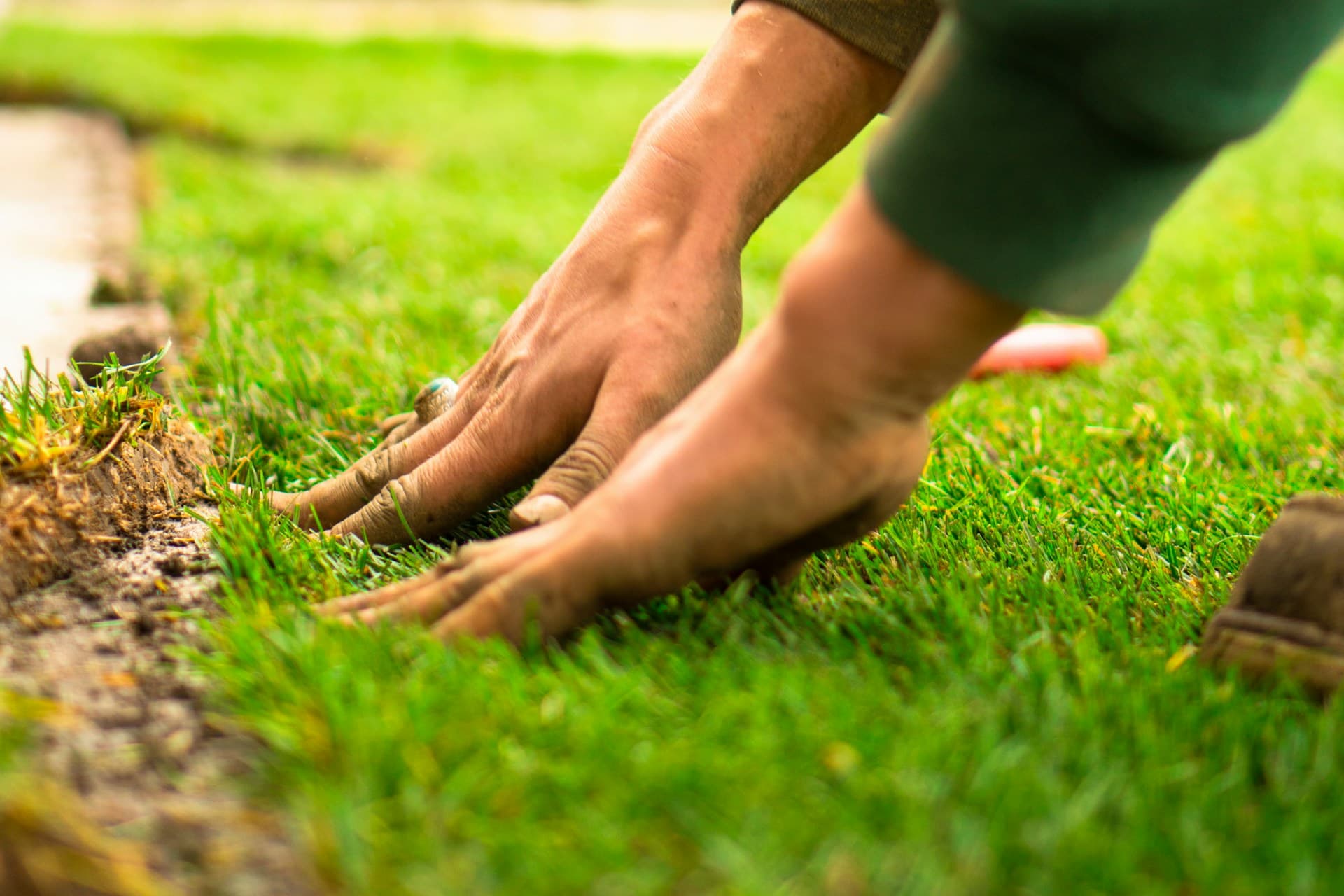
Turf Laying
Installation of turf rolls and slabs for residential and commercial landscapes. Covers site preparation including removal of existing vegetation, soil grading and levelling, rotary hoeing for soil amendment, turf roll laying in courses, tight butt jointing, rolling for soil contact, and edge cutting. Includes controls for manual handling of heavy turf rolls (15-25kg each), powered mobile plant operation (turf cutter, bobcat, mini roller), underground services strike hazards during ground preparation (BYDA mandatory), UV and heat exposure from full outdoor work, noise exposure from turf cutter and powered equipment, soil and fertiliser dust inhalation, and slip/trip hazards from wet soil and hose trip points. Pre-filled hazards, controls, and risk ratings.
Turf rolls land on a residential job 30 to 40 percent heavier than the supplier's spec when they've been freshly watered before delivery, and the lifting plan written for the spec weight crumbles when reality is wetter. A turf contractor's claim data is dominated by acute back, shoulder and knee injury — repeated lifts of 15-to-25-kilogram rolls hundreds of times in a day, plus 20-kilo soil and fertiliser bags, plus the bend-and-place-and-rise rhythm that runs all morning. The Model Code of Practice on Hazardous Manual Tasks drives the substitution decision: a roll mover, a barrow trolley, and team lifts on the rolls that arrive heavier than spec.
The ground-prep stage carries the second risk column. A walk-behind turf cutter, a bobcat or a rotary hoe pulls in the trades' powered-plant hazards, and the operator who treats a "small residential top-up" job as not requiring BYDA misses the cable strike that sits 100 to 200 millimetres below the lawn. The Model Code of Practice on Excavation Work treats any ground disturbance as triggering BYDA before the cutter goes in, regardless of depth ambitions.
Cumulative noise across multiple petrol tools — turf cutter at 90-100 dB(A), rotary hoe at 85-95, mini roller at 85-90 — adds up to a daily dose well above the threshold under AS/NZS 1270:2002, and Class 4 to 5 muffs need to be the start-of-day default rather than the upgrade. UV exposure on full-sun installs runs eight hours, and Australia's outdoor skin cancer rates make SPF 50+ and a wide-brim hat job-essential. White Card on construction sites, RIIMPO318F for bobcat work, RIIMPO320F where a mini-excavator is in use, BYDA awareness and current first aid stack the operator side. Worst-case roll weight, BYDA before the cutter, hearing protection on at the trailer — three calls before the first roll lands.
What's In Your SWMS
7 Hazards & Controls
Back injuries, shoulder strain, knee damage (bursitis, meniscus tears, patellofemoral pain), herniated discs, repetitive strain injury, muscle tears, chronic pain
Use mechanical delivery of turf rolls directly to laying area by bobcat or telehandler to minimise manual transport distance
Use turf carts or trolleys specifically designed for turf rolls instead of hand carrying. Use smaller roll sizes where available (10-15kg). Use mini roller (walk-behind) instead of hand-rolling.
- Turf cart or trolley for moving rolls from delivery point to laying face
- Bobcat or telehandler for bulk transport of rolls across site
- Mini roller for consolidation instead of hand rolling
- Foam kneeling mat or gel knee pads for sustained kneeling during laying
- Wheelbarrow with pneumatic tyre for soil amendment transport
- Team lift for items over 20kg - use correct technique (bend knees, keep back straight, hold close to body)
- Position turf delivery within 5m of laying face to reduce carry distance
- Rotate between tasks (laying, cutting, rolling) every 20-30 minutes to vary posture
- Take 5-minute rest breaks every 30 minutes - stand and stretch
- Mandatory stretching before work: focus on back, hips, knees, and shoulders
- Stretch again during breaks - maintain flexibility throughout day
- Daily hydration: drink 250mL water every 15-20 minutes
- Brief all workers on proper lifting technique during toolbox talk
- Modify work pace in heat - heavy manual tasks in cooler morning hours
Heavy-duty knee pads essential for kneeling. Work gloves for grip and blister prevention. Steel cap boots for dropped roll protection.
17-Step Work Procedure
Equipment & PPE
Equipment (13)
- Turf cutter (walk-behind or tractor-mounted)
For removing existing lawn and vegetation. Walk-behind models typically 0.5-1.2m cutting width, operate at 90-100 dB(A). Tractor-mounted for large areas. Requires regular blade sharpening for safety.
- Mini roller / lawn roller
For compacting soil base and rolled turf to ensure soil contact. Walk-behind or ride-on. Typically 600-900kg for walk-behind models.
- Rotary hoe / cultivator
For tilling soil to 100mm depth to incorporate amendments and break up compacted layers. 85-95 dB(A) at operator position.
- Laser level and spirit level
For establishing grades and confirming drainage falls. Laser level for large areas, spirit level (1200mm) for detailed checking.
- Wheelbarrows (heavy-duty)
For transporting soil amendments, fertiliser, and turf rolls. Pneumatic tyres for uneven, wet ground.
- Hand tools (shovels, rakes, turf knife, shears)
Pointed shovel for digging, square shovel for spreading, garden rake for levelling, turf knife/shears for cutting turf to fit edges.
- String lines, pegs, and measuring tape
For marking out turf area, establishing grades and alignment. String lines keep laying courses straight.
- Fertiliser spreader (broadcast or drop)
For even application of starter fertiliser and soil amendments. Prevents over-application in patches.
- Irrigation hose and sprinkler setup
For establishing initial irrigation and heavy soak after laying. Minimum 19mm hose with sufficient length to cover area.
- Topsoil / turf underlay mix
Quality topsoil or pre-mixed turf underlay for grading and final levelling. Confirm free-draining properties with supplier.
- Starter fertiliser and soil amendments
Balanced NPK starter fertiliser (e.g., 10-3-6) for establishment. May include wetting agents to improve water infiltration.
- Underground service locator (CAT and Genny)
For verifying underground service locations before and during ground preparation. Use in conjunction with BYDA plans.
- First aid kit
Include eye wash, sunburn treatment, muscle strain relief, bandages, and blister dressings.
PPE (7)
- Safety glasses or gogglesAS/NZS 1337.1:2010
Essential during turf cutter and rotary hoe operation for protection against soil particles and debris ejection.
- Hearing protection (earplugs or earmuffs)AS/NZS 1270:2002
Mandatory for turf cutter operation (90-100 dB(A)), rotary hoe (85-95 dB(A)), bobcat operation (80-95 dB(A)), and mini roller use. Class 4 (SLC80 26-29 dB) minimum per AS/NZS 1270 SLC80 classification.
- Safety boots (steel cap, non-slip)AS 2210.3:2019
Steel cap essential for dropped turf rolls and heavy tools. Non-slip sole for wet, muddy ground conditions.
- Work gloves (general handling)AS/NZS 2161.1:2016
Leather or synthetic gloves for handling turf rolls and soil. Grip is essential on wet materials.
- Sun protection (hat, long sleeves, sunscreen)
Wide-brim hat (minimum 7.5cm brim), long-sleeved shirt, SPF 50+ sunscreen applied every 2 hours. UV-rated safety glasses. Australian UV extreme during summer.
- High-visibility vest or clothingAS 4602.1:2024
Required when powered mobile plant (bobcat, excavator, turf cutter) is operating on site. Day-only Class D minimum.
- Knee pads (heavy-duty)
Essential for prolonged kneeling during turf laying and edge cutting. Gel or foam type with hard outer shell.
Training & Emergency
Competency Requirements
- Construction Induction Card (White Card)training
Required for all workers on construction sites
- Turf Laying or Landscaping Experiencetraining
Demonstrated experience in turf installation including site preparation, laying, rolling, and basic grading. Entry-level workers should be under supervision of experienced worker.
- BYDA (Before You Dig) Awarenesstraining
Understanding of BYDA process, plan interpretation, service colour codes, safe digging within identified service zones. All workers involved in ground disturbance must be briefed.
- Bobcat / Skid Steer Operation (RIIMPO318F)
Required for any worker operating a bobcat or skid steer loader on site. Unit of competency RIIMPO318F from a Registered Training Organisation (RTO).
- Excavator Operation (RIIMPO320F)
Required for any worker operating a mini excavator. Unit of competency RIIMPO320F from an RTO. Not required if hand excavation/grading only.
- First Aid Certificate
Recommended for at least one team member on site. HLTAID011 Provide First Aid. Important given heat stress, manual handling, and heat stroke risks.
- Manual Handling and Ergonomics Training
Recommended for workers regularly handling heavy turf rolls and performing sustained kneeling work. Training on safe lifting technique, micro-breaks, and posture management.
Emergency Procedures
UNDERGROUND SERVICE STRIKE (Electrical): Do NOT touch damaged cable. Move all workers clear immediately. Call 000 if sparking or fire hazard. Contact electricity distributor emergency line immediately (number on BYDA plans). Do not resume work until service made safe by asset owner.
UNDERGROUND SERVICE STRIKE (Gas): Evacuate area immediately (minimum 50m radius). Do not use mobile phones or any ignition sources in vicinity. Call 000. Contact gas distributor emergency line (number on BYDA plans). Do not attempt to stop leak or re-enter area.
HEAT STROKE (MEDICAL EMERGENCY): This is life-threatening. Call 000 immediately. Move person to shade. Remove excess clothing. Cool rapidly: spray with water, apply ice packs to neck, armpits, and groin. Do not give fluids if confused or unconscious. Continue cooling measures until emergency services arrive.
TURF CUTTER ENTANGLEMENT: Stop operation immediately. If body part trapped: do not pull away - call 000 for emergency services. Provide emergency services with equipment details and injury location. If conscious, monitor for shock - keep warm, reassure.
STRUCK-BY PLANT INCIDENT: If worker struck by bobcat, excavator, or roller: call 000. Do not move injured person unless in immediate danger. Provide first aid for injuries sustained. Ensure all plant stopped and keys removed. Complete incident investigation and stop work.
Everything above, included in your SWMS document.
Get This TemplateWriting a SWMS from scratch?
That's 2-4 hours of research, formatting, and cross-referencing regulations.
We've done the starting work — pick your template, add your details, review.
Or just do this:
- Unlimited documents
- All 70+ templates
- Instant PDF & DOCX
- Cancel anytime
High-Risk Construction Work Categories
Under Australian WHS Regulations (Section 291 - High Risk Construction Work; Chapter 7 Part 7.2 - Noise; Chapter 4 Part 4.4 - Hazardous Manual Tasks), this work is classified as high-risk due to:
- Involves use of powered mobile plant (Turf cutter (walk-behind or tractor-mounted) for removing existing vegetation. Bobcat or mini excavator for site grading and material movement. Mini roller for soil compaction and post-laying consolidation.)
- Work on or near energised electrical installations (Ground preparation (rotary hoeing, bobcat excavation) may encounter underground electrical services. BYDA enquiry mandatory before any ground disturbance.)
- Work on or near pressurised gas mains or piping (Ground disturbance for site levelling and soil preparation may encounter underground gas services. BYDA enquiry mandatory. Hand dig within safe zone of located gas services.)
Australian Standards Referenced
National Guidance Documents
- Safe Work Australia - Model Code of Practice: Hazardous Manual Tasks
- Safe Work Australia - Model Code of Practice: Excavation Work
- Safe Work Australia - Guide to Managing Exposure to Whole-Body Vibration
- Safe Work Australia - Guide to Exposure to Solar UV Radiation
- Safe Work Australia - Managing Noise and Preventing Hearing Loss Code of Practice
- Before You Dig Australia (BYDA) - Best Practice Guide
Who Needs This SWMS?
This template is designed for the following trades and roles performing turf laying work.
Frequently Asked Questions
Do I need a BYDA enquiry before preparing ground for turf laying?
Yes. Before You Dig Australia (BYDA) enquiry is mandatory before any ground disturbance, including rotary hoeing, bobcat grading, or excavation for site preparation. Submit a free enquiry at www.byda.com.au or call 1100 at least 2 business days before planned ground work. BYDA plans identify underground electrical, gas, water, sewer, and telecommunications services. Failure to obtain BYDA plans can result in serious injury, service disruption, and prosecution.
How heavy are turf rolls and what is proper lifting technique?
Standard turf rolls weigh 15-25kg depending on moisture content and turf type. A single person can handle this weight using proper technique: bend knees (not waist), keep back straight, hold roll close to body, and lift with legs. For rolls exceeding 20kg or uneven weight distribution, use team lift with two workers. Avoid twisting or reaching above shoulder height. Use turf trolleys and carts where available to minimize manual carrying.
What training is needed for turf laying work?
Minimum requirements include: White Card (construction induction) for all construction work, BYDA awareness training for workers involved in ground preparation, and demonstrated experience in turf installation. If using powered equipment: RIIMPO318F (bobcat) or RIIMPO320F (excavator) competency tickets required for equipment operators. Recommended but not required: First Aid Certificate (HLTAID011) given manual handling and heat stress risks.
How do you prevent heat stroke when laying turf in summer?
Heat stroke is life-threatening. Prevention requires: check UV index and forecast temperature before work, schedule heavy tasks (grading, carrying) for cooler parts of day (before 10am, after 2pm), drink 250mL water every 15-20 minutes (do not wait for thirst), rest in shade for 10 minutes every hour when temperature exceeds 35°C, apply SPF 50+ sunscreen every 2 hours, and wear wide-brim hat and long sleeves. Monitor workers for heat stress symptoms: headache, dizziness, nausea, confusion, lack of sweating. If heat stroke symptoms develop, call 000 immediately and cool with water.
What is the difference between wet and dry turf conditions for laying?
Turf is best laid when soil is moist (not waterlogged). Wet turf causes: heavy, difficult handling, increased slip/trip hazards from muddy ground, poor soil contact, and humping as excess water drains. Dry turf is harder to handle, has less weight for soil contact, and dries out faster after laying. Ideal conditions: lay turf when soil has been watered to field capacity (moist but not boggy) approximately 12-24 hours before laying. Ensure adequate water available for heavy soak immediately after laying.
What are the main hazards specific to turf laying work?
The seven key hazards covered in this SWMS are: manual handling (heavy turf rolls, repetitive kneeling), underground services strikes (ground disturbance), powered plant operation (turf cutter, bobcat, roller), UV and heat exposure (full outdoor work), noise exposure (turf cutter, rotary hoe), dust inhalation (soil prep, fertiliser), and slips/trips/falls (wet ground, hoses, uneven terrain).
Is hearing protection needed when using a turf cutter?
Yes. Turf cutter operation generates 90-100 dB(A) at operator position, which exceeds the Australian 8-hour exposure standard of 85 dB(A). Class 4 hearing protection (earmuffs or moulded plugs) is mandatory during turf cutter operation. Rotary hoe (85-95 dB(A)), bobcat (80-95 dB(A)), and mini roller (85-90 dB(A)) also require Class 4 protection. Prolonged exposure causes permanent, irreversible hearing loss. Annual hearing tests recommended for workers regularly operating noisy equipment.
What PPE is essential for turf laying?
Essential PPE includes: safety glasses (debris protection), hearing protection (Class 4) when plant operating, steel cap non-slip boots (turf roll crush protection, wet ground grip), work gloves (grip and blister prevention), knee pads (prolonged kneeling), sun protection (wide-brim hat, long sleeves, SPF 50+ sunscreen), and hi-vis vest (when powered plant operating). P2 dust mask recommended for fertiliser application and dusty soil conditions.
How do you establish proper drainage falls during turf laying?
Minimum drainage fall is 1:100 (1m drop per 100m distance). For patios and small areas: use laser level or spirit level to confirm grades before laying. For larger areas: use laser level to establish finished level at key points. After rolling turf, perform water test: apply water and observe sheet flow - water should flow across surface without ponding in low spots. If ponding occurs, lift affected turf rolls, add soil to low spots, and re-roll. Final grade check: corners and edges typically higher than center to achieve drainage falls.
Can turf be laid on slopes exceeding 1:4 gradient?
Steep slopes (exceeding 1:4 = steeper than 25%) present significant slip/trip hazards and can cause turf rolls to slide downslope after laying, breaking butt joins and losing soil contact. Slopes steeper than 1:4 require additional controls: use biodegradable netting over rolled turf to temporarily secure while roots establish, increase water for better soil contact adhesion, use only short-duration watering (avoid long periods of saturation), or install temporary retention barriers. For very steep slopes exceeding 1:3 gradient, consider alternative stabilization methods (turf reinforcement netting, hydroseed, or step-terracing) instead of standard turf laying.
What aftercare instructions should be provided to clients?
Critical aftercare: watering daily for minimum 2 weeks to keep soil consistently moist (not saturated), no foot traffic for 2-3 weeks until roots establish, no mowing for 2-3 weeks, avoid heavy activity on turf for 4-6 weeks. Light fertilisation 4-6 weeks after laying with balanced NPK fertiliser. Establish regular watering schedule: 25mm per week during growing season (more in extreme heat). Mowing: start when turf reaches 40-50mm height, mow to 30-35mm height, gradually reduce mowing frequency as establishment improves. Provide written aftercare schedule and contact details for questions.
Get Your Turf Laying SWMS
Pre-filled. Risk-rated. Ready in 5 minutes.
Get Your SWMS PDFNo credit card required. First SWMS is free.
