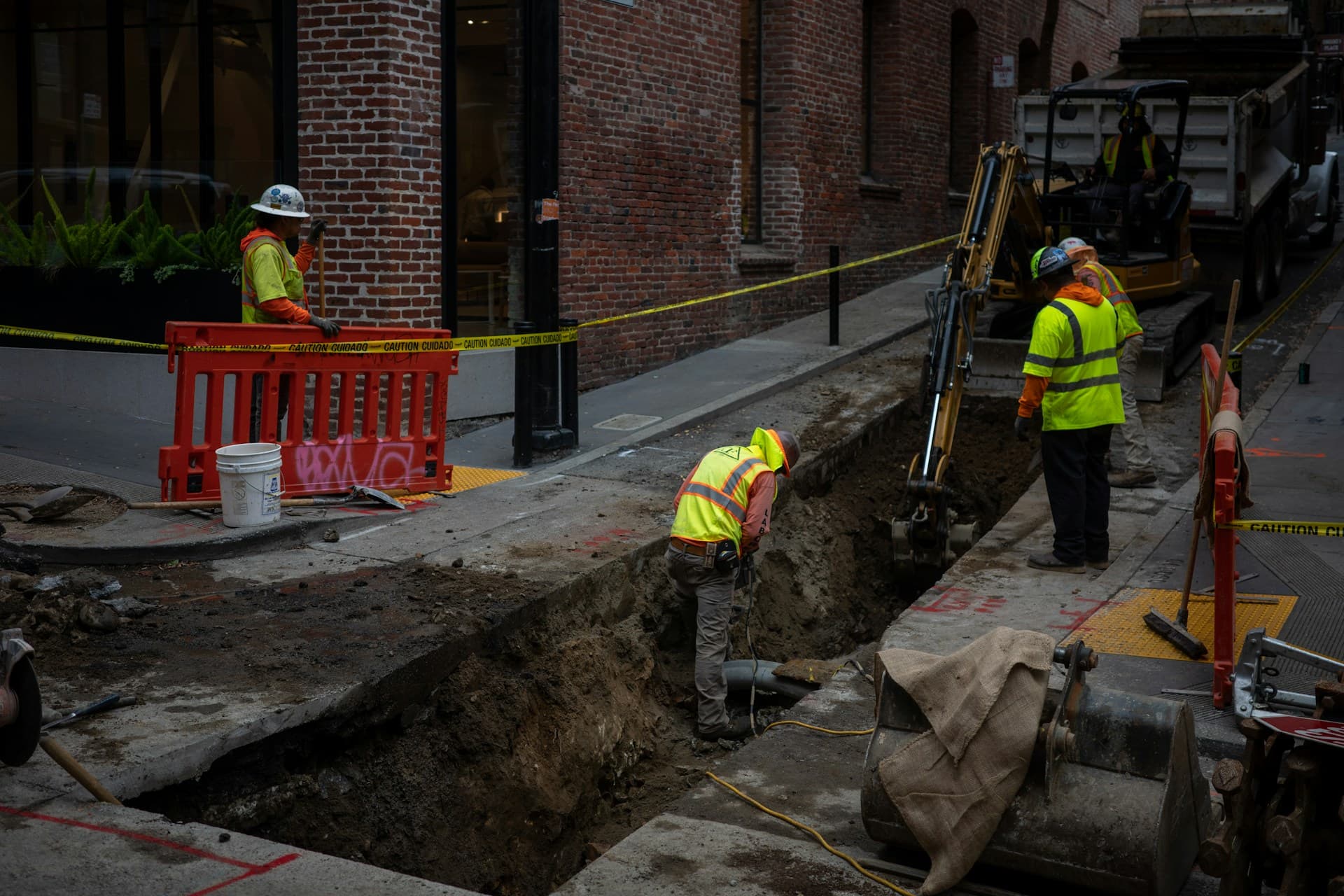
Pipe Laying (Underground)
Underground pipe laying for water supply, sewer, and stormwater in new residential subdivisions, commercial developments, and civil infrastructure projects. Covers trench excavation (mechanical and hand), bedding preparation (sand/gravel), pipe laying and jointing (PVC solvent cement, rubber ring, electrofusion PE), grade/fall establishment using pipe laser, haunch and overlay compaction, hydrostatic pressure testing, CCTV inspection, backfilling and compaction, and surface reinstatement. Typical depths 300mm to 3m+. Primary hazards: trench collapse and burial (1 cubic metre soil = 1,600kg), underground services strike (BYDA mandatory, 20,000+ strikes annually in Australia), powered plant operation and struck-by injuries, PVC solvent cement and chemical exposure (MEK/THF volatile organic compounds, heavier than air accumulating in trenches), noise and vibration (85-110 dB(A) from excavators, compactors), manual handling at depth, and traffic/pedestrian hazards in roadway/nature strip work. Compliant with AS/NZS 3500 series, WHS Excavation Work Code of Practice, and Safe Work Australia guidance. Pre-filled hazards, controls, and risk ratings.
A subdivision foreman knows the depth that flips a trench from straightforward to high-risk construction work without needing to check — 1.5 metres. Below that, the Excavation Work Code of Practice doesn't push the SWMS into HRCW territory and a sensible shoring or battering plan covers the work; above it, the document goes through the principal contractor with all the paperwork that brings. Water mains often run shallow enough to dodge the line; sewer and stormwater rarely do. Crews that apply the same SWMS to both miss the trigger on the deeper work, which is the kind of paperwork miss that turns into a personal liability claim when a trench wall fails.
What kills people in those deeper trenches is rarely the obvious mechanism. Soil at 1,600 kg per cubic metre traps a worker fast — a fall of one metre buries to mid-chest, and the diaphragm can't expand against the load, so the cause of death is mechanical asphyxiation rather than crush. AS 4744.1:2025 - Steel shoring and trench lining - Design (which superseded AS 4744.1-2000 in 2025) covers shoring and trench support; the choice between shoring boxes, shields, hydraulic props and battering depends on soil class, adjacent loads (kerb traffic, stockpiles, plant) and weather. Spotter discipline on plant within 1.5m of the trench edge sits next to that — slewing tail-swing strikes are the second mechanism, and they happen when a worker stands up in the trench at the wrong moment.
The chemical and noise profile runs over a full day. PVC solvent cement vapours (MEK at WES 150 ppm, THF) are heavier than air and accumulate in trenches; ground-level jointing or rubber-ring jointing replaces the in-trench solvent step. Excavator noise sits in the 85–95 dB(A) range, plate compactors at 95–110, concrete saws above that — double protection (plugs plus muffs) is the practice over an eight-hour exposure rather than a luxury. BYDA referrals, the AS/NZS 3500 series for water/sanitary/stormwater installation, electrofusion controllers for PE pipe runs, hydrostatic test before backfill, and the operator tickets — RIIMPO320F for the excavator, RIIWHS202E for confined-space entry where pits go in — round out the operator side. Subdivision pipework moves fast; the SWMS keeps the speed safe by deciding the day before, not the morning of.
What's In Your SWMS
7 Hazards & Controls
Crush injuries, fractured limbs and spine, asphyxiation from burial, death (almost always fatal if buried >1m)
Not practicable — pipe laying inherently requires trenching. Consider trenchless technology (pipe-bursting, horizontal directional drilling) for shallow pipes where economically viable.
Use wider trench profile with battered sides (45° maximum) to reduce unsupported wall height where space permits.
Establish 3m exclusion zone from trench edge during excavation. No stockpiling of spoil within 1m of edge. Barricade and sign all open excavations immediately.
- MANDATORY: Install trench shoring, shields, or boxes for all trenches >1.5m depth (must comply with AS 4744.1:2025 - Steel shoring and trench lining - Design - and be designed by competent person)
- Alternative: Batter trench walls to angle of repose (maximum 45° for standard soils) or bench in stepped profile (1m vertical face maximum)
- Install dewatering pump if groundwater present — continuous pumping to maintain trench stability. Discharge minimum 10m from excavation.
- Provide safe entry/exit (ladder or ramp) within 9m travel distance in any direction. Fix ladder securely at both top and bottom.
- Conduct geotechnical assessment for unstable ground (sand, silt, clay with high water content, previously disturbed fill). Geotechnical engineer design required.
- Use trench support progressively — install shoring before workers enter each section
- Written SWMS mandatory for all deep trenches >1.5m (high-risk construction work)
- Competent person to inspect trench walls daily and after rainfall, vibration, or ground disturbance
- Brief all workers on trench collapse warning signs: visible cracks, bulging walls, soil slumping, water seepage, fissures
- Stop work immediately if instability observed — evacuate trench and reassess before re-entry
- Monitor weather forecast — suspend trench work during or immediately after heavy rainfall
- Restrict traffic and heavy plant vibration near trench — minimum 5m distance from edge. No vehicle parking within 3m.
Safety helmet with chin strap (AS/NZS 1801:2024), safety boots (AS 2210.3:2019), high-visibility clothing (AS 4602.1:2024), full-body harness (AS/NZS 1891.1:2020) if rescue entry required
21-Step Work Procedure
Equipment & PPE
Equipment (15)
- Excavator (mini 1-3 tonne or standard 8-20 tonne)
For trench excavation. Mini excavator for confined access/shallow trenches, standard for high-volume spoil removal on mains work. Daily pre-start inspection mandatory. ROPS/FOPS fitted and intact. Seat belt functional. Verify hydraulic hoses, bucket teeth, and attachment locks.
- Pipe laser level and receiver (red or green laser)
Establishes and maintains grade/fall during pipe laying. Accuracy ±1-2mm per 100m. Essential for water/sewer/stormwater mains to ensure correct slopes (typically 0.5-1.5% fall). Mounted on pipe, projected along trench. Battery-powered, receiver rod used for alignment checks. Calibration annually.
- Plate compactor (petrol or diesel-powered, 200-400kg)
For compacting bedding material and overlay material around pipe. Multiple passes (3-5 per layer) to achieve 90-95% compaction. Generates 85-95 dB(A) noise and significant whole-body vibration. Operator rotation recommended every 2 hours.
- Jumping jack (pneumatic or petrol-powered rammer)
For spot compaction in confined areas (around bends, valves, connections). High vibration and noise (90-100 dB(A)). Hand-arm vibration syndrome risk from prolonged operation. Limit operator time.
- Bedding material (sand and/or gravel, 20kg bags or bulk)
150-300mm sand/gravel bedding under pipe to support pipe and protect from stone contact. Material specification: <50mm gravel mix, well-graded. Volume calculation: bedding thickness × pipe circumference × trench length. Manual or mechanical placement.
- Pipe cutters and saws (PVC handsaws, mechanical cutters, angle grinders)
For cutting PVC, concrete, or PE pipes to length on site. Handsaws for PVC (clean, smooth cut), angle grinder for concrete (wet-cutting to manage dust). Deburr all cut ends. Wear eye protection and hearing protection when grinding.
- PVC solvent cement and primers (MEK/THF-based)
For PVC pipe jointing. Volatilizes rapidly — heavier than air, accumulates in trenches. Workplace exposure standard MEK 150 ppm TWA. Adequate ventilation and respiratory protection required if working in deep trenches with poor air movement. Primers (purple/clear) applied before cement.
- Hydrostatic pressure test pump and gauge
Tests water/sewer pipes for leakage. Pressurizes pipe to specified test pressure (typically 1.5× working pressure). Manual or petrol-powered pump. Pressure gauge (0-500 kPa range). Hose and test plugs for isolation. Document all test results.
- CCTV drain inspection camera system
Post-laying inspection to verify pipe alignment, joint quality, debris removal, and structural integrity. Cable-based or robotic crawler. May be required by client/council. Identifies defects for repair before backfilling.
- Submersible dewatering pump
For removing groundwater from trenches. Discharge to approved point minimum 10m from excavation. May be required for deep trenches or high water table. Continuous pumping during work if groundwater present.
- Trench shoring, shields, or boxes (for trenches >1.5m)
MANDATORY for trenches >1.5m depth per AS 4744.1. Designed by competent person. Hydraulic props, steel boxes, or shield systems. Adequate for expected soil loading. Daily inspection before worker entry.
- Before You Dig Australia (BYDA) plans and service location information
MANDATORY before excavation. Received from BYDA enquiry (minimum 2 business days ahead). Identifies gas, electrical, water, and telecommunications service locations. Marked on site before excavation. Consulted at daily toolbox meetings.
- Hand tools (shovels, mattocks, pipe wrenches, adjustable spanners, tape measures)
Manual excavation near services, fine work around pipes, bedding placement, and pipe connection. Deburring tools for cut ends. Tape measures for grade checks and alignment.
- Safety barriers, fencing, traffic cones, and warning signs
Temporary fencing minimum 2m from trench edge. Traffic cones/signs if near roadway. Appropriate traffic management plan if on sealed road. Secured and visible day/night.
- Site lighting (portable lights, floodlights, or work lamps)
Minimum 50 lux at work face if working during dawn, dusk, or night. Protects workers and improves safety visibility. Battery or mains-powered.
PPE (10)
- Safety helmet (hard hat)AS/NZS 1801:2024
Mandatory when working in or near trenches. Chin strap required when entry/exit on ladders or in rescue scenarios. Impact-rated polycarbonate.
- High-visibility clothing (Class D/N or higher)AS 4602.1:2024
Day/night compliant if near roadways or heavy plant. Minimum Class D for all pipe laying sites. Class N recommended for roadway work. Vest or full suit.
- Steel cap safety boots with ankle support and steel mid-soleAS 2210.3:2019
Mandatory for trench work. Waterproof with excellent anti-slip sole for wet conditions. Steel mid-sole for puncture protection from sharp bedding stone.
- Work gloves (leather or synthetic)AS/NZS 2161.1:2016 (general requirements). Chemical protection performance is most commonly specified to EN ISO 374.
For handling rough pipes, sharp stone bedding, and hand tools. Cut-resistant preferred. Nitrile gloves if handling PVC cement to prevent skin absorption of volatiles.
- Half-face respirator or supplied air (if PVC cement use in deep trenches)AS/NZS 1716:2012 (device); AS/NZS 1715:2009 (selection/use/fit testing)
MANDATORY if working in deep trenches with PVC solvent cement fumes. MEK/THF volatile organic compounds heavier than air — accumulate at trench bottom. AS/NZS 1716 classifies particulate filters as P1/P2/P3 (NOT R-series — R95 is the U.S. NIOSH classification, not Australian). For organic vapours from PVC cement use a half-face respirator with organic-vapour cartridge per AS/NZS 1715:2009 selection guidance; supplied air for high exposure in sealed trenches. Medical clearance and annual fit testing required.
- Hearing protection (earmuffs or earplugs)AS/NZS 1270:2002
Mandatory when operating excavators, plate compactors, jumping jacks (85-110 dB(A)). Class 3-4 earmuffs (per AS/NZS 1270 SLC80 classification system) for high noise environments. Insert foam earplugs correctly for full protection. Hearing loss is permanent.
- Safety glasses or gogglesAS/NZS 1337.1:2010
Mandatory when cutting pipes (angle grinder for concrete), using solvent cement, or grinding pipe ends. Protects against flying debris, chemical splash, dust.
- Sunscreen (SPF 50+) and hydration
SPF 50+ broad spectrum applied every 2 hours. Minimum 1-2L water per hour in hot conditions. Electrolyte replacement drinks for 4+ hour shifts. Shade breaks if temperature >28°C.
- Full-body harness with lifeline (for deep trench work >1.5m)AS/NZS 1891.1:2020 (harness/equipment); AS/NZS 1891.4:2025 (selection/use/maintenance)
MANDATORY for entry into deep trenches >1.5m if rescue entry required. D-ring attachment points on shoulders. 30m lifeline minimum. Regularly inspected and maintained per AS/NZS 1891.4:2025.
- Dust masks (P2 or P3)AS/NZS 1716:2012 (device); AS/NZS 1715:2009 (selection/use)
For dry conditions with dust generation (cutting concrete pipes, grinding, trench excavation in dry ground). Not effective against organic vapors (use respirator for PVC cement fumes).
Training & Emergency
Competency Requirements
- General Construction Induction (White Card)training
Mandatory for all personnel on construction sites. CPCCWHS1001. Valid for 5 years. Covers basic WHS responsibilities, hazard identification, emergency procedures.
- Plumbing/Drainage Licencelicence
Certificate III in Plumbing (CPC32420) or Certificate II in Drainage (CPC20720). State-specific licence required. Verify current registration with state building/plumbing authority.
- Excavator Operator Competencyticket
RIIMPO320F - Conduct civil construction excavator operations (or equivalent). Verify operator competency for specific machine class (mini vs standard). Some states require additional plant operator licensing — check with state WHS regulator.
- Plate Compactor and Vibratory Equipment Operationtraining
Training in safe operation of plate compactors, jumping jacks, and pneumatic rammers. Awareness of vibration hazards (hand-arm vibration syndrome), noise exposure, and operator fatigue. Proper startup, operation on slopes, maintenance, and shutdown.
- Pipe Laser and Laser Level Operationtraining
Training in operating pipe laser transmitter and receiver. Understanding of grade/fall calculation, alignment procedures, and accuracy limits. Calibration awareness. Safe handling of laser equipment (eye safety).
- Before You Dig Australia (BYDA) Awarenesstraining
Understanding of BYDA process, plan interpretation, safe excavation near located services, hand excavation/pot-holing procedures. Free resources at www.byda.com.au. Briefed at site induction with specific reference to located services on this project.
- First Aid Certificatecertificate
HLTAID011 - Provide First Aid. At least one person on site must hold current certificate. Recommended for all workers due to remote nature of pipe laying and potential for serious incidents.
- Respiratory Protection and Solvent Safety
Training in use of half-face respirators with organic vapor cartridges. Understanding of PVC cement fume hazards (MEK/THF), heavier-than-air accumulation in trenches, and safe work practices. Medical clearance for respirator use. Annual fit testing.
Emergency Procedures
TRENCH COLLAPSE OR BURIAL: Call 000 immediately. Do NOT enter collapsed trench. Begin careful hand excavation from sides to free buried worker if safely possible. Maintain airway if conscious. Do NOT move worker until professional rescue has assessed spinal injury risk. Prepare for resuscitation. Notify regulator immediately.
UNDERGROUND ELECTRICAL CABLE STRIKE: Do NOT touch cable or equipment. Evacuate area minimum 8m. Call 000 and electricity distributor emergency line. If operator is in plant cab, remain inside with window closed until power is confirmed isolated by authorities. If worker is in contact with cable, do NOT touch worker until power isolated.
GAS MAIN STRIKE: Evacuate all personnel upwind immediately. No ignition sources (phones, vehicles, cigarettes, naked flames). Call 000 and gas authority emergency line. Do NOT attempt to seal or repair leak. Wait for gas authority to control leak and clear area for re-entry.
SOLVENT VAPOR EXPOSURE (HEADACHE, DIZZINESS): Evacuate to fresh air immediately. Sit/lie down in shaded area. Breathe deeply. Monitor for resolution of symptoms (typically 15-30 minutes in fresh air). If symptoms persist or worsen, seek medical attention. Inform medical provider of solvent exposure.
WORKER STRUCK BY PLANT: Call 000 immediately. Provide first aid if trained and safe. Preserve scene for investigation. Do NOT move injured worker unless in immediate danger. Provide information to ambulance on mechanism of injury (struck, crush, entanglement, rollover).
HAND/ARM VIBRATION INJURY (SUDDEN NUMBNESS, TINGLING, WHITENING): Remove from vibrating equipment immediately. Warm hands gradually (not rapid heating). Seek medical attention if symptoms persist. Document incident. May indicate vibration white finger (HAVS) developing.
HEARING LOSS OR TINNITUS ONSET: This is typically gradual, not acute. If sudden tinnitus, seek medical attention to rule out acoustic trauma or other causes. Ensure hearing protection is being used correctly for all future high-noise work.
Everything above, included in your SWMS document.
Get This TemplateWriting a SWMS from scratch?
That's 2-4 hours of research, formatting, and cross-referencing regulations.
We've done the starting work — pick your template, add your details, review.
Or just do this:
- Unlimited documents
- All 70+ templates
- Instant PDF & DOCX
- Cancel anytime
High-Risk Construction Work Categories
Under Australian WHS Regulations (291 - High Risk Construction Work (applies to trenches >1.5m)), this work is classified as high-risk due to:
- Work in or on trench deeper than 1.5 metres (Sewer and water mains commonly excavated 1.5m to 3m+ depth. Deep trenches for main laying are primary hazard. One cubic metre of soil weighs approximately 1,600kg. Collapse is almost always fatal. Shoring, battering, or benching MANDATORY for trenches >1.5m per WHS Excavation Work Code of Practice. Residential water supply trenches typically 450-600mm (lower risk). Commercial/civil mains 1m-3m+ (high risk).)
- Use of powered mobile plant (Excavators (5-30 tonne), mini excavators, bobcats, plate compactors, jumping jacks, rollers operating in close proximity to workers in and around trenches. Struck-by, crush, rollover hazards. Plant vibration destabilising trench walls. Pedestrian exclusion zones mandatory. Quick-hitch attachment failure (50% non-compliance rate nationally). Vibrating compaction equipment generates whole-body and hand-arm vibration.)
- Work near traffic, public roadways, or pedestrian areas (Pipe laying in roadways, nature strips, footpaths, and easements common in subdivisions and civil works. Vehicle strike risk, pedestrian falling into excavation, traffic vibration on trench walls. Traffic management plan required for sealed roads. High-visibility clothing mandatory.)
- Work on or near energised electrical installations (Underground electrical cables may be present at pipe laying depth. Striking electrical cable can be fatal. BYDA and hand excavation mandatory before mechanical plant near located services. Electrical strike at depth compounds risk due to wet soil conditions.)
- Work on or near pressurised gas mains or piping (Deep excavation for water/sewer mains often parallels gas infrastructure at similar depths. BYDA enquiry mandatory. Gas strike can cause explosion and fire. Hand excavation (pot-holing) required before mechanical work near located gas services.)
- Work in area with contaminated or flammable atmosphere (PVC solvent cement (MEK/THF) volatile organic compounds heavier than air — accumulates in trenches rapidly. PE electrofusion fume exposure, primer chemicals, lubricants. Workplace exposure standard: MEK 150 ppm TWA. Sewer pipes particularly risk for H₂S if cutting into live mains nearby.)
Australian Standards Referenced
Who Needs This SWMS?
This template is designed for the following trades and roles performing pipe laying (underground) work.
Frequently Asked Questions
When is pipe laying work classified as high-risk construction work requiring a SWMS?
Pipe laying is classified as high-risk construction work when trenches exceed 1.5 metres in depth. A written SWMS is mandatory for all high-risk construction work under WHS Regulation 2017. Most sewer and stormwater mains (1-3m+ depth) exceed 1.5m, triggering SWMS requirements. Water supply lines (typically 450-600mm) usually do not. However, best practice is to prepare a SWMS for all underground pipe laying due to multiple hazards (services strike, plant hazards, chemical exposure).
What precautions prevent trench collapse during deep pipe laying?
For trenches >1.5m depth, you MUST use one of three methods: (1) Trench shoring — steel boxes, shields, or hydraulic props designed to AS 4744.1:2025 (Steel shoring and trench lining - Design) by competent person, (2) Battering — sloping trench walls back to angle of repose (maximum 45° for standard soils), or (3) Benching — cutting horizontal steps with each face maximum 1m vertical. Shoring is most common for pipe laying. Additional requirements: daily inspection by competent person, dewatering if groundwater present, safe entry/exit within 9m, no stockpiling soil within 1m of trench edge.
Is BYDA (Before You Dig) enquiry mandatory for underground pipe laying?
Yes, absolutely MANDATORY. Before You Dig Australia (BYDA) enquiry is required by law before ANY ground disturbance in all Australian states. For pipe laying: (1) Submit enquiry at least 2 business days before excavation by calling 1100 or visiting www.byda.com.au (free service), (2) Receive plans from all utility authorities (gas, electricity, water, telecommunications), (3) Review plans at toolbox meeting — mark service locations on site, (4) Hand excavate (pot-hole) within 500mm of any located service to confirm depth, (5) Do NOT mechanically excavate near located services. Over 20,000 underground utility strikes occur annually in Australia. Penalties: NSW up to $22,000 (individual), $44,000 (company).
What are the dangers of PVC solvent cement in underground pipe laying?
PVC solvent cement contains volatile organic compounds (VOCs): methyl ethyl ketone (MEK) and tetrahydrofuran (THF). These chemicals are heavier than air and accumulate rapidly in deep trenches with poor ventilation. Workplace exposure standard for MEK: 150 ppm TWA. Acute symptoms: headache, dizziness, eye/respiratory irritation, nausea, CNS depression. Protection: (1) Apply PVC cement at ground level before lowering pipes into trenches, (2) Use rubber-ring jointed PVC instead of solvent cement where possible, (3) If jointing in trenches: use respirator (half-face with organic vapor cartridge), (4) Ensure adequate ventilation — do NOT work in sealed trenches with VOC exposure, (5) Wear nitrile gloves to prevent skin absorption.
What noise levels are generated during pipe laying and how do I protect hearing?
Excavators generate 85-95 dB(A), plate compactors 95-110 dB(A), jumping jacks 90-100 dB(A), concrete saws 105-110 dB(A). Safe Work Australia exposure limit: 85 dB(A) TWA (time-weighted average). Protection: (1) Hearing protection mandatory for operators within 3m of equipment (AS/NZS 1270 Class 3-4), (2) Double protection for prolonged exposure >8 hours: foam earplugs inserted correctly PLUS earmuffs, (3) Rotate operators every 2 hours to reduce cumulative exposure, (4) Maintain equipment to specifications — worn parts increase noise, (5) Hearing loss is permanent and irreversible — protection is essential.
What are the steps for safe hydraulic pressure testing of completed pipe lines?
Hydrostatic pressure testing procedure: (1) Close off line with test plugs at both ends, (2) Fill line slowly with clean water (avoid rapid pressurization which can damage weak joints), (3) Pressurize to specified test pressure (typically 1.5× working pressure — check design specification), (4) Monitor pressure gauge continuously for 15-30 minutes (standard hold time), (5) Observe all joints visually for water seepage (pass = no seepage, fail = any dripping), (6) Record test result (pass/fail, pressure held, duration), (7) Document with photos of gauge and joints, (8) Any leakage requires joint repair and re-testing. Test performed before backfilling allows easier repair access.
What is the purpose of CCTV inspection after pipe laying and before backfill?
CCTV (Closed-Circuit Television) inspection verifies pipe system quality before backfilling. Benefits: (1) Confirms pipe alignment and correct grade/fall throughout line, (2) Verifies joint quality and proper jointing technique, (3) Identifies debris, sediment, or stones inside pipe from installation, (4) Detects structural defects (cracks, joint displacement, misalignment) before system goes live, (5) Provides video record for handover to client/council. Defects identified at inspection stage are much cheaper and easier to repair than post-backfill. CCTV often required by council or client as condition of system approval.
What precautions are needed when laying pipes near traffic-affected roads?
For pipe laying in roadways or nature strips: (1) Install temporary barriers (concrete blocks, portable fencing) minimum 2m from trench edge, 5m from kerbline if near roadway, (2) Deploy traffic management plan if on sealed road: certified traffic controller, traffic cones, reduced speed signs, traffic lights if applicable. Contact local council for requirements, (3) Install warning signs at 20m intervals visible day and night, (4) Cover open trenches with secured steel plates when unattended, (5) High-visibility clothing Class D/N mandatory for all workers, (6) Assign safety observer to monitor traffic during excavation, (7) Work during off-peak traffic times if possible, (8) Install adequate lighting if working during dawn/dusk/night.
What equipment is essential for establishing correct grade/fall during pipe laying?
Pipe laser level systems are essential for achieving correct grades and falls. Components: (1) Laser transmitter (mounted inside pipe) projects red or green laser beam along pipe centreline, (2) Laser receiver (tripod-mounted rod outside trench) detects beam at designed grade, (3) Proper procedure: set transmitter at starting invert level, align receiver at designed fall distance downstream, use laser beam to guide pipe positioning, (4) Verify grade every 2-3 pipe sections, (5) Typical falls: water supply 0.5-1%, sewer 0.5-1.5%, stormwater variable 0.5-2% depending on catchment. Incorrect grade causes flow problems (sediment accumulation if too flat, erosion/noise if too steep).
What should I do if an underground electrical cable is struck during excavation?
Electrical cable strike response: (1) STOP work immediately. Do NOT continue. (2) Evacuate area minimum 8m from strike point, (3) Call 000 if anyone injured or in contact with cable, (4) Call electricity distributor emergency line (find number from bill or www.openElectricalNetwork.com), (5) If plant operator is in cab: remain inside with window closed until power confirmed isolated by authorities. Do NOT exit cab unless instructed by authorities, (6) If worker is in contact with cable: do NOT touch worker until power isolated — contact can be fatal, (7) Do NOT touch cable or equipment, (8) Preserve scene for investigation, (9) Report incident to workplace regulator — likely notifiable incident, (10) Post-incident investigation mandatory.
What competencies are required for the pipe laying crew?
Minimum competencies required: (1) White Card (CPCCWHS1001) — mandatory for all construction work, valid 5 years, (2) Plumbing/Drainage Licence (Certificate III or II) — required by law for plumbing/drainage work, verify current registration with state authority, (3) Excavator Operator Competency (RIIMPO320F) — for mechanical excavation, verify competency class matches machine size, (4) Plate compactor/vibratory equipment operation — formal or on-the-job training in safe operation, (5) Pipe laser and laser level operation — understanding of grade/fall calculation and accuracy, (6) BYDA awareness — understanding of service plan interpretation and pot-holing procedures, (7) First Aid Certificate (HLTAID011) — at least one person on site holds current certificate, (8) Respiratory protection training (if using respirators for solvent cement fumes) — half-face respirator use, cartridge change, fit testing.
Get Your Pipe Laying (Underground) SWMS
Pre-filled. Risk-rated. Ready in 5 minutes.
Get Your SWMS PDFNo credit card required. First SWMS is free.
