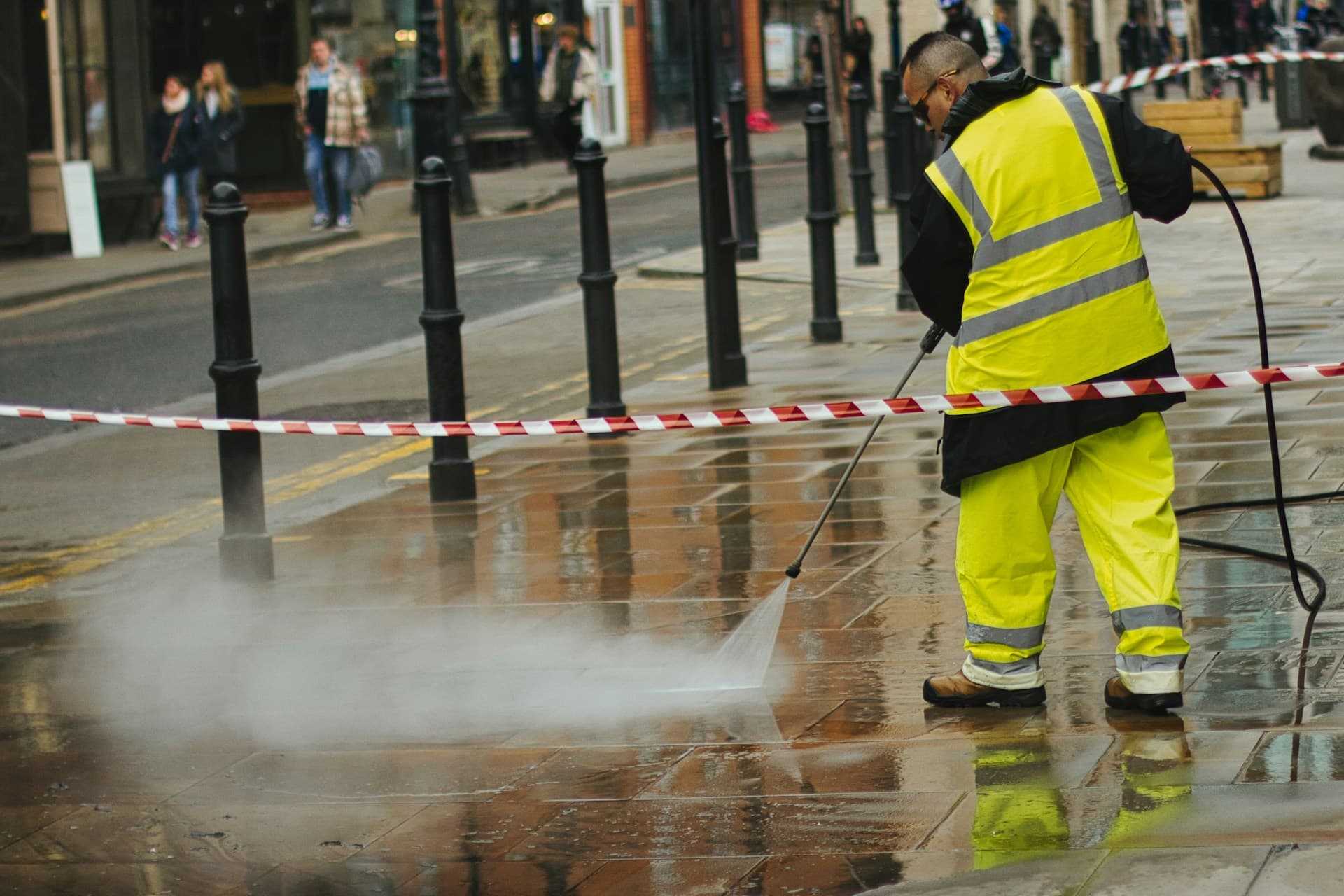
Pressure Washing / High-Pressure Cleaning
High-pressure water cleaning of driveways, paths, decks, building exteriors, fences, retaining walls, and outdoor surfaces using pressure washers from 1,500–5,000 PSI. Covers high-pressure water injection injuries (the most serious hazard — clinical literature reports skin-penetration thresholds as low as ~100 PSI, and pressure washers operating above 1,500 PSI dramatically exceed this; injection injuries cause devastating internal tissue damage invisible externally, with 30–40 % requiring amputation), electrical hazards from electric pressure washers operating near water and wet surfaces, slip hazards on wet cleaned surfaces, noise exposure (85–100 dB(A)), chemical exposure from detergents and degreasers, projectile debris dislodged by water jet, manual handling of heavy equipment and hoses, UV and heat exposure during extended outdoor work, and environmental compliance for wastewater runoff. Higher-output equipment is classified under AS 4233.1:2013: Class A covers systems with output 800–5,600 bar·L/min; Class B covers >5,600 bar·L/min (requires certified RTO operator training). Systems below 800 bar·L/min fall outside the standard's scope but the same controls (trigger discipline, RCD, PPE, never on asbestos) still apply. Never use high-pressure water on asbestos-containing materials. Pre-filled hazards, controls, and risk ratings.
A pressure washer above 1,500 PSI penetrates skin on contact, and the resulting injection injury is a small puncture wound with massive deep-tissue destruction underneath. Around 30 percent of these injuries end in amputation, and the surgical window is hours, not days — the operator who shrugs off "a small cut to the hand" because they didn't see arterial bleeding is the one whose limb the surgical team can't save by midnight. Trigger guards, never pointing the wand at any body part, and a clearly-rehearsed "hospital now" response are the controls that matter when the machine is running. AS 4233.1:2013 governs high-pressure water jetting systems and the operator competency that backs them.
Asbestos-cement roofs are the hard rule on this trade: never pressure-wash them. The water jet atomises asbestos fibre into airborne respirable particles, contaminates the surrounding property, and is illegal — SafeWork NSW and equivalent state regulators have issued specific safety alerts. The Model Code of Practice on How to Safely Remove Asbestos covers the broader handling rules; pre-2004 fibre-cement roofs are presumed asbestos until tested otherwise.
Stormwater compliance and surface selection are the two columns operators underestimate. Detergent runoff entering stormwater drains is an EPA offence in most states; drain covers, lawn soakage and chemical containment are mandatory on commercial work. Pressure has to match the surface — softwood decking at over 600 PSI gouges the grain, and "deck restoration" jobs that ended up needing replacement after over-pressuring are documented insurance disputes. Electric pressure washers near water and wet surfaces require RCD-protected supply, and AS/NZS 3760:2022 test-and-tag covers the equipment electrical safety. Class A units (under 5,600 bar litres per minute) need documented operator training; Class B units pull in AS 4233.1:2013 refresher training every two years. White Card on construction sites, hazardous substances training for the detergents and current first aid round out the qualifications brought to the job.
What's In Your SWMS
7 Hazards & Controls
Amputation (30 % of cases), compartment syndrome, extensive tissue necrosis, severe infection (contaminated water forced into deep tissues), permanent disability, nerve and blood vessel damage. Delayed treatment dramatically worsens outcomes.
Use lowest effective pressure for the task. Use rotary surface cleaner attachment (enclosed head) to eliminate direct wand exposure on flat surfaces. Never use 0° (pencil jet) nozzle except in controlled industrial applications.
Substitute high-pressure wand with surface cleaner attachment where practicable. Use wider fan nozzles (25° or 40°) to reduce point pressure. Use downstream chemical application at low pressure instead of high-pressure cleaning alone.
Maintain minimum 1 m exclusion zone around operating wand tip. Never allow second person within wand operating radius. Never direct water jet toward any person.
- Trigger lock / dead-man trigger: wand stops immediately when grip released
- Safety lanyard connecting wand to operator (prevents uncontrolled wand if dropped)
- Correct nozzle selection: 25° or 40° fan for most residential/commercial work; avoid 0° pencil jet
- Hoses rated minimum 25 % above machine maximum pressure; inspect before each use
- Foot valve / dump valve for safe depressurisation
- NEVER point wand at any person, including yourself — treat like a firearm
- NEVER place hand, foot, or any body part in front of nozzle to test pressure
- Depressurise system before disconnecting hoses, changing nozzles, or clearing blockages
- Grip wand firmly with both hands — recoil force can cause loss of control
- Operator training on injection injury recognition: any wound from pressure washer penetrating skin requires IMMEDIATE emergency department assessment, no matter how minor it appears
- Carry injection injury information card for ED staff (many emergency doctors unfamiliar with this injury type)
- Do not use pressure washer while fatigued — fatigue reduces grip strength and reaction time
Waterproof safety boots, waterproof clothing rated to withstand water jet, face shield, safety glasses
10-Step Work Procedure
Equipment & PPE
Equipment (7)
- Pressure washer — petrol or electric
Classified under AS/NZS 4233.1:2013. Class A: under 5,600 bar·L/min (typical residential/commercial units 1,500–4,000 PSI). Class B: over 5,600 bar·L/min (industrial — requires certified operator). Pre-use inspection: hoses for cracks and bulging, fittings for leaks, nozzle condition, trigger lock function, safety lanyard. RCD protection mandatory for electric units.
- High-pressure hoses, fittings, and nozzle tips
Hoses rated to exceed maximum machine pressure by minimum 25 %. Inspect before each use for cuts, abrasion, bulging, and coupling leaks. Multiple nozzle tips: 0° (pencil jet — highest risk), 15°, 25°, 40° fan spray, and detergent tip. Never use 0° nozzle on body or near people.
- Rotary surface cleaner attachment
Enclosed spinning nozzle head for flat surfaces (driveways, paths). Significantly reduces overspray, projectile debris, and striping compared to open wand. Recommended for all flat surface work.
- RCD-protected power supply / portable RCD
Mandatory for electric pressure washers. Residual Current Device trips at 30 mA to prevent electrocution in wet conditions. Test RCD before each use. Do not use extension leads in wet areas unless industrial-rated and RCD-protected.
- Warning signage and barricades
"Caution — Wet Surface" signs, "Cleaning in Progress" signage, safety cones, and barrier tape for exclusion zones. Essential for public areas, footpaths, and commercial properties.
- Spill containment and wastewater management kit
Absorbent booms or berms to prevent chemical-laden wastewater entering stormwater drains. Drain covers for nearby stormwater inlets. Absorbent granules for spills. Required for environmental compliance.
- First aid kit
Stocked and checked. Must include wound dressings, eye wash (minimum 500 mL for chemical splash), burns dressings, and information card on high-pressure injection injuries for emergency department staff.
PPE (6)
- Safety glasses AND full face shieldAS/NZS 1337.1:2010
Both required for operator in direct control of pressure washer. High-impact safety glasses under full face shield. Protects against high-velocity water rebound, projectile debris dislodged from surfaces (concrete chips, paint flakes, rust), and chemical splash from detergents.
- Hearing protection — earmuffs or earplugsAS/NZS 1270:2002
Mandatory — pressure washers produce 85–100 dB(A). Class 3–4 minimum. Petrol-powered units louder than electric. Extended operation requires hearing protection for entire duration. Note: hearing protectors should not reduce noise below 75 dB(A) to maintain hazard awareness.
- Waterproof safety boots — steel/composite toe, non-slip soleAS 2210.3:2019
Waterproof construction essential — operator works in standing water. Steel or composite toe cap protects against dropped equipment. Non-slip sole critical for wet surface traction. Ankle support for uneven terrain.
- Waterproof / water-resistant protective clothing
Full-length waterproof trousers and jacket or waterproof overalls. Must withstand direct force of water jet rebound. Protects against hypothermia in cooler conditions, chemical contact from detergent spray, and UV exposure. Close-fitting — loose clothing can snag on equipment.
- Chemical-resistant waterproof glovesAS/NZS 2161.10.1:2024 (chemical/microorganism risks); AS/NZS 2161.1:2016 (general)
Required when handling detergents, degreasers, and cleaning chemicals. Nitrile or PVC construction. Must maintain grip on wet pressure washer trigger and wand. Check SDS for specific glove material requirements for each chemical used.
- Sun protection — SPF 50+ sunscreen, hat, long sleeves
SPF 50+ applied under waterproof clothing to exposed skin. Broad-brimmed hat compatible with face shield and hearing protection. Reapply sunscreen every 2 hours and after heavy sweating.
Training & Emergency
Competency Requirements
- Pressure Washer Operation Trainingtraining
For Class A equipment (output 800–5,600 bar·L/min per AS 4233.1:2013) and for systems below 800 bar·L/min that fall outside the standard's scope: documented training covering safe operation, injection injury awareness, nozzle selection, surface pressure limits, chemical handling, and emergency procedures. Refresher training every 2 years. Current unit of competency is CPPCLO3020 (Pressure wash and clean surfaces; supersedes the legacy PRMCL20B and CPPCLO3020A codes), available via RTOs.
- Class B High-Pressure Water Jetting Certification
MANDATORY for Class B equipment exceeding 5,600 bar·L/min output per AS 4233.1:2013. Certified operator training through registered training organisation (RTO). Current unit is MSMWJ301 (Operate a high pressure water jetting system; supersedes MSAPMWJ301A). Not required for standard residential/commercial pressure washers.
- General Construction Induction (White Card)
CPCCWHS1001 — Required if pressure washing on active construction sites.
- Chemical Handling and Hazardous Substances Training
Required when using chemical detergents, degreasers, or acid-based cleaners. Workers must understand SDS interpretation, chemical storage, spill management, and appropriate PPE selection. Formal training recommended; at minimum, workers briefed on SDS for each chemical used.
- First Aid Certificate
HLTAID011 — At least one worker should hold current certificate. Critical for responding to injection injuries, chemical exposure, and electrical incidents.
Emergency Procedures
HIGH-PRESSURE INJECTION INJURY: This is a SURGICAL EMERGENCY. Call 000 immediately. The wound may appear minor (small puncture) but internal tissue damage is devastating — 30 % of cases require amputation. DO NOT apply ice. DO NOT apply compressive dressings. DO NOT close the wound. Elevate the affected area. Administer basic pain relief if available. Transport URGENTLY to emergency department with surgical capability. Give ED staff the injection injury information card — many doctors are unfamiliar with this injury. Inform them of: fluid injected (water/chemical), pressure (PSI), and time of injury.
CHEMICAL SPLASH IN EYES: Irrigate immediately with clean water or eye wash for minimum 15 minutes. Hold eyelids open during flushing. Do NOT rub eyes. Call 000 if acid or caustic chemical. Transport to emergency department with SDS for the chemical.
ELECTRICAL SHOCK: Do NOT touch victim if still in contact with electrical source. Turn off power at source. Call 000. If victim is clear: check breathing, begin CPR if required. Even if victim appears well, they MUST receive medical assessment.
CHEMICAL INHALATION: Move to fresh air immediately. If breathing difficulty persists, call 000. Provide SDS to paramedics. Do not induce vomiting if chemical ingested.
Everything above, included in your SWMS document.
Get This TemplateWriting a SWMS from scratch?
That's 2-4 hours of research, formatting, and cross-referencing regulations.
We've done the starting work — pick your template, add your details, review.
Or just do this:
- Unlimited documents
- All 70+ templates
- Instant PDF & DOCX
- Cancel anytime
High-Risk Construction Work Categories
Under Australian WHS Regulations (General duties — Sections 19–22; Part 5.1 — Management of risks of plant), this work is classified as high-risk due to:
- Work on/near pressurised gas mains or piping (High-pressure water jetting systems operate at 1,500–5,000+ PSI. Skin-penetration thresholds are reported clinically at pressures as low as ~100 PSI; pressure washers above 1,500 PSI dramatically exceed this. Class B systems (>5,600 bar·L/min output) are classified as high-risk plant under AS 4233.1:2013; Class A (800–5,600 bar·L/min) requires documented operator training; systems below 800 bar·L/min sit outside the standard but warrant the same controls. (Note: WHS Reg 291 HRCW category for "pressurised gas" applies to gas not water; pressure-washing falls under general plant management.))
- Work on/near traffic or adjacent to road (Applicable when pressure washing driveways adjacent to roads, footpath cleaning, building facades near traffic, or commercial car park cleaning. Wet overspray onto roadways creates slip hazard for vehicles.)
Australian Standards Referenced
National Guidance Documents
- Safe Work Australia — Guide for Managing Risks from High Pressure Water Jetting
- Safe Work Australia — Model Code of Practice: Managing Risks of Plant in the Workplace
- Safe Work Australia — Model Code of Practice: Managing Electrical Risks in the Workplace
- Safe Work Australia — Model Code of Practice: Managing Noise and Preventing Hearing Loss at Work
Who Needs This SWMS?
This template is designed for the following trades and roles performing pressure washing / high-pressure cleaning work.
Frequently Asked Questions
What is a high-pressure injection injury and why is it so dangerous?
A high-pressure injection injury occurs when the water jet penetrates the skin and forces water, air, and contaminants into deep tissues. At pressures above 1,500 PSI, water can easily pierce skin. The wound appears deceptively minor — often just a small puncture mark — but the internal damage is devastating: massive tissue destruction, compartment syndrome (dangerous pressure buildup in muscles), nerve and blood vessel damage, and severe infection from contaminated water forced into deep tissues. 30 % of pressure injection injuries result in amputation. This is a surgical emergency requiring immediate emergency department assessment and likely emergency surgery — even if the wound looks minor. Always carry an injection injury information card for ED staff, as many emergency doctors are unfamiliar with this injury type.
Do I need a licence to operate a pressure washer in Australia?
There is no general pressure washing licence in Australia. However, equipment classification under AS/NZS 4233.1:2013 determines training requirements: Class A machines (under 5,600 bar·L/min output — this covers most residential and commercial pressure washers) require documented training but no formal certification. Class B machines (over 5,600 bar·L/min — industrial/commercial water jetting systems) require certified operator training through a registered training organisation (RTO). All operators need documented competency refreshed every 2 years. The unit of competency PRMCL20B (Clean using pressure washing) is available through RTOs.
Can I pressure wash an asbestos roof or surface?
Absolutely not. It is illegal and extremely dangerous to use high-pressure water on asbestos-containing materials. High-pressure water breaks asbestos fibres into microscopic particles that become airborne and are inhaled, causing mesothelioma (fatal cancer), asbestosis, and lung cancer. SafeWork NSW has issued specific safety alerts about pressure cleaning asbestos roofs. Before pressure washing any building constructed before 2003, confirm the asbestos status of all surfaces. If asbestos is present, engage a licensed asbestos removalist before any cleaning work.
What pressure should I use for different surfaces?
Correct pressure selection prevents both surface damage and injury: Concrete driveways can handle 2,000–3,000 PSI for heavy soiling (800–1,200 PSI for light cleaning). Brick pavers tolerate 1,200–2,000 PSI. Asphalt is delicate — maximum 1,500 PSI. Timber decks are the most sensitive: softwood (cedar, pine) only 500–600 PSI maximum, general hardwood 500–1,000 PSI, composite decking 1,500–2,000 PSI. Always start at the lowest effective pressure and increase gradually. Use wider fan nozzles (25° or 40°) rather than pencil jets (0°) for surface cleaning. Maintain at least 30–45 cm (12–18 inches) distance between nozzle and surface.
What about wastewater and stormwater regulations?
In Australia, chemical-laden wastewater from pressure washing must not enter stormwater drains. Stormwater flows directly to waterways without treatment. Before starting work, identify and cover nearby stormwater drains with absorbent booms or drain covers. Direct all runoff to garden/lawn soakage areas where it can be absorbed by soil. If using chemicals (detergents, degreasers), contain and manage all runoff. Some commercial operations require specific environmental licences from the local council or EPA. Water restrictions also vary by location and season — check your local water authority guidelines for any restrictions on pressure washer use.
What PPE is required for pressure washing?
Minimum PPE includes: both safety glasses AND full face shield (AS/NZS 1337.1), hearing protection (AS/NZS 1270 — Class 3–4 minimum), waterproof safety boots with non-slip soles and steel/composite toe (AS/NZS 2210.3), waterproof protective clothing (full-length trousers and jacket), and chemical-resistant gloves when handling detergents. Sun protection (SPF 50+, hat, UPF clothing) for outdoor work. Hi-vis clothing (AS/NZS 4602.1) when working near traffic. The face shield is critical — it protects against high-velocity water rebound, concrete chips, and chemical splash that safety glasses alone cannot fully prevent.
Get Your Pressure Washing / High-Pressure Cleaning SWMS
Pre-filled. Risk-rated. Ready in 5 minutes.
Get Your SWMS PDFNo credit card required. First SWMS is free.
