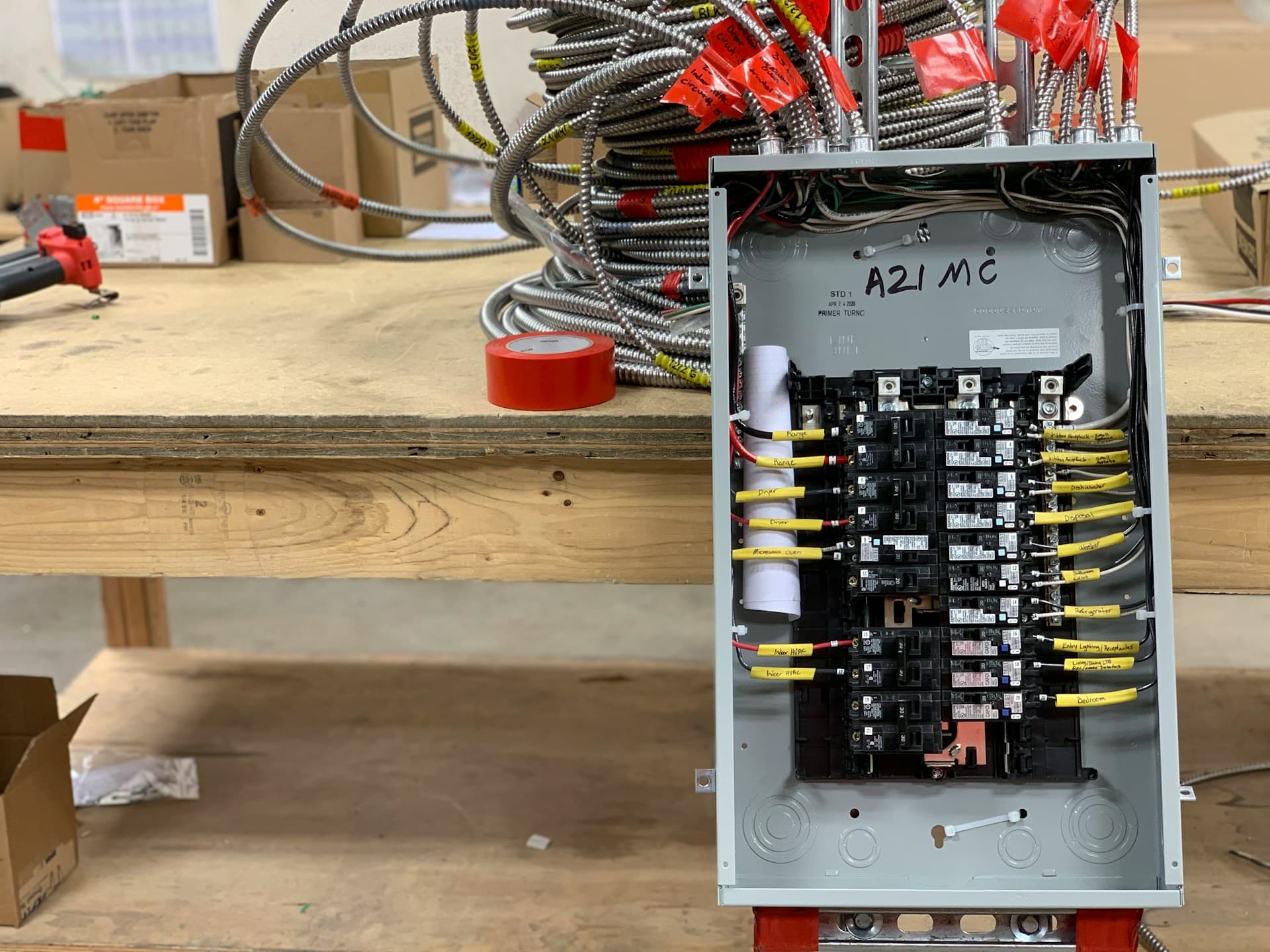
Switchboard Installation and Upgrade
Installation of new switchboards and upgrading existing switchboards in residential and commercial premises. Covers isolation and lockout/tagout procedures, asbestos identification in pre-1990 boards, arc flash hazard management, circuit breaker and RCD installation, cable termination, testing and commissioning, and live testing. Includes controls for electric shock and electrocution, arc flash/blast, falls from heights, asbestos exposure, manual handling of heavy panels, confined space work in electrical rooms, and burns from live conductors. Pre-filled hazards, controls, and risk ratings.
WorkSafe Queensland has tracked dozens of arc-flash incidents on switchboards since 2013, and that record is the reason a switchboard upgrade SWMS reads differently to a general electrical one. Copper vaporises and expands enormously during a fault; plasma temperature in the arc can reach close to 20,000°C; the pressure wave throws molten metal across the room. The control that prevents this is not better PPE — it's not working live — and the document has to commit to that explicitly before it goes any further.
That commitment is built around AS/NZS 4836:2023 and the three-point test-before-touch procedure: proving unit confirmed on a known live source, conductor tested, proving unit re-confirmed, using a properly rated proving unit rather than a non-contact voltage tester used in isolation. Where live work is genuinely unavoidable, an Energised Electrical Work Permit is mandatory, with a written risk assessment, a dedicated safety observer, two qualified persons minimum, and arc-rated clothing matched to the calculated incident energy. Most domestic upgrades skip the permit step entirely; that gap is what the Energy Safe Victoria "Never Work Live" campaign and equivalent state messages were written to close.
The other failure modes that distinguish this work from light-fitting installation are asbestos backing boards (dark brown fibrous boards with a tar smell that shouldn't be drilled or cut without a licensed assessor), multiple-source isolation where solar PV, battery storage or a generator survives mains isolation, and the manual handling of large commercial enclosures. AS/NZS 3000:2018 sets the RCD requirement on new install lighting, power and fixed appliance circuits, and the Model Code of Practice on Managing Electrical Risks covers the broader duty. The job lodges with the state via CCEW, eCoC or equivalent, and Level 2 ASP authorisation kicks in for service-mains and metering work.
What's In Your SWMS
7 Hazards & Controls
Electric shock, cardiac arrest, death by electrocution, burns, muscle contractions causing secondary injuries (falls)
Arrange disconnection of incoming supply by electricity distributor before major switchboard replacement. Complete de-energisation eliminates shock hazard.
Use pre-wired switchboard assemblies to minimise time working near live parts. Use insulated bus bar systems.
Isolate all energy sources using lockout/tagout per AS/NZS 4836. Personal padlock on each isolation point. Danger tag with name, date, time. Verify isolation with direct-contact multimeter after proving instrument function.
- Lockout/tagout devices on all isolation points - personal padlock per worker
- Insulated tools rated to IEC 60900:2018 (1000V AC / 1500V DC) for all work near electrical installations
- Insulated matting at switchboard work area
- RCD protection on final subcircuits (30mA max rated residual current, must trip within 300ms — AS/NZS 3000:2018 + AS/NZS 3760:2022)
- Shrouded/finger-safe terminals and bus bars on new installations
- TEST BEFORE YOU TOUCH - prove instrument, test conductor, prove instrument again (three-point test)
- Isolation plan documented and communicated to all workers before work begins
- Only licensed electricians to perform switchboard work
- No live work unless written risk assessment and Energised Electrical Work Permit approved
- Safety observer present during any work near energised parts
- Multi-point testing: live-to-earth, live-to-neutral, between all phases
- Never assume supply is off - always verify by testing
- Apprentices under direct supervision only, no access to live parts
Insulated electrical gloves (Class 00 minimum) with leather protectors. Arc-rated clothing (minimum HRC 1). Non-conductive safety footwear. Arc-rated face shield during live testing.
15-Step Work Procedure
Equipment & PPE
Equipment (12)
- Digital multimeter (CAT III/IV rated)
Minimum CAT III 600V rating for switchboard work. CAT IV for incoming supply side. Must be current calibration. Fluke 117/179 or equivalent.
- Proving unit / known voltage source
Fluke PRV240FS or equivalent three-point proving unit. Used to verify multimeter is functioning before and after testing de-energised conductors. Critical for "test before you touch" procedure.
- Non-contact voltage tester (CAT III rated)
For initial proximity detection only. Must NOT be relied upon as sole means of verifying de-energisation. Always confirm with direct-contact multimeter.
- Insulation resistance tester (megger)
For testing insulation resistance on new circuits before energisation. 500V DC test voltage for 240V circuits.
- Lockout/tagout kit (padlocks, hasps, danger tags)
Personal padlock for each worker. Danger tags with worker name, date, time. Hasps for multiple isolations. Lockout devices suited to switchboard isolators.
- Cable/pipe locator
For tracing concealed cables before drilling or cutting. Electromagnetic and radio frequency detection.
- Cordless drill/driver
For mounting switchboard enclosure, drilling fixing holes, and securing components. Battery-powered to eliminate lead hazard near live equipment.
- Cable cutters, strippers, and crimpers
Insulated tools rated to 1000V for work near live parts. Cable cutters for mains cable (up to 16mm²). Crimping tools for lugs.
- Torque wrench / torque screwdriver
For bus bar connections and circuit breaker terminations. Correct torque prevents loose connections (fire and arc flash risk). Check manufacturer specifications.
- Non-conductive fibreglass ladder
Metal and metal-reinforced ladders PROHIBITED near live electrical equipment. Industrial rating 120kg minimum. Secured at top.
- CO2 fire extinguisher
CO2 type suitable for electrical fires. Located within 5m of work area. Do NOT use water or foam extinguishers on electrical equipment.
- First aid kit (with burn dressings)
Include burn dressings, eye wash, and defibrillator if available. AED recommended for all electrical work due to cardiac arrest risk.
PPE (6)
- Safety glasses (impact rated, non-conductive frames)AS/NZS 1337.1:2010
Impact rated for debris from drilling and cable cutting. Non-conductive frames mandatory for electrical work.
- Arc-rated long-sleeve shirt and trousers (minimum HRC 1 / 5-8 cal/cm²)ASTM F1506 / NFPA 70E
No native AS/NZS arc-rated garment standard exists; the joint ESV/WorkSafe Arc Flash Hazard Management Guideline references the US ASTM F1506 / NFPA 70E framework (the IEC 61482 series is the international equivalent). Minimum ATPV 5 cal/cm² for general switchboard work; higher rating for boards with fault level >10kA. No synthetic fabrics that can melt onto skin. Natural-fibre undergarments.
- Insulated electrical gloves (Class 00 minimum)AS/NZS IEC 60903:2020
Class 00 rated to 500V AC for low-voltage switchboard work. AS/NZS IEC 60903:2020 superseded AS/NZS 2225:1994 in March 2020. Leather protector gloves over insulated gloves to prevent puncture. Visual inspection before each use.
- Non-conductive safety footwearAS 2210.3:2019
Electrical hazard (EH) rated. Non-conductive sole and heel. Steel cap for dropped equipment protection.
- Hard hat with chin strap (non-conductive)AS/NZS 1801:2024
Class E (electrical) rated hard hat. Chin strap for work above head height. Non-vented type for arc flash protection.
- Arc-rated face shield or balaclavaASTM F2178
No native AS/NZS arc-rated face shield standard exists; ASTM F2178 is the US standard cited in Australian arc-flash guidance. Required when opening energised switchboards or performing live testing. ATPV rating must match or exceed incident energy calculation. Full face and neck coverage.
Training & Emergency
Competency Requirements
- Construction Induction Card (White Card)training
Required for all workers on construction sites. CPCCWHS1001.
- Electrical Licence (A Grade / Unrestricted)licence
A Grade or unrestricted electrical licence required for switchboard work. Licence class varies by state. Apprentices under direct supervision only with no access to live parts.
- AS/NZS 4836 Safe Working on Low-Voltage Installationstraining
Training in safe work procedures per AS/NZS 4836 covering isolation, lockout/tagout, testing, arc flash hazards, and PPE requirements. Essential for all switchboard work.
- Asbestos Awareness Trainingtraining
Required for all workers who may encounter asbestos in pre-1990 switchboards (Lebah, Zelemite, Miscolite, Ausbestos backing boards). There is no national CPCC unit code for awareness alone — jurisdictions point to courses such as the ACT-owned 11084NAT Course in Asbestos Awareness and equivalent state-recognised e-learning. CPCCDE3014 (Remove non-friable asbestos) and CPCCDE3015 (Remove friable asbestos) are removal-licence units, not awareness training — see Safe Work Australia asbestos guidance.
- Level 2 Accredited Service Provider (ASP)
Required in some states (e.g., NSW) for work on service mains, meter panels, and distributor equipment. Required for disconnection/reconnection at service fuse.
- Working at Heights Training (RIIWHS204E)
Required if switchboard work involves working above 2m (e.g., commercial installations, elevated meter boards). 1-day course, refresh every 2-3 years.
- First Aid Certificate (HLTAID011)
Recommended for at least one team member. Critical due to electric shock cardiac arrest risk. CPR and AED training essential for electrical workers.
Emergency Procedures
ELECTRIC SHOCK (PERSON STILL CONNECTED): Do NOT touch person. Turn off power at isolation point or use non-conductive object (dry timber, plastic) to separate person from source. Call 000. Begin CPR immediately if not breathing. Use AED if available.
ARC FLASH INJURY: Call 000 immediately. Move person away from switchboard (check for secondary hazards first). Cool burns with running water for 20 minutes. Do not remove fused clothing. Monitor for shock symptoms. Record estimated incident energy for medical team.
ASBESTOS EXPOSURE (DISTURBED ACM): Stop work immediately. Evacuate area. Seal off work zone. Do not attempt cleanup. Contact licensed asbestos assessor. All potentially exposed workers to register for health monitoring.
CARDIAC ARREST (FROM ELECTRIC SHOCK): Call 000. Begin CPR immediately (30 compressions, 2 breaths). Use AED if available - follow voice prompts. Continue until ambulance arrives. Electric shock cardiac arrest has good survival rates with prompt CPR and defibrillation.
Everything above, included in your SWMS document.
Get This TemplateWriting a SWMS from scratch?
That's 2-4 hours of research, formatting, and cross-referencing regulations.
We've done the starting work — pick your template, add your details, review.
Or just do this:
- Unlimited documents
- All 70+ templates
- Instant PDF & DOCX
- Cancel anytime
High-Risk Construction Work Categories
Under Australian WHS Regulations (Section 291 - High Risk Construction Work; Chapter 4 Part 4.7 - Electrical Safety), this work is classified as high-risk due to:
- Work on/near energised electrical installations (Switchboard work involves direct interaction with energised 240V/415V electrical installations. Live testing required after installation. AS/NZS 4836 procedures mandatory.)
Australian Standards Referenced
National Guidance Documents
- Safe Work Australia - Model Code of Practice: Managing Electrical Risks in the Workplace
- Safe Work Australia - Model Code of Practice: How to Manage and Control Asbestos in the Workplace
- Safe Work Australia - Model Code of Practice: Confined Spaces
- Safe Work Australia - Model Code of Practice: Hazardous Manual Tasks
- Safe Work Australia - WHS Profile: Electricians
Who Needs This SWMS?
This template is designed for the following trades and roles performing switchboard installation and upgrade work.
Frequently Asked Questions
Do you need a licence to install or upgrade a switchboard in Australia?
Yes. Switchboard installation and upgrade work must be performed by a licensed electrician with an A Grade or unrestricted electrical licence. Licence classes vary by state but all require Certificate III in Electrotechnology (UEE30820) or equivalent. Apprentices may only work under direct supervision and must not access live parts. In some states, a Level 2 Accredited Service Provider (ASP) is additionally required for work on service mains and metering.
What is the "test before you touch" procedure for switchboard work?
Test before you touch is a three-point testing procedure mandated by AS/NZS 4836. Step 1: Prove your multimeter is working by testing on a known live source or proving unit. Step 2: Test the switchboard conductors you intend to work on - live-to-earth, live-to-neutral, and between all phases. Step 3: Prove your multimeter again on the known live source. This confirms both that the circuit is de-energised AND that your testing instrument was functioning correctly. Never rely on a non-contact voltage tester alone.
Do old switchboards contain asbestos?
Most switchboards installed before 1990 in Australia contain asbestos-containing materials (ACM), typically as electrical backing boards. Common brands include Lebah, Zelemite, Miscolite, and Ausbestos. These appear as dark brown or black boards with a fibrous texture and tar-like smell. You cannot visually confirm asbestos without testing - if in doubt, assume it is present and engage a licensed asbestos assessor. Never drill, cut, or sand suspected ACM.
What is arc flash and why is it dangerous during switchboard work?
Arc flash is an explosive release of energy caused by a short circuit or fault inside a switchboard. Copper conductors vaporise and expand up to 67,000 times their original volume, creating temperatures that can reach close to 19,000°C at the arc terminals, pressure waves, molten metal spray, and toxic gases. WorkSafe Queensland has documented multiple arc flash incidents on switchboards in recent years (32 since 2013, 20 requiring hospitalisation per WorkSafe QLD reporting), and arc flash has caused fatalities elsewhere in Australia (e.g. the 2018 Yallourn power-station fatality, $1.5m WorkSafe Victoria conviction). An arc flash lasting milliseconds can cause fatal burns. Arc-rated PPE matched to the calculated incident energy is mandatory.
What is lockout/tagout and when is it required?
Lockout/tagout (LOTO) is a mandatory isolation procedure under AS/NZS 4836 to ensure energy sources remain isolated while work is performed. Each worker places their own personal padlock on the isolation device and attaches a completed danger tag showing their name, date, and time. Only the worker who placed the lock may remove it. LOTO is required before any switchboard work where de-energisation is the control measure. Multiple energy sources (mains, solar, batteries, generators) must all be identified and isolated.
What does an Energised Electrical Work Permit actually require?
An EEWP is mandatory under AS/NZS 4836:2023 wherever live work is genuinely unavoidable. The permit captures a written risk assessment specific to the task, the calculated incident energy at the work point and matching arc-rated PPE class, a dedicated safety observer with no other duty during the work, minimum two qualified persons on site, the test-before-touch sequence, the rescue procedure, and the supervising authority sign-off. Most domestic switchboard upgrades skip the permit step entirely on the basis that "everyone's an electrician" — that gap is what Energy Safe Victoria's "Never Work Live" campaign and the state regulators around it were written to close.
Can electricians work on live switchboards?
Live work should be avoided wherever possible - de-energise and isolate first. When live work is absolutely necessary (e.g., cannot disconnect supply), it requires a written risk assessment, an Energised Electrical Work Permit approved by the WHS manager, a dedicated safety observer, minimum two qualified persons, and full arc-rated PPE. The South Australian Office of the Technical Regulator specifically addresses live switchboard upgrade procedures. Energy Safe Victoria runs a "Never Work Live" campaign.
Why is asbestos backing on older switchboards an audit-failure pattern?
Pre-1990 residential and commercial switchboards commonly used asbestos backing boards — Lebah, Zelemite, Miscolite, Ausbestos — dark brown fibrous panels with a tar smell. Drilling, cutting or sanding those panels during an upgrade releases respirable asbestos fibres into a confined cupboard or plant room. The Model Code of Practice on How to Safely Remove Asbestos requires a competent person assessment before any work that disturbs suspected asbestos-containing material. Workflow: visual identification before the cover comes off, sample testing if uncertain, and Class B licensed removal where more than 10m² of non-friable material is in scope. Skipping the assessment because "the upgrade was supposed to take an hour" is a documented prosecution pathway.
What testing is required after installing a new switchboard?
Post-installation testing includes: insulation resistance test on all circuits (minimum 1MΩ at 500V DC), earth continuity test, polarity test, correct circuit identification, voltage readings on all phases, RCD trip time testing (30mA within 300ms), and earth loop impedance. All results must be recorded on a Certificate of Compliance (CCEW) or Certificate of Electrical Safety (CES) depending on state requirements. The certificate must be lodged with the relevant state authority.
What are the RCD requirements for new switchboards?
Under AS/NZS 3000:2018, RCDs (safety switches) rated at maximum 30mA are required on all circuits in new installations including lighting, power, and fixed appliance circuits. RCDs must trip within 300ms. Existing switchboard upgrades must bring RCD protection to current standard. RCDs should be tested every 3 months using the push-button test (as per AS/NZS 3760). The 2018 Wiring Rules significantly expanded RCD requirements compared to earlier editions.
Get Your Switchboard Installation and Upgrade SWMS
Pre-filled. Risk-rated. Ready in 5 minutes.
Get Your SWMS PDFNo credit card required. First SWMS is free.
